Earthwork Volume — Average End Area & Prismoidal
Finds the volume of earth between two cross-sections of a road, channel, embankment or trench. Surveyors, estimators and highway designers use it to total cut and fill from station to station. Enter the two end areas and the distance between them for the average end area volume. Add the area of the section halfway between them to get the prismoidal volume and the correction between the two methods as well.
Equations
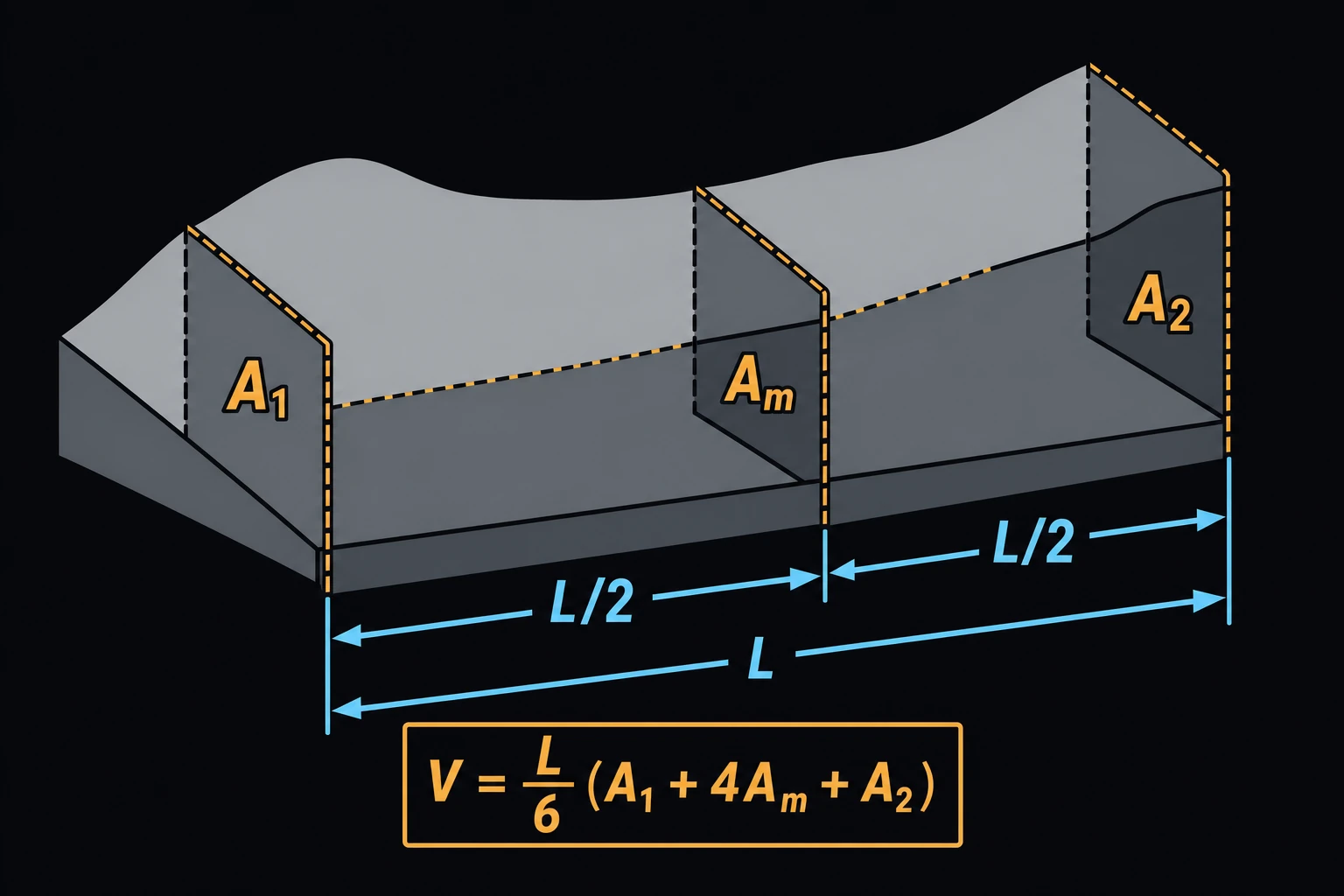
Vea = L·(A1 + A2)/2 Vpr = L·(A1 + 4Am + A2)/6
A1 and A2 are the cross-section areas at the two ends, in m². Am is the area of the section midway between them. L is the distance between the end sections, measured along the centerline. Vea is the average end area volume and Vpr the prismoidal volume [1]. The prismoidal correction is Vea − Vpr = L·(A1 + A2 − 2Am)/3.
When to use which
The average end area method is the everyday method for earthwork quantities and pay items [1], [2]. It is exact only when the area changes linearly from one section to the next. When the ground shape changes between sections, the true volume is usually smaller, and the average end area overstates it. The prismoidal formula is exact for any prismoid, so use it when the mid-section is surveyed or when a contract calls for it. Leave Mid-Section Area at 0 to skip it.
Common mistakes
- Am is the area of the real section at the midpoint, surveyed or drawn from the averaged dimensions of the end sections. It is not the average of A1 and A2. Entering that average makes Vpr equal Vea.
- Keep cut and fill apart. Where a section changes from cut to fill, split the run at the grade point, where the area is zero, and work out each part on its own.
- On a curve, sections are not parallel. L is the centerline distance, and the error grows when the centroid of the area sits well off the centerline.
- This is the bank (in-place) volume. Use the earthwork shrink and swell calculator to turn it into loose or compacted volume.
Worked example
Two stations 20 m apart on a road cut have cut areas of 12.5 m² and 18.4 m². The survey crew also took a section at the halfway point, with an area of 15.1 m². How much material comes out between the stations?
- Enter End Area at Section 1 12.5 and End Area at Section 2 18.4.
- Enter Mid-Section Area 15.1.
- Enter Distance Between Sections 20 m and press Solve. The Solution shows:
Average-end-area volume: 309 m³
Average-end-area volume: 404.157 yd³
Prismoidal volume: 304.333 m³
Prismoidal volume: 398.053 yd³
Prismoidal correction (Vea − Vpr): 4.66667 m³
Check by hand: 20 × (12.5 + 18.4)/2 = 309 m³, and 20 × (12.5 + 4 × 15.1 + 18.4)/6 = 20 × 91.3/6 = 304.33 m³. The correction is 20 × (30.9 − 30.2)/3 = 4.67 m³, about 1.5 % of the volume. One cubic yard is 0.7646 m³, so 309 m³ is 404 yd³.