Back-EMF Calculator
Finds the back-EMF of a DC motor: the voltage its spinning armature generates, which opposes the supply. Work it out from the motor’s voltage constant and speed, or from a measurement of the terminal voltage and armature current with the armature resistance. Engineers and hobbyists use it to estimate motor speed, check a motor’s constant against its datasheet and size drives and controllers for brushed and brushless DC motors.
Equations
E = Kb·ω ω = 2πN/60
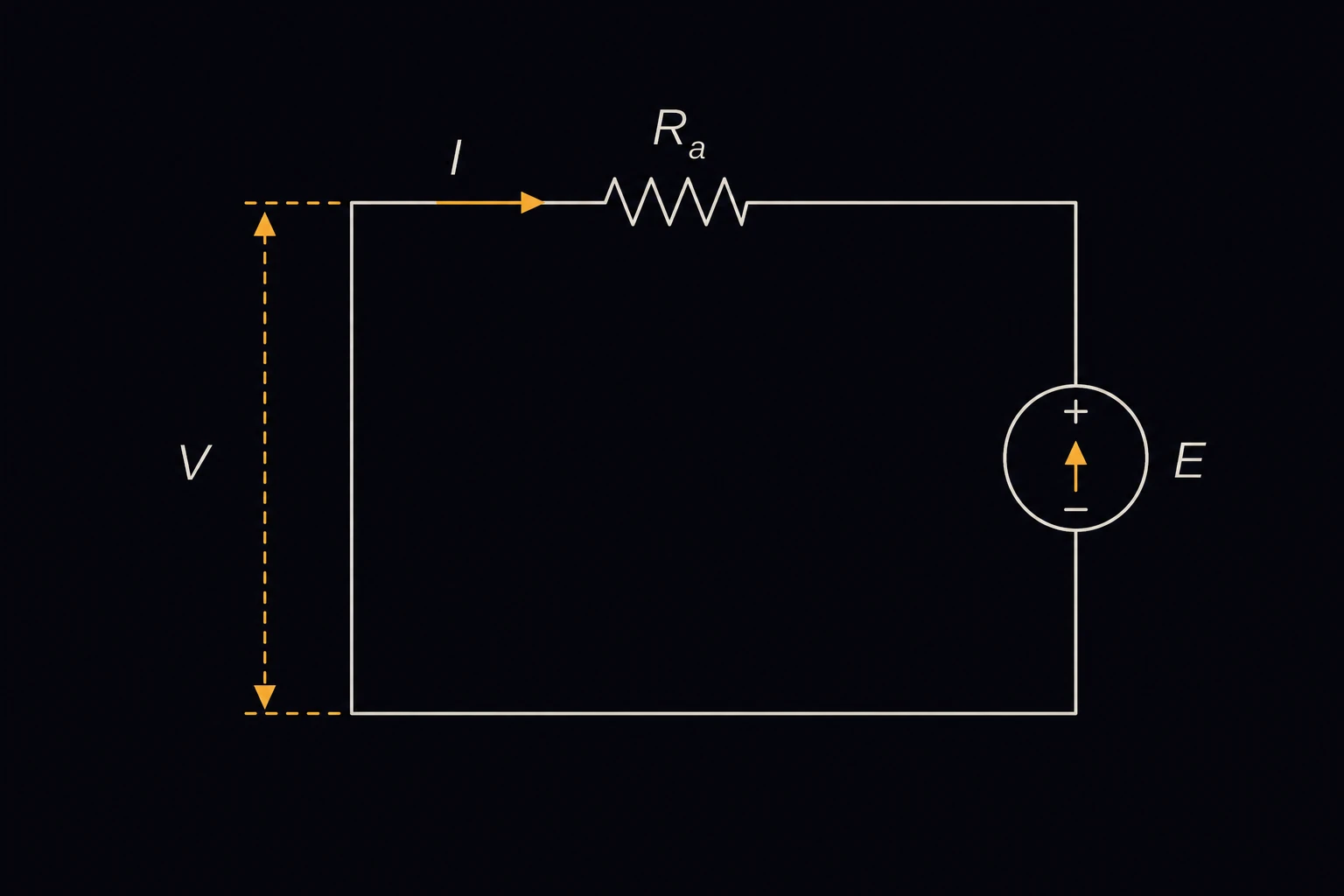
E = V − I·Ra
E is the back-EMF in volts. Kb is the voltage (back-EMF) constant in volts per rad/s, and ω the shaft speed in rad/s, found from the speed N in rpm [1]. In the second equation, V is the voltage at the motor’s terminals, I the armature current and Ra the armature resistance, including the brushes. The supply voltage drives the current against E, and the difference is lost in Ra [1].
In SI units, Kb in V·s/rad has the same value as the torque constant Kt in N·m/A. Because E is proportional to speed, a motor runs up until E almost equals V; its no-load speed is about V/Kb.
Limits and common mistakes
- Datasheets often give the constant in V per 1000 rpm. Divide by 104.72 to get V per rad/s; 10 V/krpm is 0.0955 V·s/rad.
- Measure Ra at the motor’s running temperature. Copper resistance rises about 0.4 % per °C, so a cold reading overstates E.
- The equations are for a DC motor with a fixed field (a permanent-magnet or separately excited motor). In a series or shunt motor the field changes with load and Kb changes with it.
- Enter a negative current when the machine is generating (being driven by its load). E then comes out larger than V.
Worked example
A 24 V brushed gearmotor runs at 2500 rpm on its test load and draws 3.2 A. Its armature resistance, measured warm, is 0.8 Ω. Find its back-EMF.
- Choose Method From terminal voltage, current & Ra.
- Enter Terminal voltage (V) 24 V and Armature current (I) 3.2 A.
- Enter Armature resistance (Ra) 0.8 Ω and press Solve. The Solution shows: Back-EMF (E): 21.44 V
Check: the resistance takes 3.2 × 0.8 = 2.56 V, and 24 − 2.56 = 21.44 V. At 2500 rpm, ω = 261.8 rad/s, so the motor’s Kb is 21.44 / 261.8 = 0.0819 V·s/rad. With the other method, a Kb of 0.0819 at 2500 rpm gives 21.4414 V, the same to the precision of the rounded constant.