Basic Kinematics
Finds where a body is and how fast it is moving after a set time, when it moves in a straight line with constant acceleration. Give the initial velocity, the acceleration and the elapsed time, and the page gives the final velocity and the displacement. Use it for vehicles speeding up or braking, conveyors and carriages starting and stopping, and objects falling with no air resistance.
Equations
v = v0 + a·t Δx = v0·t + ½a·t²
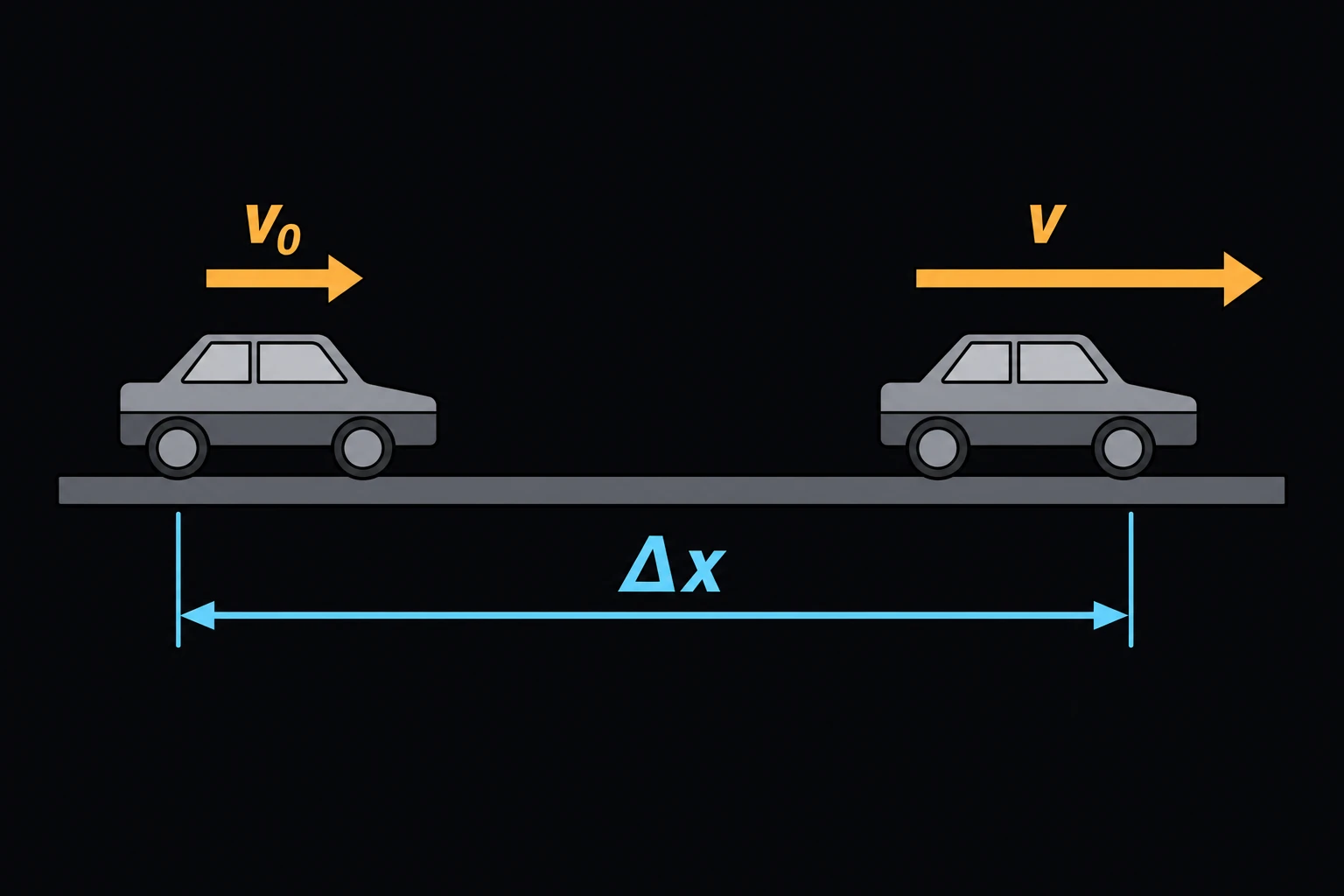
v0 is the velocity at the start, a the acceleration, t the elapsed time, v the velocity at the end and Δx the displacement, the change in position along the line of motion [1]. All of them share one positive direction. A velocity or acceleration pointing the other way is entered as a negative number, so braking is a negative acceleration when the body moves in the positive direction. For a falling object, take down as positive and use a = 9.81 m/s², or pick g from the unit list and enter 1.
Limits and common mistakes
- The acceleration must stay constant for the whole time. Drag, a motor’s falling torque or a ramped speed profile need to be split into steps, each with its own constant acceleration.
- Δx is displacement, not distance traveled. If the velocity changes sign during t, the equations assume the body turns around and comes back. A braking car stops instead, at t = v0/|a|. Enter no more than that time, or the result is wrong.
- Keep the signs consistent. A negative Δx means the body ended up behind its starting point.
- To find a stopping distance without the time, use v² = v0² + 2a·Δx with v = 0.
Worked example
A truck traveling at 25 m/s (90 km/h) brakes at a steady 6 m/s². How fast is it going, and how far has it gone, 4 s after the brakes come on?
- Enter Initial Velocity (v0) 25 m/s.
- Enter Acceleration (a) −6 m/s², negative because it opposes the motion.
- Enter Elapsed Time (t) 4 s and press Solve. The Solution shows:
Final Velocity (v): 1 m/s
Displacement (Δx): 52 m
The truck would stop at 25/6 = 4.17 s, so 4 s is still within the braking phase. Check: v² − v0² = 1 − 625 = −624, and 2a·Δx = 2 × (−6) × 52 = −624. The average speed, (25 + 1)/2 = 13 m/s, over 4 s also gives 52 m.