Battery Capacity & Runtime
Estimates how long a battery will run a steady load, the discharge rate as a C-rate, and the energy the battery stores. Use it for a first sizing of a battery bank for a camper, boat, off-grid cabin, UPS or portable instrument, or to check whether a battery’s rating suits the load.
Equations
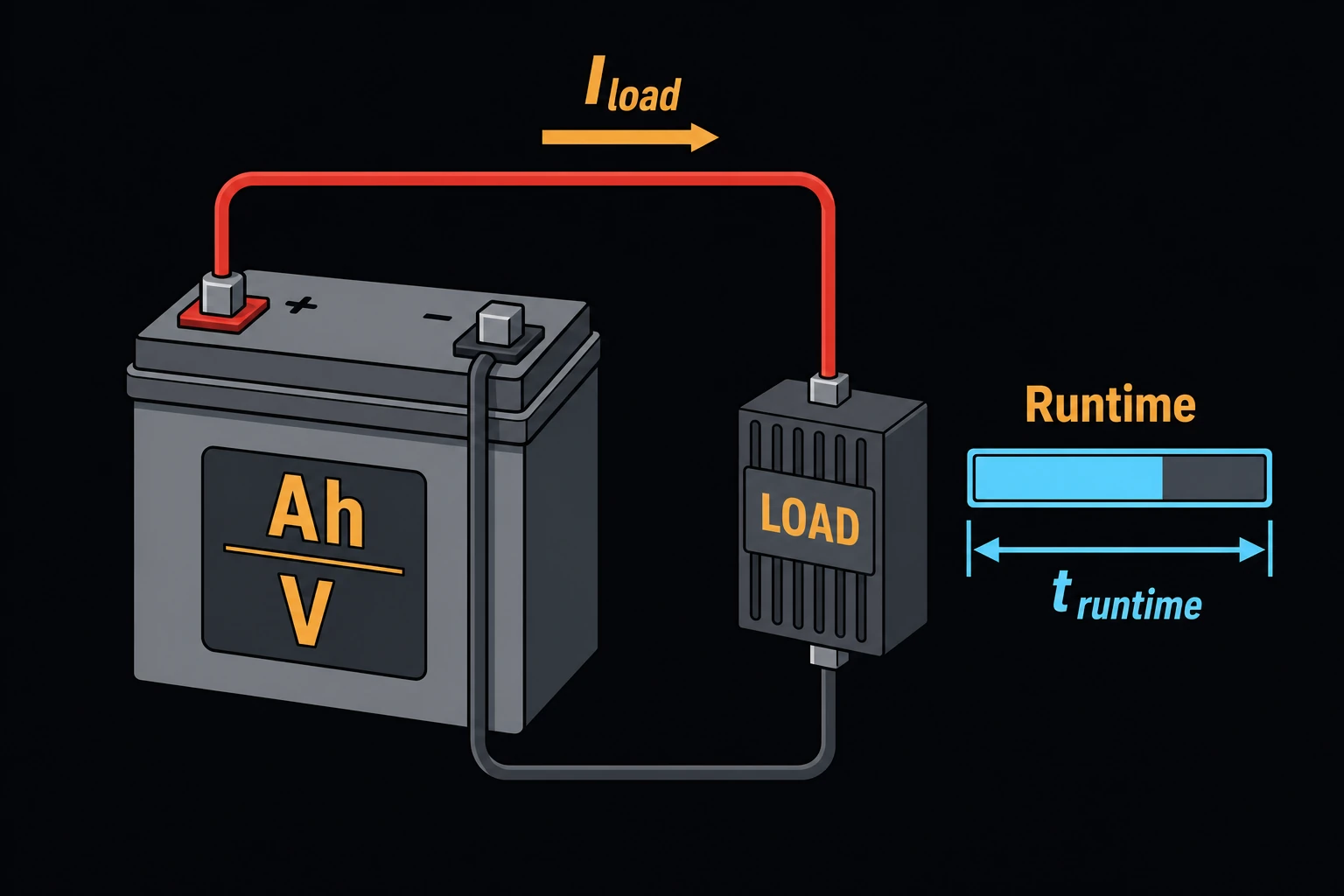
t = CAh / Iload C-rate = Iload / CAh E = CAh·V
CAh is the rated capacity in amp-hours, from the battery’s label or data sheet. Iload is the steady current the load draws, and t is the runtime in hours. The C-rate expresses that current as a multiple of the capacity: 1 C empties the battery in one hour, and 0.05 C (C/20) in twenty [1]. V is the nominal battery voltage, such as 12 V for a six-cell lead-acid battery or 3.6 V for a lithium-ion cell, and E is the stored energy in watt-hours.
Limits and common mistakes
- The runtime assumes the whole rated capacity comes out, whatever the current. Real capacity falls as the current rises (the Peukert effect, strongest in lead-acid) and at low temperature [1]. The rating usually applies at one rate, often the 20-hour rate for lead-acid. At much higher currents expect noticeably less.
- Most batteries should not be fully discharged. Lead-acid batteries last far longer if used to about 50 % depth of discharge, so the useful runtime is about half the result. Lithium batteries tolerate deeper discharge.
- For a load given in watts, divide by the battery voltage to get Iload. If the load runs through an inverter or converter, add its losses first.
- Capacity fades with age and cycling, so size a new bank with a margin.
Worked example
A camper has a 12 V, 100 Ah AGM battery. The fridge, lights and water pump together average 8 A. How long will the battery last between charges?
- Enter Capacity (Ah) 100.
- Enter Voltage (V) 12 V.
- Enter Load current (Iload) 8 A and press Solve. The Solution shows:
Runtime: 12.5 h
Discharge C-rate: 0.08 C
Stored energy: 1,200 Wh
Check by hand: 100 Ah / 8 A = 12.5 h, 8/100 = 0.08 C, and 100 Ah × 12 V = 1,200 Wh. The load is a little above the 20-hour rate of 5 A, so the full capacity is nearly available. Stopping at 50 % depth of discharge to protect the AGM battery, plan on about 6 hours between charges.