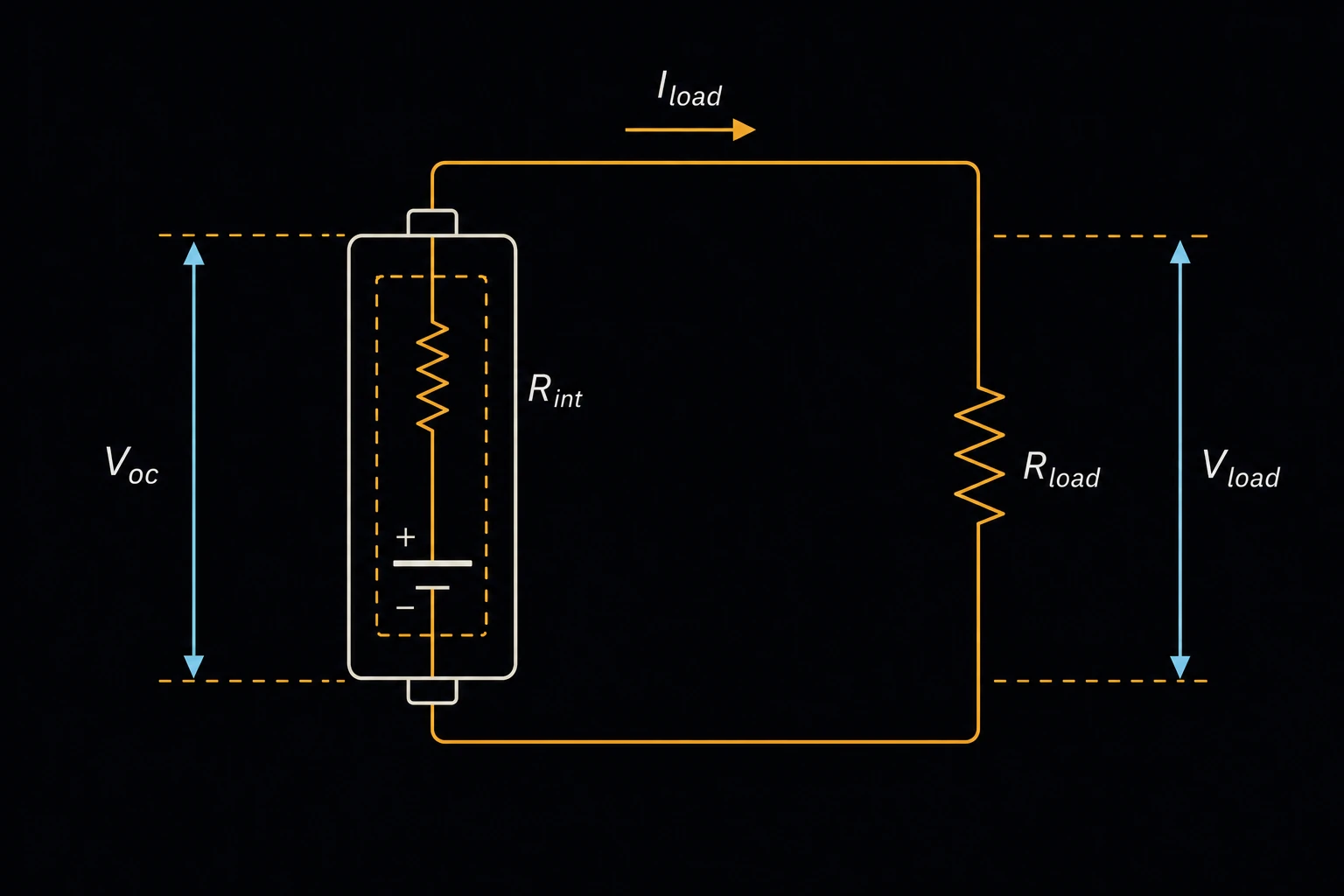
Battery Internal Resistance
Finds the internal resistance of a battery or cell from two voltmeter readings and one current reading. Use it to judge the health of a lead-acid, lithium or NiMH battery, to compare cells before matching them in a pack, or to predict how far the voltage will sag under a heavy load such as a motor or inverter.
Equation
Rint = (Voc − Vload) / Iload
A real battery behaves like an ideal voltage source in series with a small resistance [1]. Voc is the open-circuit voltage, read at the terminals with no load connected. Vload is the terminal voltage while the load draws a steady current Iload. The difference is the voltage lost inside the battery, and dividing it by the current gives Rint in ohms. Once you know Rint, the sag at any other current is I·Rint, and the heat generated inside the battery is I²·Rint.
Limits and common mistakes
- Take both voltages at the battery posts, not at the far end of the cables. Otherwise the cable and connector resistance is counted as part of the battery.
- Read Vload a few seconds after the load is applied. A short pulse gives the ohmic resistance. A longer load adds polarization, so the voltage keeps falling and the result grows with time [1].
- Internal resistance rises at low temperature and low state of charge [1]. Compare batteries at the same temperature and charge level.
- The voltage difference is often only a few tenths of a volt. A meter that reads to 0.01 V limits the precision, so use a load large enough to give a clear drop.
- Voc must be at or above Vload. A loaded reading higher than the open-circuit one means the battery was still recovering from a charge, or the readings were swapped.
Worked example
A 12 V flooded lead-acid battery in a work truck is suspected of being weak. It reads 12.72 V at rest. With a 20 A load bank connected, it reads 12.38 V at the posts after five seconds.
- Enter Open-circuit voltage (Voc) 12.72 V.
- Enter Voltage under load (Vload) 12.38 V.
- Enter Load current (Iload) 20 A and press Solve. The Solution shows: Internal resistance (Rint): 0.017 Ω
Check by hand: 12.72 − 12.38 = 0.34 V, and 0.34 / 20 = 0.017 Ω, or 17 mΩ. A healthy battery of this size is usually a few milliohms, so this one would sag 17 mΩ × 200 A = 3.4 V during a 200 A engine crank. That leaves it near 9 V, which points to a battery near the end of its life.