Beam Reactions, Shear & Moment
Gives the support reactions, the maximum shear and the maximum bending moment for a single-span beam, and draws its shear and moment diagrams as you type. It covers the four textbook cases: a simply supported beam or a cantilever, each with a uniform load or one point load. Designers use it to size joists, lintels and brackets and to check hand work.
The equations
All four cases come from statics: the vertical forces and the moments about any point must sum to zero [1], [3]. For a simply supported beam of span L with a uniform load w (kN/m):
R = wL/2
Mmax = wL²/8 (at midspan)
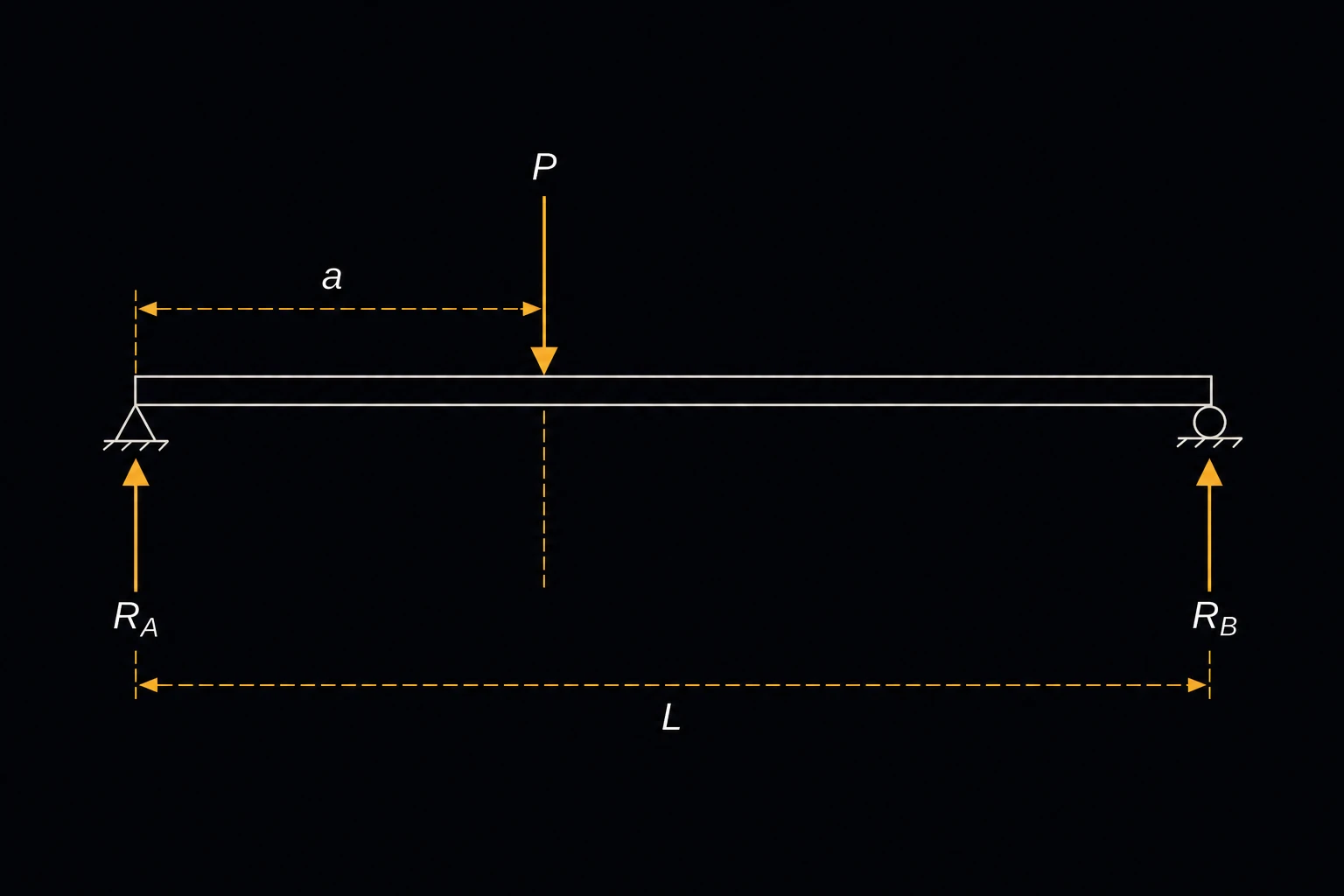
For a point load P at a distance a from the left support, with b = L − a:
R1 = Pb/L
R2 = Pa/L
Mmax = Pab/L (under the load)
For a cantilever fixed at one end, the support carries the whole load. A uniform load gives R = wL and a fixing moment M = wL²/2. A point load at a from the support gives R = P and M = Pa. The maximum shear is the larger reaction in every case. The AISC beam tables give the same formulas [2].
The shear diagram plots V(x), the net vertical force to the left of a section. The moment diagram plots M(x) with sagging (bottom fiber in tension) drawn upward, so a cantilever’s hogging moment plots below the axis.
Limits and common mistakes
- The load w is in kN/m and P in kN. Include the beam’s own weight in w.
- Use factored loads for strength design and service loads for deflection. The page applies no load factors; see Load Combinations (ASCE/SEI 7-22).
- For a cantilever, a is measured from the fixed support, not from the free end.
- For several loads, run each one and add the reactions (superposition). The maximum moments may fall at different points, so they do not simply add.
- Continuous beams, overhangs and fixed–fixed spans are statically indeterminate and are not covered.
Worked example
A 4.8 m steel floor beam, simply supported, picks up a column load of 36 kN from the floor above at 1.75 m from its left end. Find the reactions to size the end connections and the moment to size the beam.
- Choose Beam & Load Case Simply supported — point load P at a.
- Enter Span / Length (L) 4.8 m and Point Load (P, kN) 36.
- Enter Load Position from Left / Support (a) 1.75 m.
- Press Solve. The Solution shows:
Left reaction (R1): 22.875 kN
Right reaction (R2): 13.125 kN
Maximum shear (V): 22.875 kN
Maximum moment (M, under load): 40.0313 kN·m
Check: the reactions add up to the load, 22.875 + 13.125 = 36 kN. The moment under the load is R1·a = 22.875 × 1.75 = 40.03 kN·m. The same load at midspan would give PL/4 = 43.2 kN·m, the most it can produce, so a smaller value off center is right.