Sheet Metal Bend Allowance
Finds the bend allowance of a sheet metal bend: the length of material the bend itself uses, measured along the neutral axis. Add it to the straight flat lengths to get the blank size before bending. The K-factor can be typed in, picked by material from Machinery’s Handbook’s 90° bend allowances [2], or found from R/T by DIN 6935 [3]. Sheet metal designers and shop planners use it to lay out flat patterns.
Equation
BA = θ·(R + K·T)
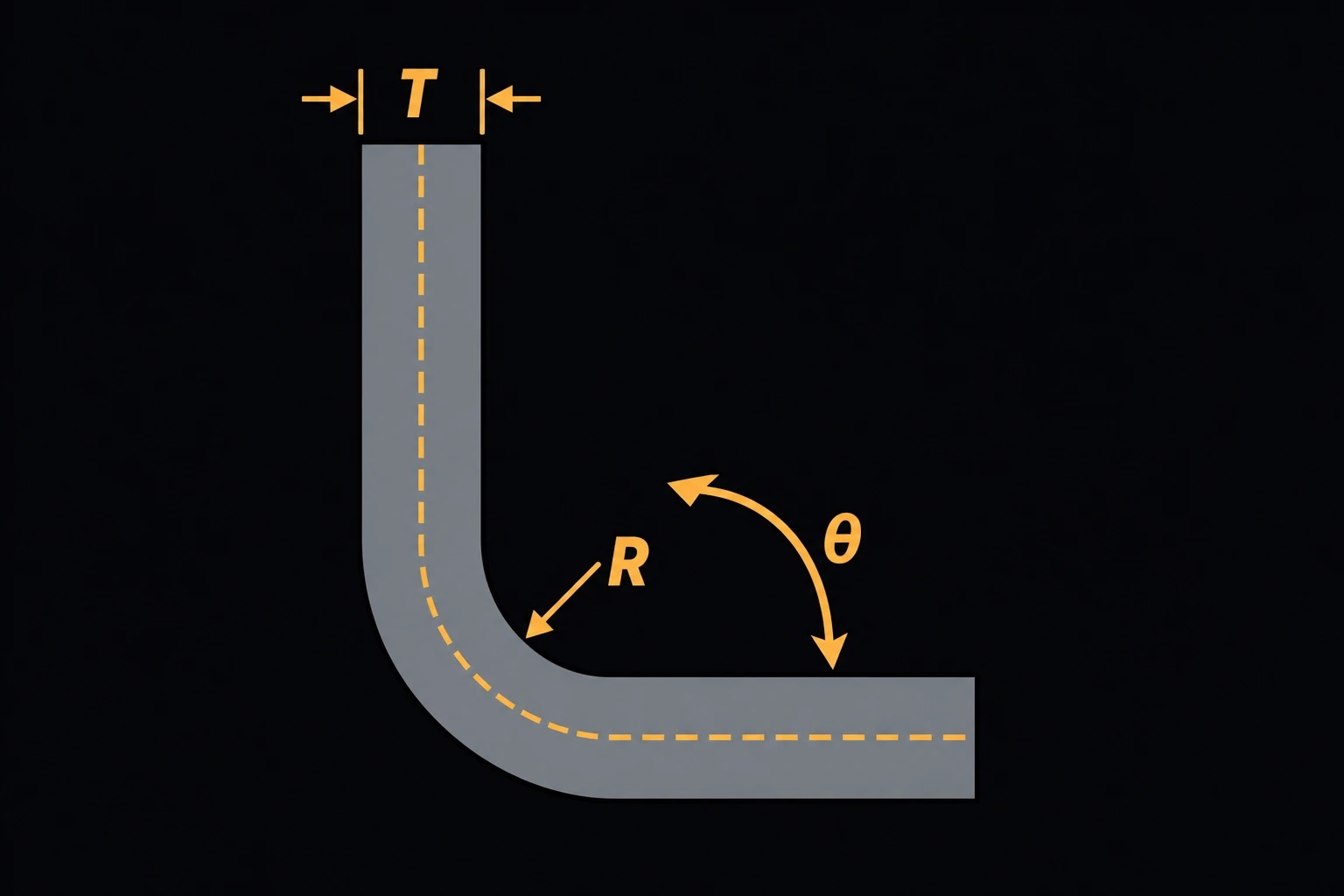
θ is the bend angle in radians (the page takes degrees), R the inside bend radius and T the sheet thickness [1]. Bending stretches the outside of the sheet and squeezes the inside. The neutral axis, which keeps its length, lies a distance K·T from the inside surface. K is between 0 and 0.5, because the neutral axis moves inward from mid-thickness in a tight bend. The Machinery’s Handbook choices turn its 90° allowance, (π/2)R + c·T, into K = c/(π/2), with c = 0.55, 0.64 or 0.71 by material [2]. DIN 6935 gives K = (0.65 + 0.5·lg(R/T))/2 for R/T from 0.65 up to 5, and 0.5 above [3]; the page then also shows R/T and the K it used.
Limits and common mistakes
- θ is the angle the sheet turns through, not the angle left between the flanges. A part with 135° between its flanges has a 45° bend.
- The flat lengths it is added to end at the bend’s tangent lines. Dimensions taken to the outside corners overlap the bend: subtract the setback, (R + T)·tan(θ/2), from each flange first.
- K-factors are averages. The real value depends on the press brake, the tooling and the material’s temper, so check the first part and correct K.
- DIN 6935 is written for steel. For other metals, type a K-factor or use the Machinery’s Handbook choices.
Worked example
An L-bracket is bent from 2 mm cold-rolled steel with a 3 mm inside radius. Its flanges measure 40 mm and 25 mm to the outside corner. What length of blank should be cut?
- Enter Bend Angle 90, Inside Bend Radius 3 mm and Material Thickness 2 mm.
- Choose K-Factor Source K from R/T (DIN 6935).
- Press Solve. The Solution shows:
Bend Allowance (BA): 5.87171 mm
R/T: 1.5
K-Factor (DIN 6935): 0.369023
The setback for a 90° bend is R + T = 5 mm, so the straight flanges are 35 mm and 20 mm. The blank is 35 + 20 + 5.87 = 60.87 mm long. Check by hand: lg 1.5 = 0.176, so K = (0.65 + 0.088)/2 = 0.369 and BA = 1.5708 × (3 + 0.738) = 5.87 mm. The Machinery’s Handbook choice for cold-rolled steel (K = 0.452) gives 6.13 mm, a quarter of a millimeter more, which is the kind of spread a test bend settles.