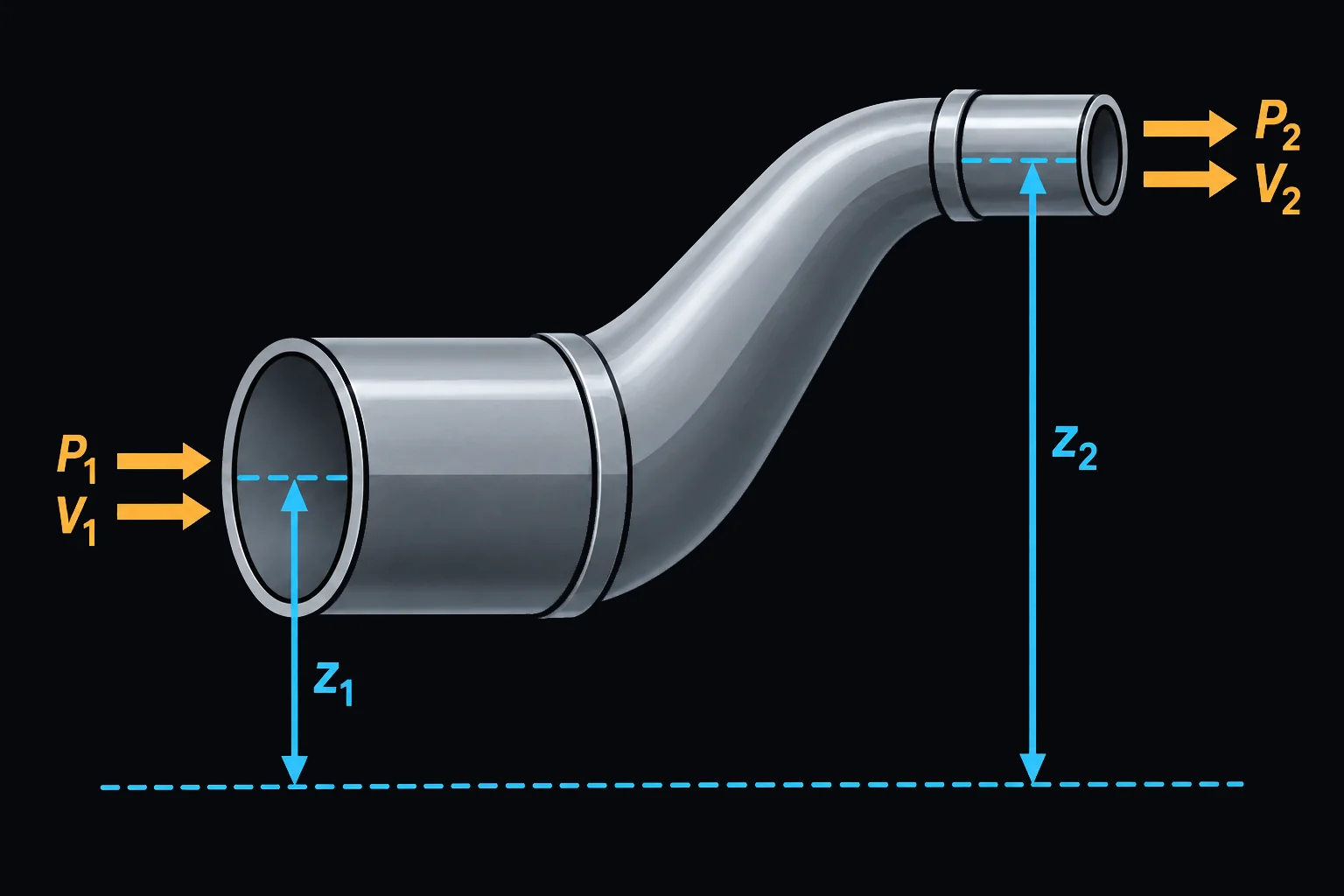
Bernoulli Equation
Finds the pressure at a second point in a pipe or duct from the pressure, velocity and elevation at a first point and the velocity and elevation at the second. Use it to see how much pressure a line loses as it climbs or narrows: at the top of a riser, in a reducer, or ahead of a nozzle. It is a first check for students and for engineers laying out piping.
The Bernoulli equation
P1 + ½ρV12 + ρgz1 = P2 + ½ρV22 + ρgz2
The page solves it for P2:
P2 = P1 + ½ρ(V12 − V22) + ρg(z1 − z2)
P is the static pressure, V the mean flow velocity and z the height above any datum you choose, at points 1 and 2. ρ is the fluid density and g = 9.80665 m/s². Each term is energy per unit volume: pressure, kinetic energy and potential energy. Along a streamline their sum stays the same [1]. Pick a Fluid to fill in its density [2]–[4], or type your own.
Enter P1 as gauge or absolute pressure, and P2 comes out the same way. The velocities usually come from the flow rate divided by the pipe area at each point.
Limits and common mistakes
- The equation has no friction. It holds for steady, incompressible flow with no pump, turbine or loss between the points [1]. In a real line, subtract the friction and fitting losses from P2; over long pipes they can be larger than every other term.
- A gas counts as incompressible only while its speed stays below about a third of the speed of sound and the pressure changes by a few percent.
- Keep z positive upward. Point 2 above point 1 lowers P2.
- The page doesn’t check the answer. If P2 in absolute terms falls near the liquid’s vapor pressure, the liquid will boil and the equation no longer applies.
Worked example
A pump delivers water at 20 °C into a riser at 350 kPa gauge and 2 m/s. Twelve meters up, the line steps down to a smaller pipe, where the water runs at 4.5 m/s. Ignoring friction, what is the pressure there?
- Enter Pressure at Point 1 350 kPa, Velocity at Point 1 2 m/s and Elevation at Point 1 0 m.
- Enter Velocity at Point 2 4.5 m/s and Elevation at Point 2 12 m.
- Choose Fluid Water, 20°C. The density fills in as 998.2 kg/m³.
- Press Solve. The Solution shows: Pressure at Point 2 (P2): 224.422 kPa
Check: the 12 m rise costs 998.2 × 9.80665 × 12 = 117.5 kPa. The speed-up costs ½ × 998.2 × (4.5² − 2²) = 8.1 kPa. 350 − 117.5 − 8.1 = 224.4 kPa gauge, before friction.