Bubble & Dew Point (Raoult's Law)
Finds the bubble-point or dew-point pressure of a two-component mixture at a given temperature, with the composition of the phase that forms, the K-values and the relative volatility. Pick two common liquids to get their vapor pressures from Antoine constants, or type the vapor pressures in. Process engineers use it for quick checks on distillation, flash and storage conditions for near-ideal mixtures.
Equations
yi·P = xi·Pisat
Pbub = x1·P1sat + x2·P2sat
Pdew = 1 / (y1/P1sat + y2/P2sat)
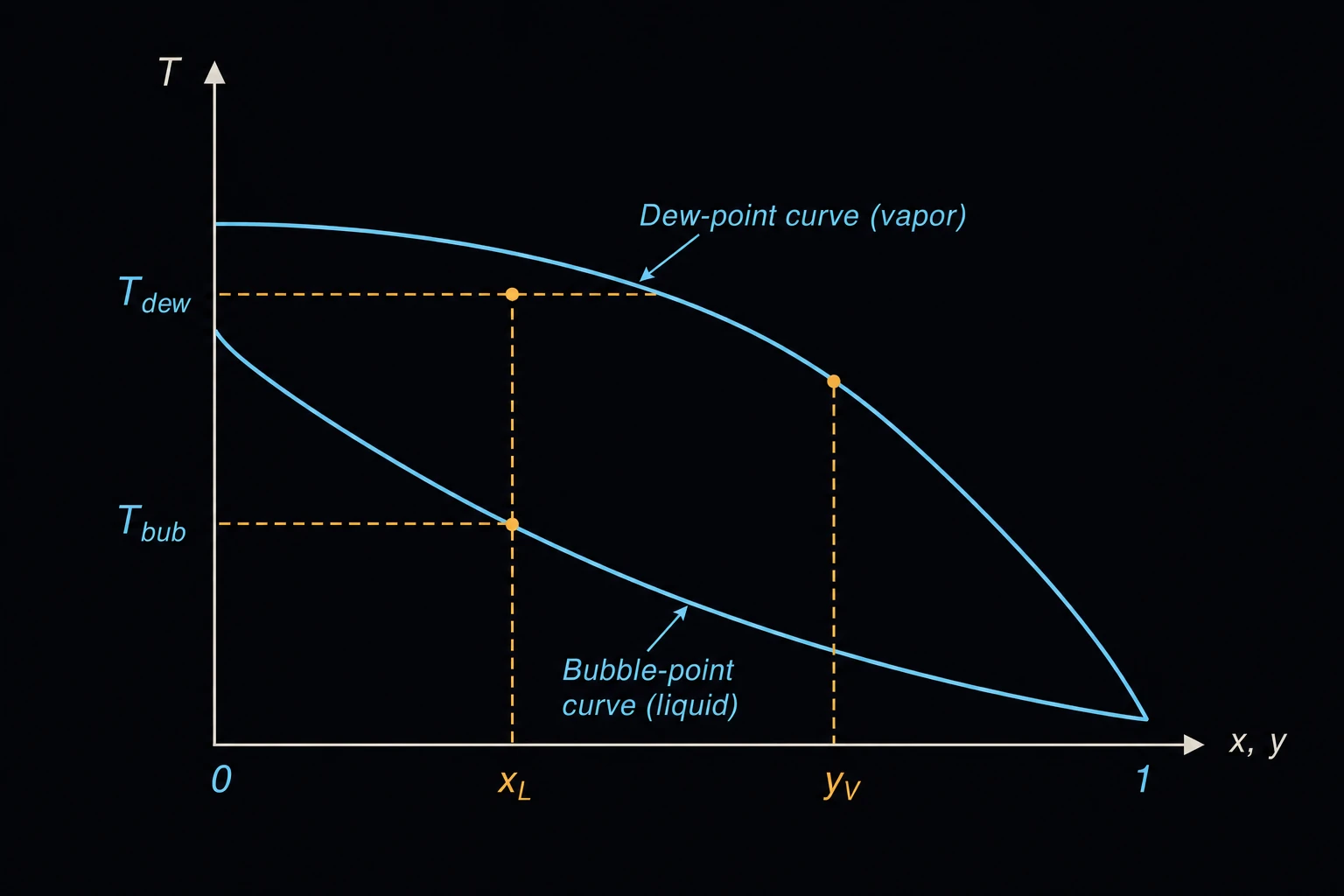
The first line is Raoult’s law [1]. xi is the mole fraction of component i in the liquid, yi its mole fraction in the vapor, P the total pressure and Pisat the pure component’s vapor pressure at the temperature. At the bubble point the liquid of composition x has just begun to boil. At the dew point the vapor of composition y has just begun to condense. Ki = yi/xi = Pisat/P, and the relative volatility is α12 = P1sat/P2sat. For a listed liquid, Psat comes from the Antoine equation [2]:
log10(Psat/bar) = A − B/(T + C)
with T in °C and the constants A, B and C from the compound table.
Limits and common mistakes
- Raoult’s law assumes an ideal liquid and an ideal-gas vapor. It suits mixtures of similar molecules, such as benzene and toluene, at low to moderate pressure. It fails for water with organics, alcohols with hydrocarbons, and any mixture that forms an azeotrope.
- Each set of Antoine constants holds over a stated temperature range [2]. Outside it, the page warns that Psat is extrapolated.
- Mole Fraction of Component 1 is x1 for a bubble point and y1 for a dew point. Mole fractions are not mass fractions.
- The page finds a pressure at a given temperature. For a bubble or dew temperature at a fixed pressure, change T until the pressure matches.
Worked example
A liquid of 40 mol% benzene in toluene is heated to 100 °C. What pressure keeps it from boiling, and what vapor would form first?
- Choose Calculation Bubble point P.
- Choose Component 1 Benzene and Component 2 Toluene.
- Enter Temperature 100 °C and Mole Fraction of Component 1 0.4, and press Solve. The Solution shows:
Bubble-point pressure Pbub: 116.691 kPa
Vapour composition y1: 0.618312
K1 = Psat1 / P: 1.54578
K2 = Psat2 / P: 0.636147
Relative volatility α12: 2.42991
Psat1 of Benzene (C₆H₆) at T (Antoine): 180.379 kPa
Psat2 of Toluene (C₇H₈) at T (Antoine): 74.2327 kPa
So the liquid stays liquid above 116.7 kPa, and the first vapor is 61.8 mol% benzene. Check by hand: 0.4 × 180.379 + 0.6 × 74.2327 = 116.69 kPa. The Antoine constants in Smith, Van Ness and Abbott [1] give 180.45 and 74.26 kPa, within 0.05 %.