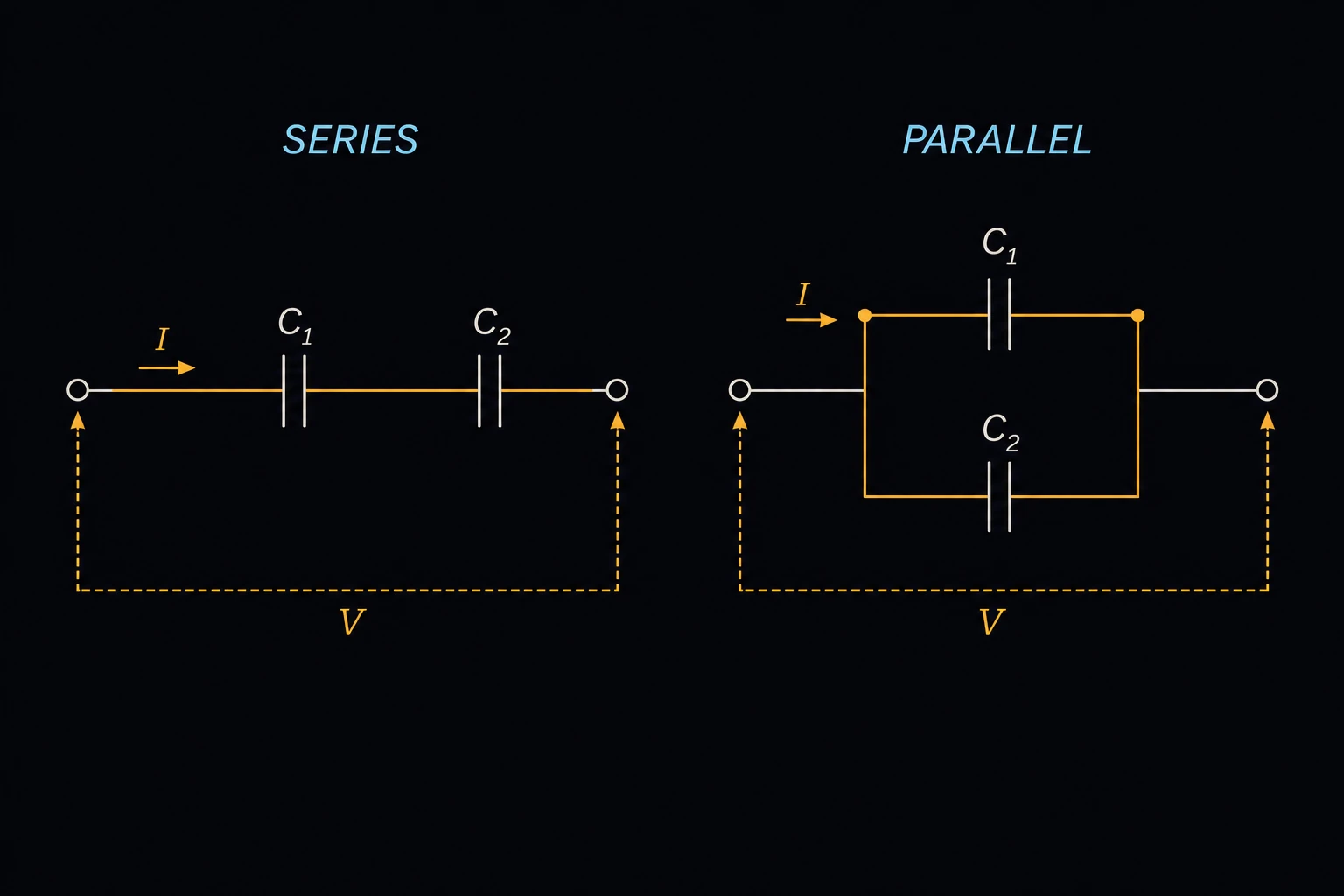
Series/Parallel Capacitance
Finds the single capacitance that can replace up to four capacitors wired all in series or all in parallel. Designers use it to build a bulk filter bank, to reach a value that isn’t stocked, or to stack capacitors in series for a higher voltage rating.
Equations
Parallel: Ceq = C1 + C2 + C3 + C4
Series: 1/Ceq = 1/C1 + 1/C2 + 1/C3 + 1/C4
C1 to C4 are the individual capacitances and Ceq the equivalent capacitance [1]. These are the reverse of the resistor rules. In parallel every capacitor sees the same voltage, so their charges add, Q = C·V, and so do their capacitances. In series every capacitor carries the same charge, so their voltages add, and the reciprocals of the capacitances add. Two in series give C1C2/(C1 + C2). The result is shown in µF.
Inputs and limits
- Each field has a unit picker (pF, nF, µF and so on). Leave a field at 0 to leave that capacitor out. Capacitors used counts the ones that went into the result.
- Negative values are rejected.
- All capacitors must be in the same arrangement. For a mixed network, work out each group first and then combine the group results.
- The page treats each capacitor as ideal. It ignores leakage, equivalent series resistance (ESR) and inductance, which matter at high frequency and for ripple current.
Common mistakes
- A parallel total is always larger than the largest capacitor. A series result is always smaller than the smallest one.
- Mixing up pF, nF and µF. 100 nF is 0.1 µF, and 1 nF is 1,000 pF.
- In series the voltage splits in inverse proportion to capacitance, so the smaller capacitor takes the larger share. Leakage in real electrolytics makes the split uneven, so series stacks normally get a balancing resistor across each capacitor.
- Electrolytic capacitors often have tolerances of ±20 % or worse, and the result is no better.
Worked example
A 60 V supply rail needs bulk filtering, but the only large electrolytics in stock are 470 µF parts rated for 35 V. Two in series share the voltage. What capacitance does the pair give?
- Choose Configuration Series.
- Enter C1 470 µF and C2 470 µF, and leave C3 and C4 at 0.
- Press Solve. The Solution shows:
Equivalent capacitance (Ceq): 235 µF
Capacitors used: 2
Check by hand: equal capacitors in series give the single value divided by the count, 470/2 = 235 µF. Each capacitor sees about 30 V, inside its 35 V rating, but only if a balancing resistor sits across each one. If 235 µF is too little, add a second series pair in parallel with the first.