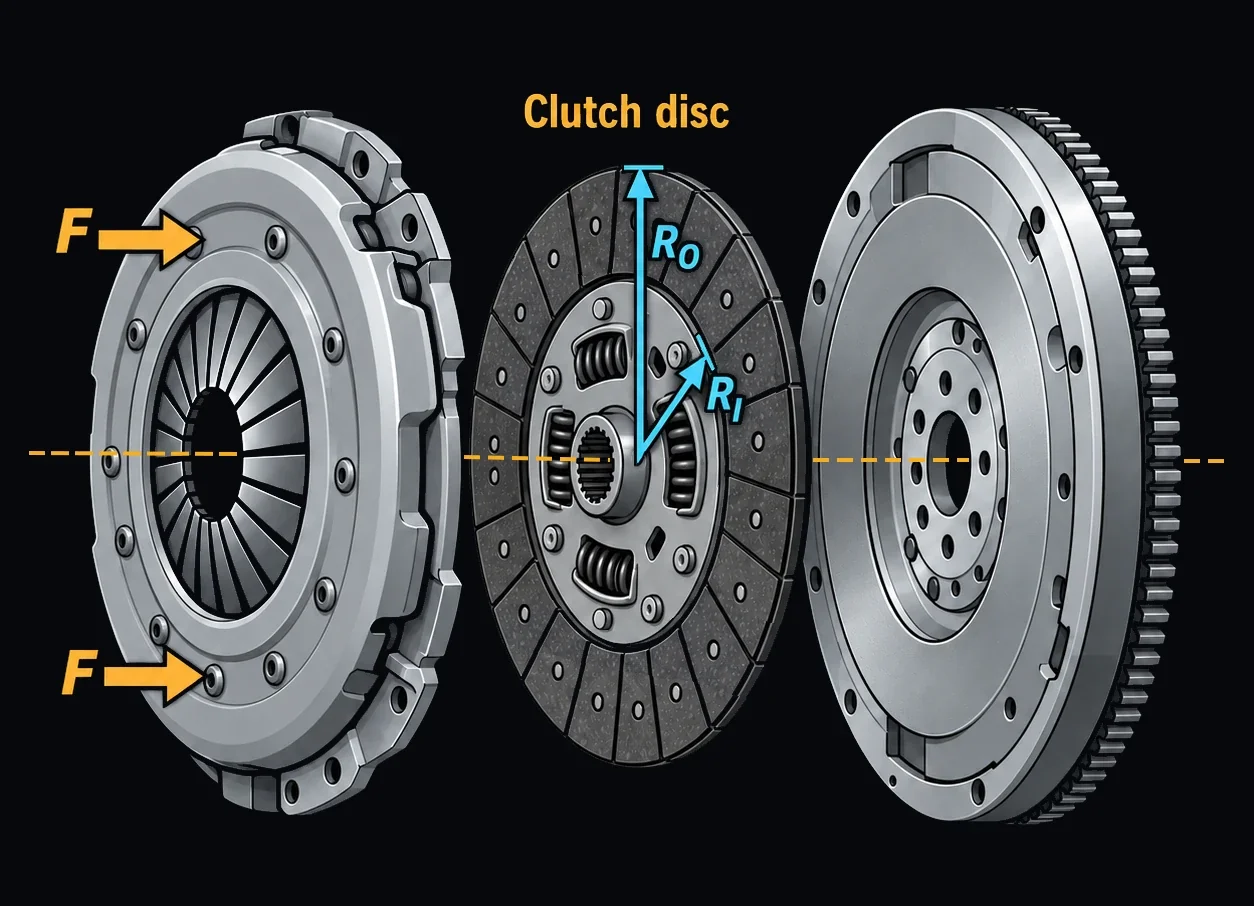
Clutch/Brake Torque
Finds the torque a disc clutch or disc brake can carry before it slips. Enter the axial clamping force, the friction coefficient, the number of friction surfaces and the inner and outer radii of the friction lining. Designers use it to size a clutch pack or its springs, and to check a brake.
Equations
Two models give the torque [1]. A new clutch presses evenly over the lining (uniform pressure). Once it has worn in, the outer edge, which slides faster, has worn away more, and the wear rate is even instead (uniform wear):
Uniform wear: T = N·f·F·(ro + ri)/2
Uniform pressure: T = N·(2/3)·f·F·(ro³ − ri³)/(ro² − ri²)
T is the torque capacity, F the axial force clamping the discs together, f the coefficient of friction between the lining and its mating face, ro and ri the outer and inner radii of the lining, and N the number of friction surfaces in contact. The same force F passes through every surface of a stack, so each one adds the same torque.
Limits and common mistakes
- Design with uniform wear. It gives the lower torque, and it is how the clutch behaves for most of its life.
- Count the surfaces, not the discs. A single-disc car clutch grips on both faces of its disc, so N = 2.
- Enter radii, not diameters.
- f falls as the lining heats up and wears. Use the maker’s value for the slipping lining, not a static value.
- The page doesn’t check the lining pressure. The highest pressure, at ri under uniform wear, must stay below the lining’s allowable value [1].
- This covers flat annular discs only, not cone clutches or drum brakes.
Worked example
A single-plate dry clutch has a lining 220 mm outside and 140 mm inside diameter. The springs clamp it with 4000 N, and the lining’s friction coefficient is 0.35. What torque can it carry once worn in?
- Choose Wear Model Uniform Wear (broken-in).
- Enter Axial Force 4000 N, Friction Coefficient 0.35 and Friction Surfaces 2.
- Enter Outer Radius 110 mm and Inner Radius 70 mm.
- Press Solve. The Solution shows:
Torque Capacity (T): 252 N·m
Torque per Friction Surface: 126 N·m
Check by hand. The mean radius is (110 + 70)/2 = 90 mm, so each face carries 0.35 × 4000 N × 0.090 m = 126 N·m, and two faces carry 252 N·m. Uniform Pressure gives 256.148 N·m for the same clutch, under 2 % more. The models differ little when the lining is narrow. The engine’s peak torque should be well below 252 N·m.