Euler Column Buckling
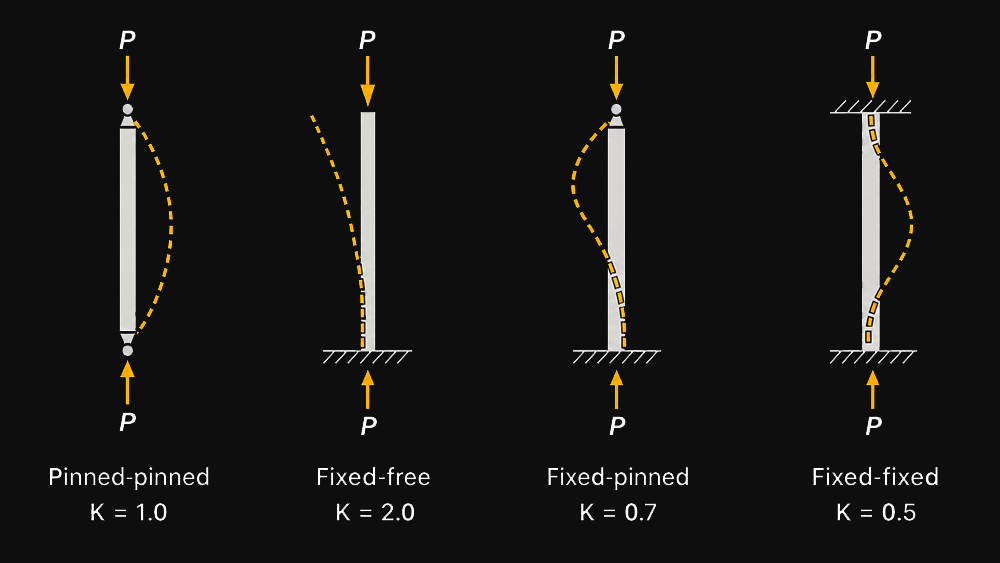
Finds the axial load at which a long, slender column buckles sideways, by Euler’s formula. Pick an end condition, a material and a section from the AISC shape tables, or enter your own I and A. Designers use it to check struts, posts and braces.
Equations
Pcr = π2·E·I/(K·L)2 σcr = Pcr/A r = √(I/A)
E is the elastic modulus, I the least moment of inertia of the section, A its area, L the unbraced length and K the effective length factor, so K·L is the length of the equivalent pinned–pinned column [1]. r is the radius of gyration, and K·L/r the slenderness ratio. Each end condition offers two values of K: the theoretical one, for perfectly pinned or fixed ends, or the AISC recommended design value, which allows for real joints that are never fully fixed [2]. A listed shape fills in its area and its weak-axis I (Iy, or the single I of a round section) [3]. A lumber species fills in Emin, the NDS modulus for stability checks [4].
Limits and common mistakes
- Euler’s formula holds only for slender columns. Short, stocky columns fail by yielding or crushing first, and this page doesn’t check that. Trust the result only when σcr is below about half the yield strength. A stockier column needs the Johnson parabola [1] or a design code.
- Pcr is the ideal buckling load, with no factor of safety. Real columns are crooked and loaded off center, and fail below it.
- Use the length between braces in the weak direction. A column braced at midheight about one axis has two lengths to check.
- A thin-walled tube or pipe can buckle locally first. For a listed HSS or pipe, the page shows the wall slenderness to check.
- Channels, angles and tees are left out: they can buckle by twisting at a lower load.
Worked example
A 6 m long square steel tube braces a roof frame and carries axial load. Its ends are pinned. Find the load at which it buckles.
- Choose End Condition Pinned–pinned and K Value Theoretical.
- Choose Material (E) Steel. The modulus fills in as 200 GPa.
- Choose Section Type HSS, Rectangular and Square and Section HSS4x4x1/4. I and A fill in from the shape.
- Enter Column Length (L) 6000 mm and press Solve. The Solution shows:
Critical Buckling Load (Pcr): 178,015 N
Critical Stress (σcr): 81.8765 MPa
Slenderness Ratio (KL/r): 155.269
Radius of Gyration (r): 38.6426 mm
Wall slenderness, wider wall (b/t or h/t on tdes): 14.2
Check by hand. The table gives I = 7.80 in⁴ and A = 3.37 in², so r = 1.52 in = 38.6 mm and KL/r = 6000/38.6 = 155. Then σcr = π² × 200,000 / 155² ≈ 82 MPa, far below the yield strength of structural steel, so the column is slender enough for Euler’s formula to apply.