Complex Number Calculator
Converts a complex number between rectangular and polar form, and adds, subtracts, multiplies or divides up to ten complex numbers. Electrical engineers use it for AC phasors and impedances, and control and vibration engineers for transfer functions and roots.
Equations
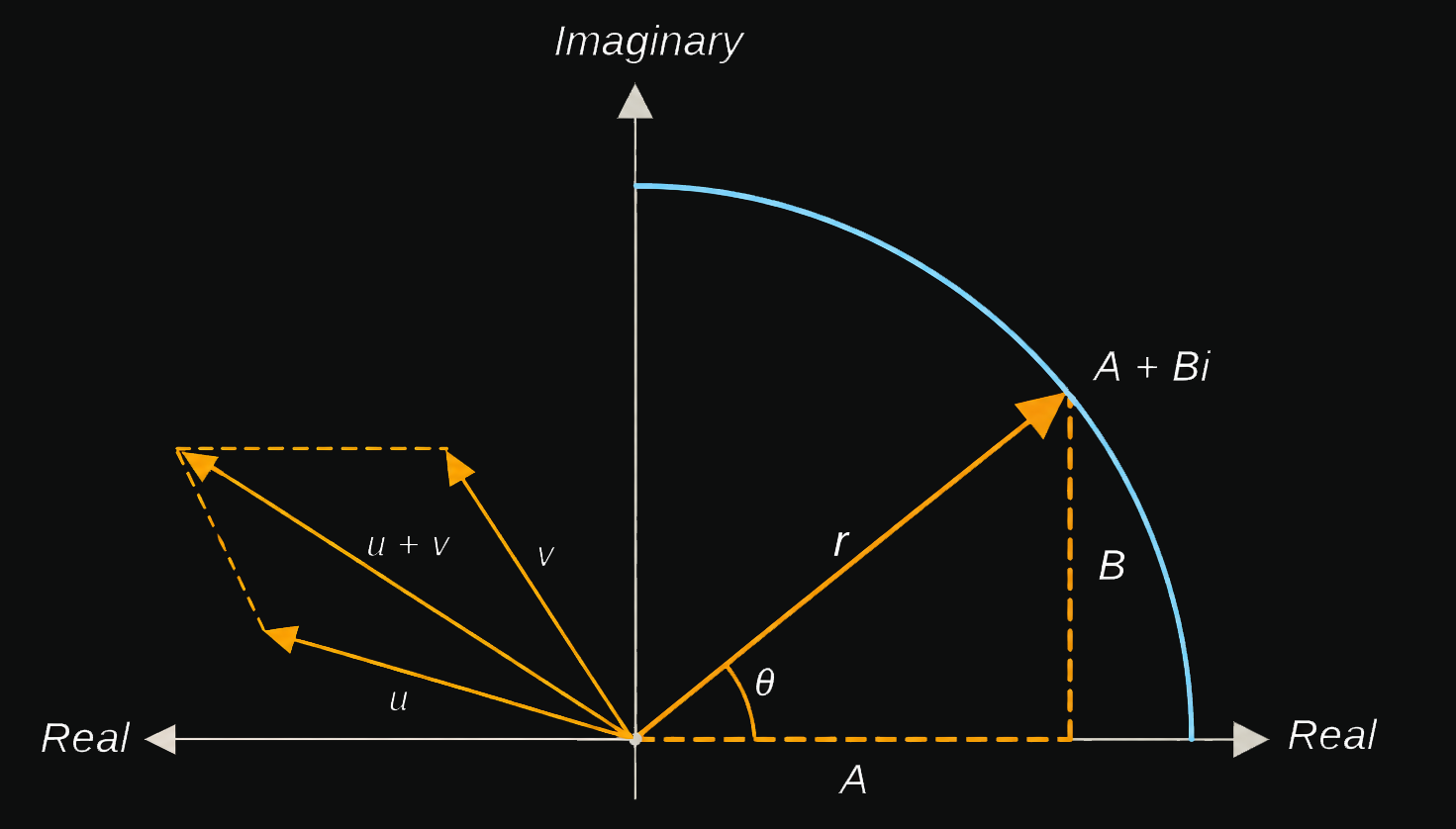
A complex number z = a + bi has a real part a and an imaginary part b, where i2 = −1. Plotted on the plane, it is a vector of length r at angle θ from the real axis [1]:
r = √(a2 + b2) θ = atan2(b, a)
a = r·cos θ b = r·sin θ
atan2 picks the quadrant from the signs of both a and b, so θ runs from −180° to +180°. Euler’s form writes the same number as z = r·eiθ, with θ in radians. Sums and differences work part by part. Products and quotients are
(a1 + b1i)(a2 + b2i) = (a1a2 − b1b2) + (a1b2 + b1a2)i
z1/z2 = [(a1a2 + b1b2) + (b1a2 − a1b2)i] / (a22 + b22)
In polar form, multiplying multiplies the magnitudes and adds the angles; dividing divides the magnitudes and subtracts the angles.
Inputs
- Operation chooses a conversion or arithmetic. For arithmetic, set Number of Vectors (2 to 10) and enter each one’s real and imaginary parts. The line above the vectors previews the expression.
- With three or more numbers the page works left to right: Subtract gives z1 − z2 − z3, and Divide gives (z1/z2)/z3.
- Angles you enter are in degrees. The magnitude can’t be negative; turn the angle through 180° instead.
Common mistakes
- Finding the angle with atan(b/a) puts a number in the second or third quadrant 180° off. The page uses atan2, so it doesn’t.
- Mixing degrees and radians. The polar form shows degrees; the exponent in Euler’s form is radians.
- Electrical texts write j for i. The arithmetic is the same.
- Adding phasors in polar form by adding magnitudes. Only phasors in phase add that way; otherwise add the rectangular parts.
Worked example
A 120 V, 60 Hz supply feeds a motor winding whose impedance is 8 + 6i Ω (8 Ω resistance, 6 Ω inductive reactance). What current does it draw, and how far does it lag the voltage? Take the voltage as the reference phasor, 120 + 0i, and find I = V/Z.
- Choose Operation Complex Number Arithmetic.
- Choose Arithmetic Operation Divide and leave Number of Vectors at 2.
- Under Vector 1, enter Real part (a₁) 120 and Imaginary part (b₁) 0.
- Under Vector 2, enter Real part (a₂) 8 and Imaginary part (b₂) 6.
- Press Solve. The Solution shows:
Rectangular Form: 9.6-7.2i
Euler's Form: 12·e^(-0.643501i)
Polar Form (r∠θ): 12∠-36.8699°
The winding draws 12 A, lagging the voltage by 36.87°, so the power factor is cos 36.87° = 0.8. Check by hand: |Z| = √(64 + 36) = 10 Ω at atan(6/8) = 36.87°, so I = 120/10 = 12 A at −36.87°.