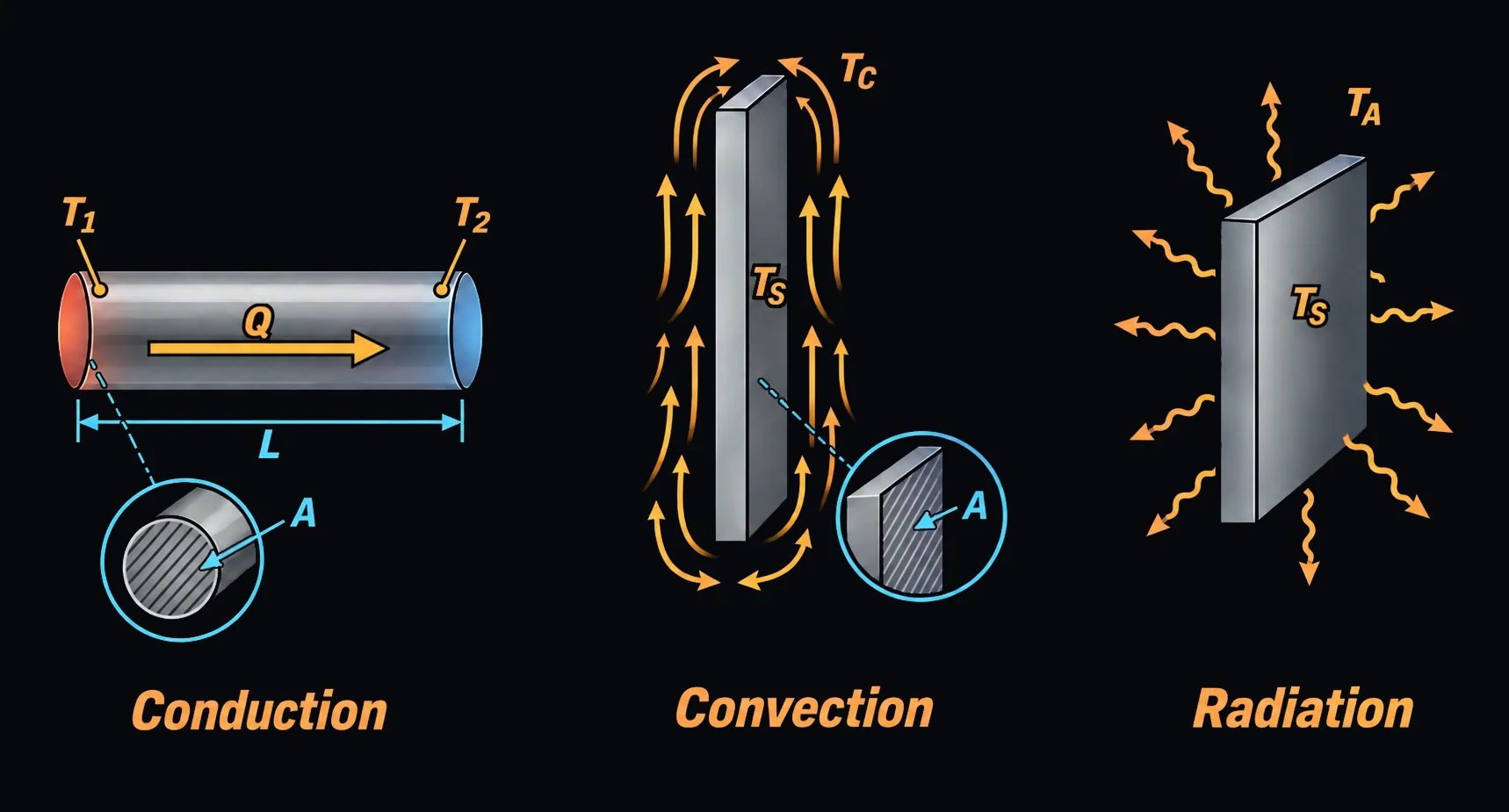
Conduction / Convection / Radiation
Finds the rate of heat flow by each of the three basic modes: conduction through a flat wall, convection from a surface to a fluid, and radiation from a surface to its surroundings. A fourth mode gives the heat needed to warm or cool a mass. Students and engineers use it for quick estimates of heat loss, heater size and warm-up energy. Each mode has presets for its property, at 300 K [2].
Equations
Conduction: q = k·A·ΔT / L
Convection: q = h·A·ΔT
Radiation: q = ε·σ·A·(Ts4 − TA4)
Sensible heat: Q = m·c·(T2 − T1)
q is the heat flow rate, in watts, and A the area it crosses. For conduction, k is the material’s thermal conductivity, L the wall thickness and ΔT the difference between the two faces. For convection, h is the convection coefficient and ΔT the difference between the surface and the fluid away from it [1]. For radiation, ε is the surface’s emissivity (0 to 1), σ = 5.670 × 10⁻⁸ W/(m²·K4) the Stefan–Boltzmann constant, Ts the surface temperature and TA that of the surroundings. The page converts both to kelvin. For sensible heat, Q is the energy in joules, m the mass, c the specific heat and T1 and T2 the start and end temperatures.
The sensible-heat mode assumes no change of phase (no melting or boiling between T1 and T2) and a specific heat c that stays constant over that range.
Limits and common mistakes
- The convection presets fill in the midpoint of a wide range [2]. Forced convection of liquids runs from 100 to 20,000 W/(m²·K), so treat a preset as an order of magnitude and use a correlation for a real design.
- The radiation formula assumes a small surface inside large surroundings, such as a pipe in a room. Between two surfaces that face each other it overstates the heat flow.
- A hot surface in air loses heat by convection and radiation together. Run both modes and add them.
- The conduction mode is for one flat layer. For a wall of several layers, or a pipe, add the thermal resistances L/(k·A) instead.
- Sensible heat assumes no melting or boiling, and c constant over the range.
Worked example
The black-painted side of an oven is 2 m² and runs at 150 °C in a 20 °C room. How much heat does it radiate?
- Choose Heat Transfer Mode Radiation and enter Surface Area 2 m².
- Choose Surface Paint, black (Parsons). The emissivity fills in as 0.98.
- Enter Surface Temperature 150 °C and Ambient Temperature 20 °C, and press Solve. The Solution shows: Heat Transfer Rate (q): 2,742.46 W
Check with a radiation coefficient, hr ≈ 4εσTm3, at the mean temperature Tm = 358 K: hr ≈ 10.2 W/(m²·K), and 10.2 × 2 × 130 = 2,650 W, within 4 %. Free convection to the room air adds a heat flow of the same order; run the Convection mode for it.