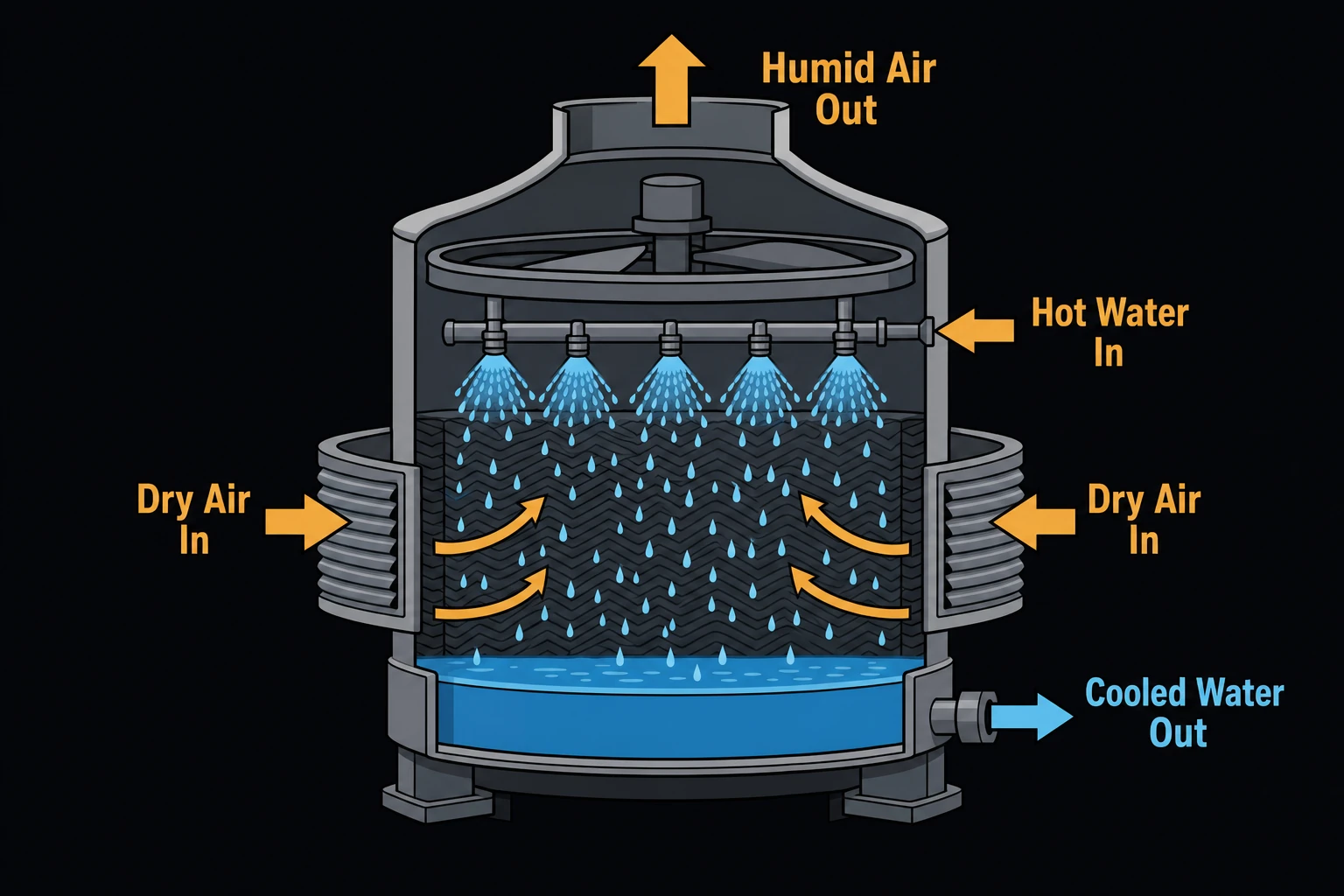
Cooling Tower Water Balance
Works out the water balance of an evaporative cooling tower: how much water it evaporates, loses as drift and must bleed off as blowdown, and so how much make-up water it needs. Plant, HVAC and water-treatment engineers use it to size make-up supplies and drains and to estimate water and chemical costs.
Equations
Range = Thot − Tcold Approach = Tcold − Twb
E = 0.00174·Q·Range D = Q·d/100
B = E/(C − 1) − D M = E + D + B
Q is the circulating water flow in m³/h. Thot is the water returning to the tower, Tcold the water leaving its basin and Twb the wet-bulb temperature of the inlet air. E is the evaporation, D the drift, B the blowdown and M the make-up, all in m³/h. d is the drift in percent of Q. C is the cycles of concentration: the ratio of dissolved solids in the tower water to those in the make-up.
The factor 0.00174 per °C assumes all the heat leaves as latent heat of evaporation: about 4.18 kJ/(kg·K) over 2,400 kJ/kg [1]. The blowdown equation is a balance on dissolved solids. Drift carries solids out too, so it counts toward the bleed. If drift alone removes enough water, the blowdown shows 0.
Inputs
- Choosing a Tower Type fills in the EPA AP-42 drift for that type [3]. Use Custom to enter a drift-eliminator guarantee, which is often 0.001 to 0.005 % on modern towers.
- Use the design wet-bulb for the site, not the dry-bulb. Tower performance is rated against the wet-bulb [2].
Limits and common mistakes
- Some heat leaves as sensible heat of the air, so real evaporation is often 10 to 20 % lower than the latent-heat estimate, more in cold weather. The estimate is a safe basis for sizing make-up.
- The approach is shown as a check, not used in the balance. An approach under about 3 °C makes a tower very large and costly.
- The cycles are set by the water chemistry, typically 3 to 7. Higher cycles save water but raise the risk of scale.
Worked example
A process cooling loop circulates 2,000 m³/h through an induced-draft tower, cooling the water from 38 to 29 °C. The design wet-bulb is 24 °C, and the water treatment allows 5 cycles. How much make-up water does the tower need?
- Enter Circulating Water Flow 2000 m³/h.
- Enter Hot Water Temperature 38 °C, Cold Water Temperature 29 °C and Ambient Wet-Bulb Temperature 24 °C.
- Enter Cycles of Concentration 5.
- Leave Tower Type on Induced draft, which fills in a drift of 0.02 %, and press Solve. The Solution shows:
Range (Thot − Tcold): 9 °C
Approach (Tcold − Twb): 5 °C
Evaporation loss: 31.32 m³/h
Drift loss: 0.4 m³/h
Blowdown: 7.43 m³/h
Make-up water: 39.15 m³/h
Check by hand: E = 0.00174 × 2000 × 9 = 31.32 m³/h, D = 2000 × 0.0002 = 0.4 m³/h and B = 31.32/4 − 0.4 = 7.43 m³/h. The rule of thumb of 1 % of the flow evaporated for every 5.6 °C of range gives 2000 × 0.01 × 9/5.6 = 32 m³/h, close to E.