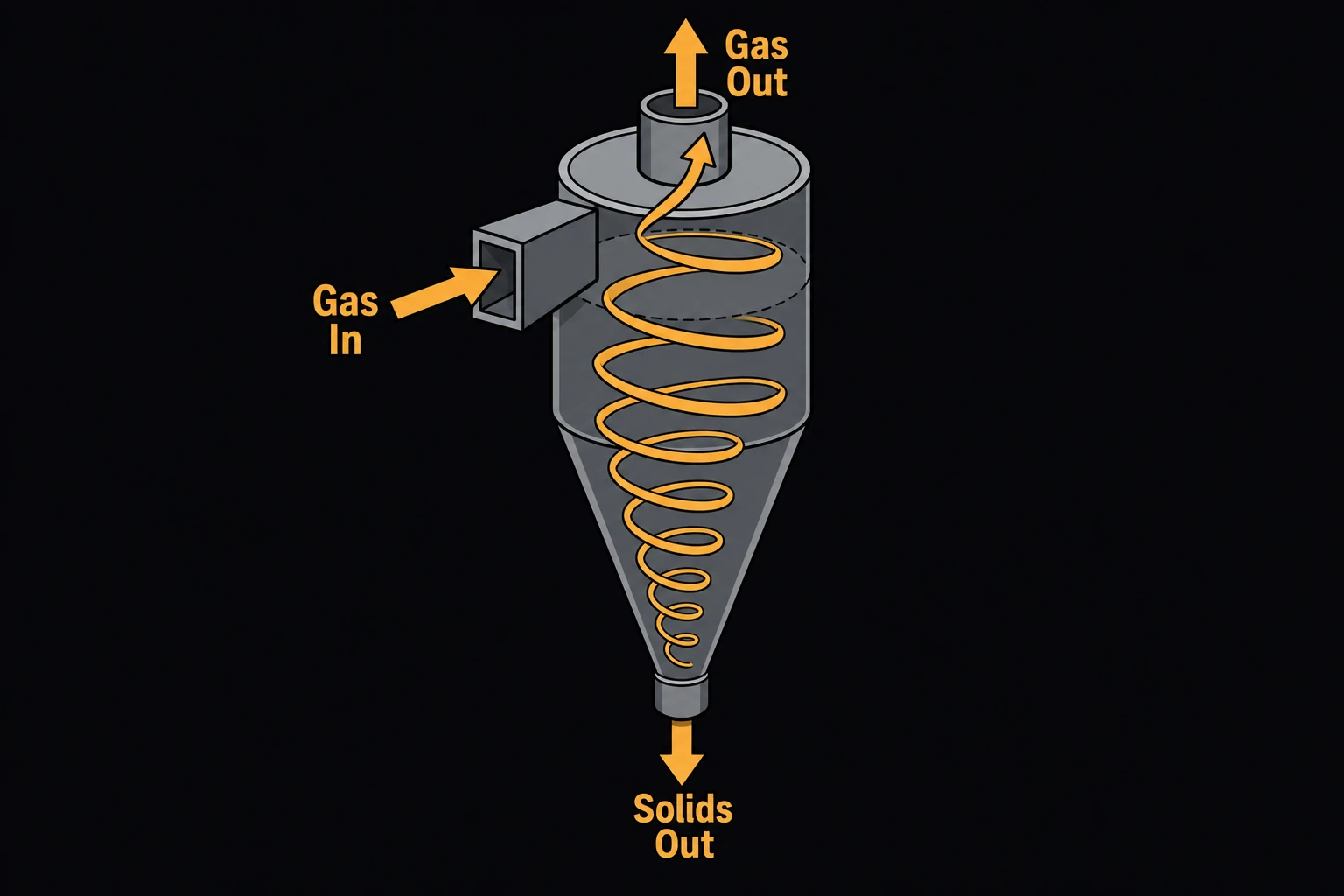
Cyclone Cut Diameter & Efficiency (Lapple)
Finds the cut diameter of a cyclone dust collector, the particle size it catches half of, and its collection efficiency for one particle size, by the Lapple method. Process and air-pollution engineers use it to size a cyclone for a dust load, to compare standard designs, and to judge whether a cyclone alone will do or a bag filter must follow it.
Equations
d50 = √(9·μ·W/(2π·Ne·vi·(ρp − ρg)))
η = 1/(1 + (d50/di)²)
d50 is the cut diameter [1], [3]. μ is the gas viscosity and W the width of the inlet. Ne is the effective number of turns the gas makes in the cyclone, and vi the gas velocity in the inlet. ρp and ρg are the particle and gas densities. η is the fraction of particles of diameter di that the cyclone catches, from Lapple’s efficiency curve as fitted by Theodore and DePaola [3].
Inputs
- Choosing a Standard Cyclone Design fills in Ne from its proportions: Ne = (Lb + Lc/2)/H, where H is the inlet height and Lb and Lc the lengths of the body and cone [3]. The menu shows each design’s inlet width as a fraction of the body diameter D, so W follows from D.
- Choosing a Gas or a Dust fills in its properties [4]–[6]. Use the solid density of the dust, not its bulk density.
- The inlet velocity is the gas flow divided by the inlet area. Most cyclones run at about 15–25 m/s [2].
Limits and common mistakes
- The result is for one particle size. For a real dust, find η for each size band and weight it by the mass in that band to get the overall efficiency [3].
- A higher inlet velocity gives a smaller cut size, but the pressure drop grows with vi². Above about 25–30 m/s, dust bounces and is picked up again, and efficiency falls.
- The Lapple model is a first estimate. Heavy dust loads usually collect better than it predicts; sticky or very fine dust can do worse.
Worked example
Cement dust in air at 20 °C goes to a Stairmand high-efficiency cyclone of 600 mm diameter, with an inlet velocity of 18 m/s. What is its cut size, and how much 5 µm dust does it catch?
- Enter Inlet Gas Velocity 18 m/s.
- The Stairmand inlet is 0.2D wide, so enter Cyclone Inlet Width 120 mm.
- Choose Standard Cyclone Design Stairmand high efficiency. Ne fills in as 5.5.
- Choose Gas Air, 20°C, 1 atm (0.018 cP and 1.2 kg/m³) and Dust Portland cement (3150 kg/m³).
- Enter Particle Diameter of Interest 5 µm and press Solve. The Solution shows:
Cut diameter d50: 3.15042 µm
Collection efficiency at di = 5 µm: 0.715817
Collection efficiency: 71.5817 %
Check by hand: 9 × 1.8×10−5 × 0.12 = 1.944×10⁻⁵, and 2π × 5.5 × 18 × 3148.8 = 1.959×10⁶. The square root of their ratio is 3.15×10⁻⁶ m, or 3.15 µm. Then η = 1/(1 + 0.630²) = 0.716. A cut size of a few microns is typical of a high-efficiency cyclone.