Decibel (dB) Conversion
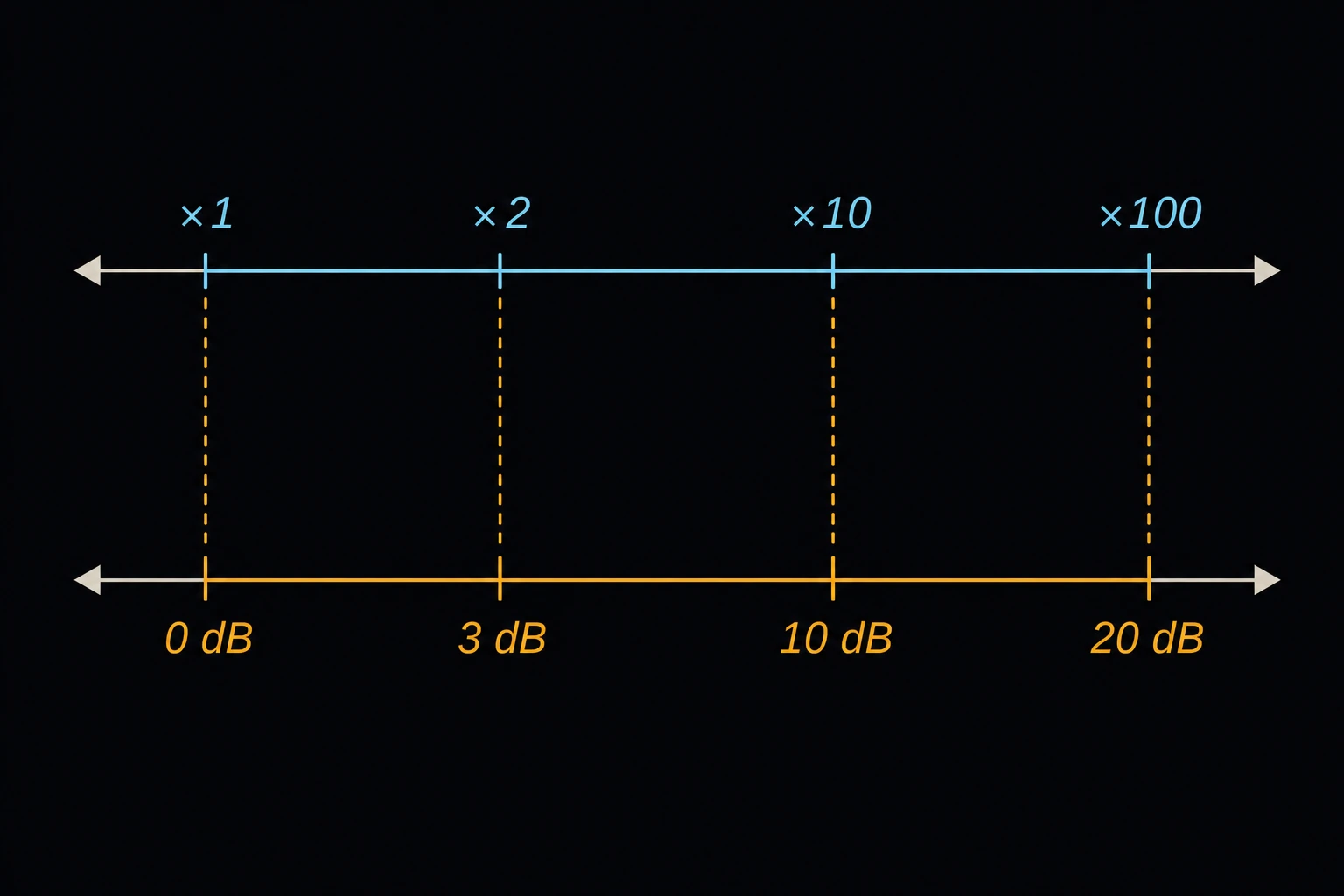
Converts a power or voltage ratio to decibels, or a decibel value back to a power or voltage ratio. Electronics, audio and RF engineers use it to read gains, losses and link budgets, where decibels turn long chains of multiplications into simple sums.
The decibel equations
dB = 10·log10(P2/P1) dB = 20·log10(V2/V1)
P2/P1 is the ratio of two powers, such as output to input power, and V2/V1 the ratio of two voltages (or currents) [1]. Power goes as the square of voltage, so a voltage ratio takes 20·log where a power ratio takes 10·log. The reverse conversions are P2/P1 = 10dB/10 and V2/V1 = 10dB/20.
Enter the ratio as a plain number with no units. A ratio above 1 is a gain and gives a positive dB value. A ratio below 1 is a loss and gives a negative one. In the reverse modes, enter a negative dB value for a loss.
Limits and common mistakes
- Use the voltage mode only when both voltages are across the same impedance. If the impedances differ, convert to power first, or the dB value is not a power gain.
- Don’t mix the two rules. A doubling of power is about 3 dB, but a doubling of voltage is about 6 dB.
- The page converts ratios. An absolute level such as dBm or dBV is a ratio to a stated reference (1 mW or 1 V), so divide by that reference before you enter it.
- The ratio must be positive. Zero or a negative ratio has no decibel value.
Worked example
A preamplifier takes a 150 mV signal and puts out 4.5 V into the same input impedance as the stage it drives. Express its voltage gain in decibels for the block diagram.
- Choose Conversion Voltage ratio → dB.
- Enter Ratio (P2/P1 or V2/V1) 30 (4.5 V ÷ 0.15 V).
- Press Solve. The Solution shows: Decibels (dB): 29.5424
Check: a ratio of 10 is 20 dB and a ratio of 3 is about 9.54 dB, so 30 is 20 + 9.54 = 29.54 dB. Had the 30 been a power ratio, the gain would be half that, 14.77 dB.