Duct Pressure Drop
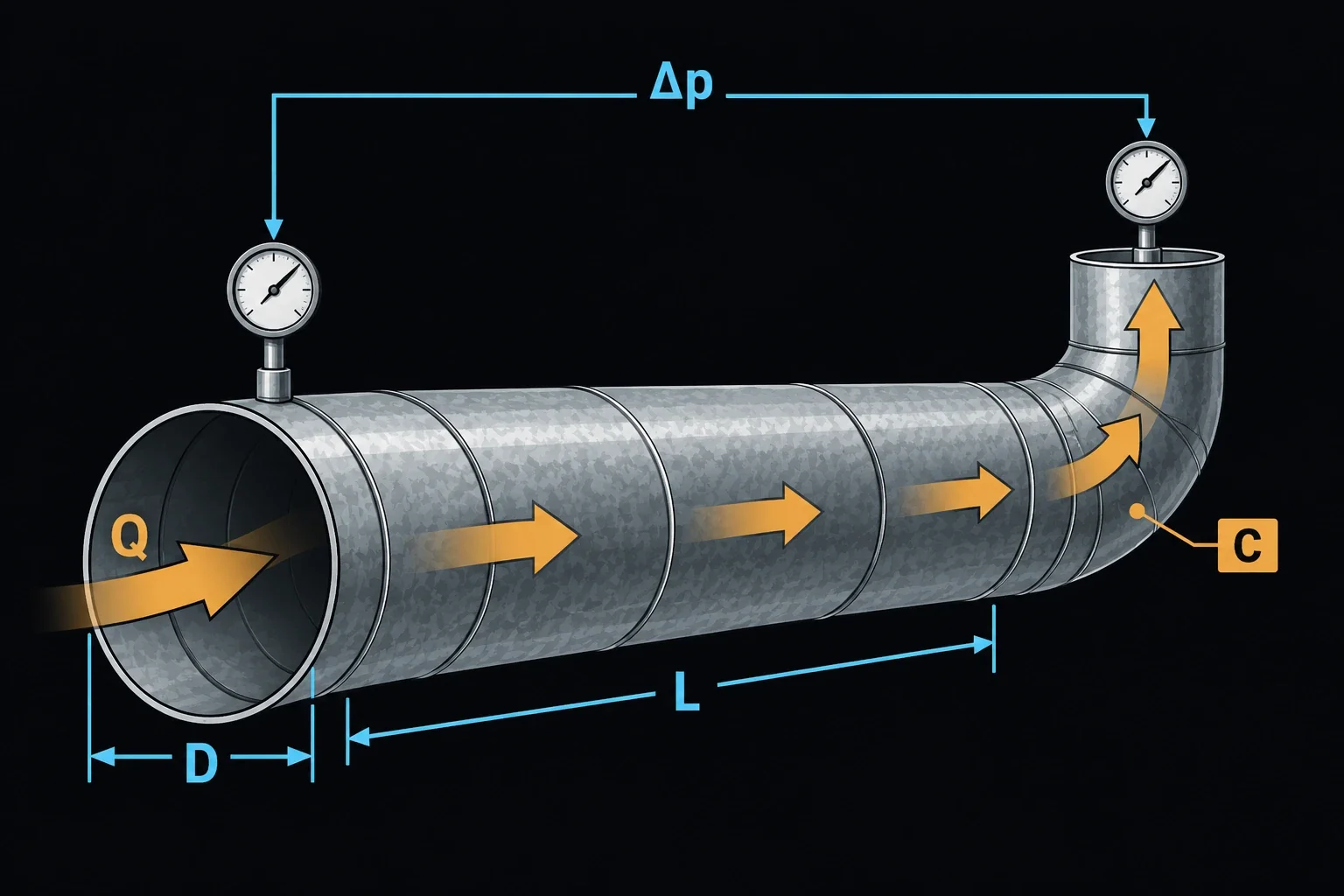
Finds the pressure loss of a run of round or rectangular duct: the friction loss of the straight duct plus the losses of its fittings. HVAC designers use it to add up the losses along the critical path of a duct system, which the fan must overcome.
Equations
Δp = f·(L/Dh)·pv + ΣC·pv pv = ρV²/2
Δp is the total pressure loss of the run, L its length and V = Q/A the mean velocity for an airflow Q through a duct of cross-section A. pv is the velocity pressure and ρ the air density. The first term is the straight-duct friction loss (Darcy–Weisbach); the second is the fitting loss [1]. f is the Darcy friction factor from the Colebrook equation [2],
1/√f = −2·log10(ε/(3.7Dh) + 2.51/(Re·√f))
with ε the duct roughness and Re = ρVDh/μ the Reynolds number, μ being the air viscosity. Below Re = 2300 the flow is laminar and f = 64/Re. Dh is the diameter of a round duct, or the hydraulic diameter 4A/P of a rectangular one, where P is the perimeter. Picking a duct material fills in ε [1]. The density and viscosity fill in as ASHRAE standard air, dry air at 20 °C and 101.325 kPa [1].
ΣC is the sum of the loss coefficients of the run’s elbows, transitions, dampers and other fittings, taken from fitting loss tables such as those in [1].
Limits and common mistakes
- Each C must be referred to this duct’s velocity pressure. A coefficient a table gives at a different section, such as the outlet of a transition or the branch of a tee, must be converted first, or its loss entered on its own run.
- The run must have one size and one airflow. Split a system into sections wherever the size or the flow changes, and add the sections along the path.
- For a rectangular duct, the page also shows Huebscher’s equivalent round duct De. That is the round duct with the same friction at the same airflow; it is not Dh, which is used only inside the friction equation.
Worked example
A 24 × 12 in. galvanized duct with longitudinal seams carries 2,400 CFM for 80 ft. The run has two elbows (C = 0.4 each) and a balancing damper (C = 0.4). Find its pressure loss.
- Enter Airflow Rate 2400 CFM and choose Duct Shape Rectangular.
- Enter Duct Width 24 in, Duct Height 12 in and Duct Length 80 ft.
- Choose Duct Material Medium smooth — galvanized steel, longitudinal seams (0.09 mm). Leave the air at standard air.
- Enter Sum of Fitting Loss Coefficients 1.2 and press Solve. The Solution shows:
Total Pressure Loss (Δp, US): 0.203202 in. w.g.
Friction Loss (straight duct): 23.7702 Pa
Fitting Loss (ΣC·pv): 26.8453 Pa
Friction Rate (Δp/L, US): 0.119286 in. w.g./100 ft
Air Velocity (V, US): 1,200 ft/min
Velocity Pressure (pv, US): 0.0898115 in. w.g.
Check: 2,400 CFM through 2 ft² is 1,200 ft/min, and the standard-air rule pv = (V/4005)² gives (1,200/4,005)² = 0.0898 in. w.g. The fittings add 1.2 × 0.0898 = 0.108 in. w.g., more than the 80 ft of straight duct. In a short run, the fittings often decide the loss.