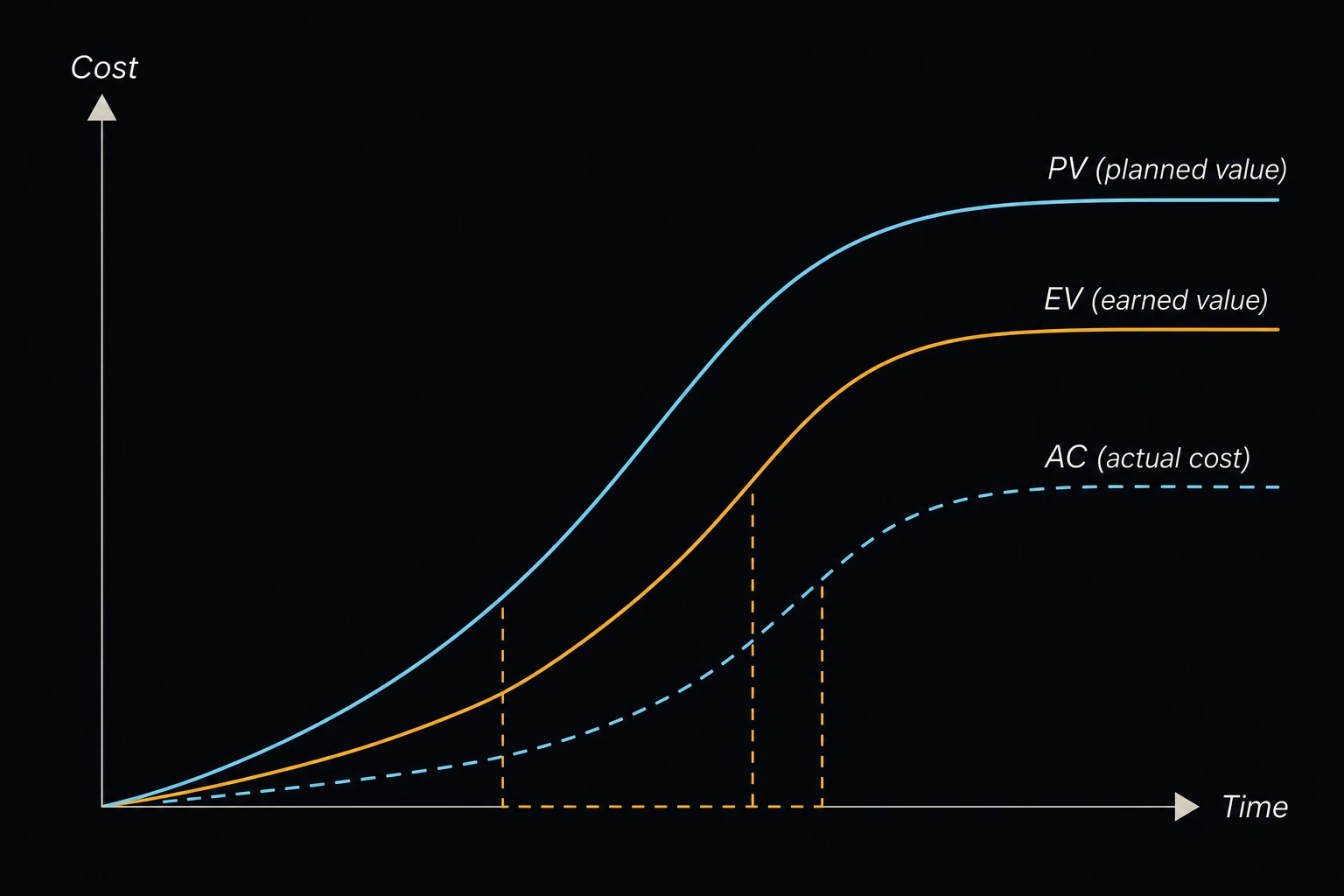
Earned Value Analysis
Measures a project’s cost and schedule performance from four numbers: the total budget, the planned value, the earned value and the actual cost to date. It gives the variances and performance indices, three estimates at completion (EAC), the estimate to complete, the variance at completion and the efficiency needed on the remaining work. Project engineers and project controls staff use it for monthly status reports and to forecast where a job will finish.
The governing equations
CV = EV − AC SV = EV − PV CPI = EV/AC SPI = EV/PV
EAC = BAC/CPI EAC = AC + (BAC − EV)/(CPI·SPI) EAC = AC + (BAC − EV)
ETC = EAC − AC VAC = BAC − EAC TCPI = (BAC − EV)/(BAC − AC)
BAC is the budget at completion, the total budget for the work. PV (planned value, also called BCWS) is the budget for the work scheduled to date. EV (earned value, BCWP) is the budget for the work actually done to date, and AC (actual cost, ACWP) is what that work cost [1], [2]. A negative CV is an overrun and a negative SV means the job is behind schedule. An index below 1 is poor performance. ETC and VAC use the CPI-trend EAC. TCPI is the cost efficiency the remaining work must reach to finish on budget [1].
Which EAC to use, and common mistakes
- The CPI trend assumes the cost performance so far will continue. It is the usual first forecast [2], [3].
- The CPI × SPI trend also lets schedule slippage drive cost, as when a late job must pay for overtime or extra shifts. It gives the highest EAC when both indices are below 1.
- “Remaining work at budget” assumes the overrun so far was a one-off. Use it only when you can name the cause and show it is gone.
- A TCPI well above the current CPI means the remaining work must go much better than the work so far. Treat finishing on budget as unlikely and report a revised EAC.
- All four inputs must be cumulative, to the same status date, in the same currency. EV and PV cannot exceed BAC.
Worked example
A plant expansion has a 1,200,000 budget. At the month-end status date, the schedule called for 480,000 of work. The work done is worth 420,000 at budget rates, and it has cost 465,000. Forecast the final cost.
- Enter Budget at Completion (BAC) 1200000.
- Enter Planned Value (PV / BCWS) 480000.
- Enter Earned Value (EV / BCWP) 420000 and Actual Cost (AC / ACWP) 465000.
- Press Solve. The Solution shows:
Cost variance (CV = EV − AC): -45,000
Schedule variance (SV = EV − PV): -60,000
Cost performance index (CPI): 0.903226
Schedule performance index (SPI): 0.875
% complete (EV / BAC): 35 %
EAC — CPI trend: 1,328,571
EAC — CPI × SPI trend: 1,451,939
EAC — remaining work at budget: 1,245,000
Estimate to complete (ETC, CPI method): 863,571
Variance at completion (VAC, CPI method): -128,571
To-complete performance index (TCPI to BAC): 1.06122
Check: CPI = 420/465 = 0.903, and 1,200,000/0.903 = 1.33 million. The job gets about 0.90 of budgeted work for each 1.00 spent. Finishing on budget would need a TCPI of 1.06, 0.16 above the current CPI, so report the 1.33 million forecast rather than the original budget.