Economic Order Quantity (EOQ)
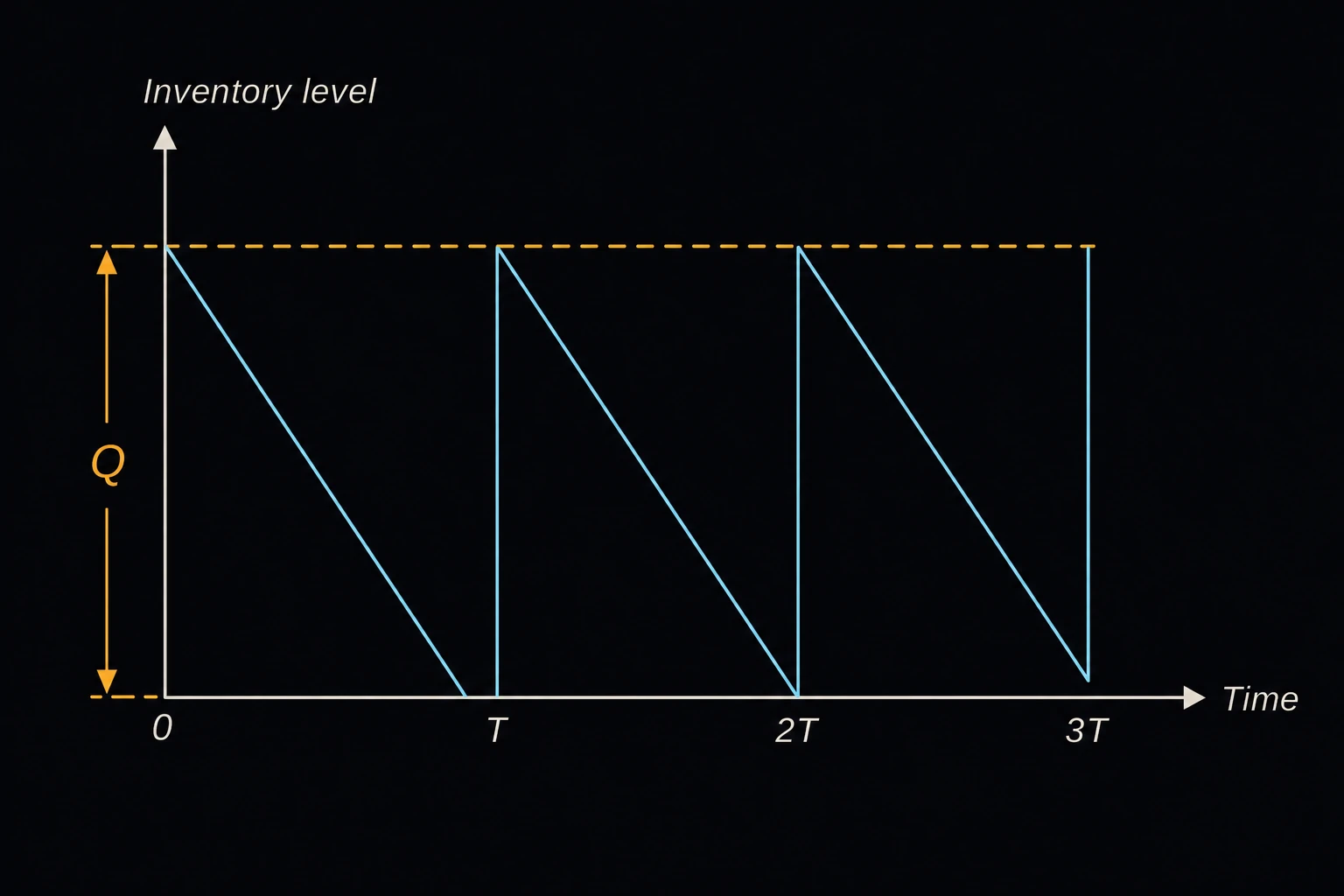
Finds the order quantity that keeps the yearly cost of ordering and holding stock as low as possible, the economic order quantity. It also gives how many orders a year that means, how long each order lasts and what the ordering and holding cost. Buyers, planners and production engineers use it to set lot sizes for parts with steady demand. The Live Cost Curve chart redraws the ordering, holding and total cost as you type.
The EOQ equation
Q* = √(2·D·S / H)
Q* is the economic order quantity, D the annual demand in units, S the fixed cost of placing and receiving one order (or of one setup, for a part made in house) and H the cost of holding one unit in stock for a year [1], [3]. With the “% of unit cost” basis, H = i·c, where i is the annual holding charge and c the unit cost [2].
TC(Q) = (D / Q)·S + (Q / 2)·H
The first term is the annual ordering cost: D/Q orders a year at S each. The second is the annual holding cost: the average stock, Q/2, times H. At Q* the two terms are equal, which is where the curves cross on the chart. The order cycle length is 365 days divided by the orders per year.
Limits and common mistakes
- The model assumes steady, known demand, an instant full delivery, no stockouts and a unit price that does not depend on Q [2]. For quantity discounts, compare the total cost at each price break, purchase cost included.
- The total shown is ordering plus holding only. It leaves out the purchase cost D·c, which does not change with Q in this model.
- The holding charge covers capital, storage, insurance, handling and obsolescence. Using only the interest rate makes H too small and Q* too large.
- The total cost curve is flat near Q*. An order 20 % off Q* costs only about 2 % more, so round Q* to a pack or pallet size [3].
Worked example
A plant buys 4,800 bearings a year at 18 each. Each purchase order costs 60 to place and receive, and the plant charges 22 % a year to hold stock. What lot size should the buyer order?
- Enter Annual Demand (D, units/yr) 4800 and Fixed Cost per Order (S) 60.
- Choose Holding Cost Basis % of unit cost per year.
- Enter Annual Holding Charge (% of unit cost) 22 and Unit Cost (for % basis / total cost) 18.
- Press Solve. The Solution shows:
Economic order quantity Q*: 381.385 units
Orders per year: 12.5857
Order cycle length: 29.0012 days
Annual ordering cost: 755.142
Annual holding cost: 755.142
Total annual inventory cost (ordering + holding): 1,510.28
Check: H = 0.22 × 18 = 3.96 a year, and √(2 × 4,800 × 60 / 3.96) = √145,455 = 381.4. The two costs are equal, as they must be at Q*. The buyer would order in lots of 400, about one order a month.