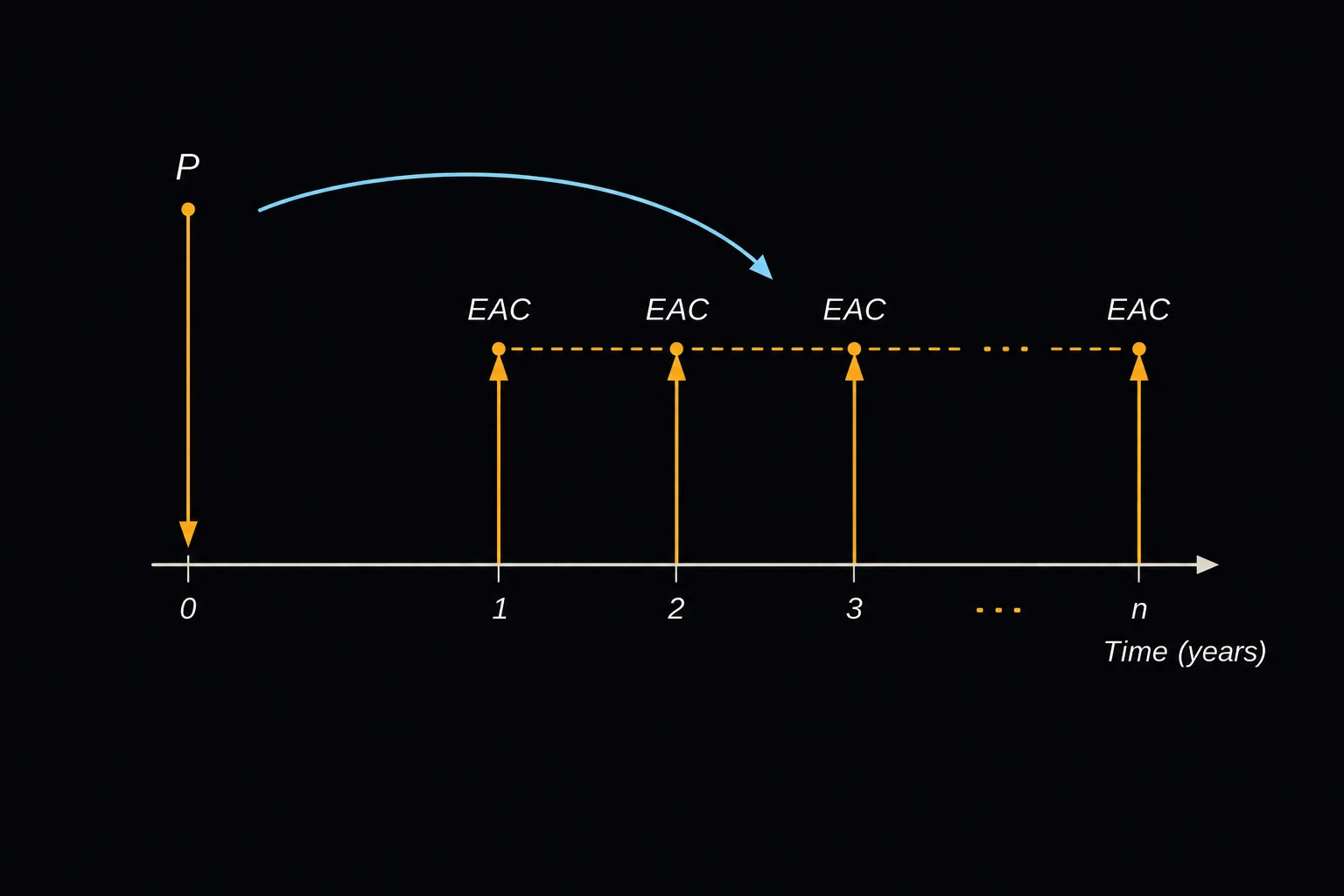
Equivalent Uniform Annual Cost
Turns the first cost, salvage value and yearly operating cost of a piece of equipment into one equivalent uniform annual cost (EUAC). Because each option becomes a cost per year, you can compare two alternatives with different service lives directly. Engineers use it to choose between pumps, motors, vehicles or buildings, and to decide when to replace an asset.
The governing equations
CR = (P − S)·(A/P, i, n) + S·i EUAC = CR + AOC
(A/P, i, n) = i(1 + i)n / [(1 + i)n − 1]
P is the first cost, S the salvage value at the end of the service life, n the service life in years, i the interest rate per year as a decimal and AOC the annual operating cost. (A/P, i, n) is the capital-recovery factor. CR is the capital-recovery cost: the yearly amount that pays back the first cost, less the salvage, with interest [1], [2]. The S·i term is the interest lost on the money tied up in the salvage value.
With a second alternative, the page lists both EUACs, the yearly difference between them and the one that costs less.
Assumptions and common mistakes
- Comparing EUACs of options with different lives assumes each would be replaced by an identical one at the end of its life, at the same costs, for as long as the service is needed [1]. If that is not true, compare over a common study period instead.
- Enter costs as positive numbers. A salvage value is a positive number too. A removal cost that exceeds the scrap value is a negative salvage.
- The operating cost must be the same every year. For a cost that grows, first convert it to an equivalent uniform amount, for example with the gradient factors on the Engineering Economics Factors page.
- Leave out anything both options share, such as the revenue the equipment earns. Only differences between alternatives matter.
- The interest rate is your MARR, and it must be above zero.
Worked example
A plant must choose an air compressor. Model A costs 45,000, lasts 10 years, sells for 5,000 at the end and costs 7,200 a year to run. Model B costs 68,000, lasts 15 years, sells for 8,000 and costs 4,100 a year. The MARR is 8 %.
- Enter Interest Rate (%) 8.
- Enter Alt A — First Cost (P) 45000, Salvage Value (S) 5000, Annual Operating Cost 7200 and Service Life (years) 10.
- Choose Compare a Second Alternative? Yes.
- Enter Alt B — First Cost (P) 68000, Salvage Value (S) 8000, Annual Operating Cost 4100 and Service Life (years) 15.
- Press Solve. The Solution shows:
Alt A — capital recovery cost: 6,361.18 /yr
Alt A — equivalent uniform annual cost: 13,561.2 /yr
Alt B — capital recovery cost: 7,649.77 /yr
Alt B — equivalent uniform annual cost: 11,749.8 /yr
Annual advantage of the cheaper option: 1,811.41 /yr
Lower-cost alternative: Alternative B
Check: (A/P, 8 %, 10) = 0.14903, so model A’s capital recovery is 40,000 × 0.14903 + 5,000 × 0.08 = 6,361. Model B costs more up front but saves about 1,800 a year, so it is the better buy.