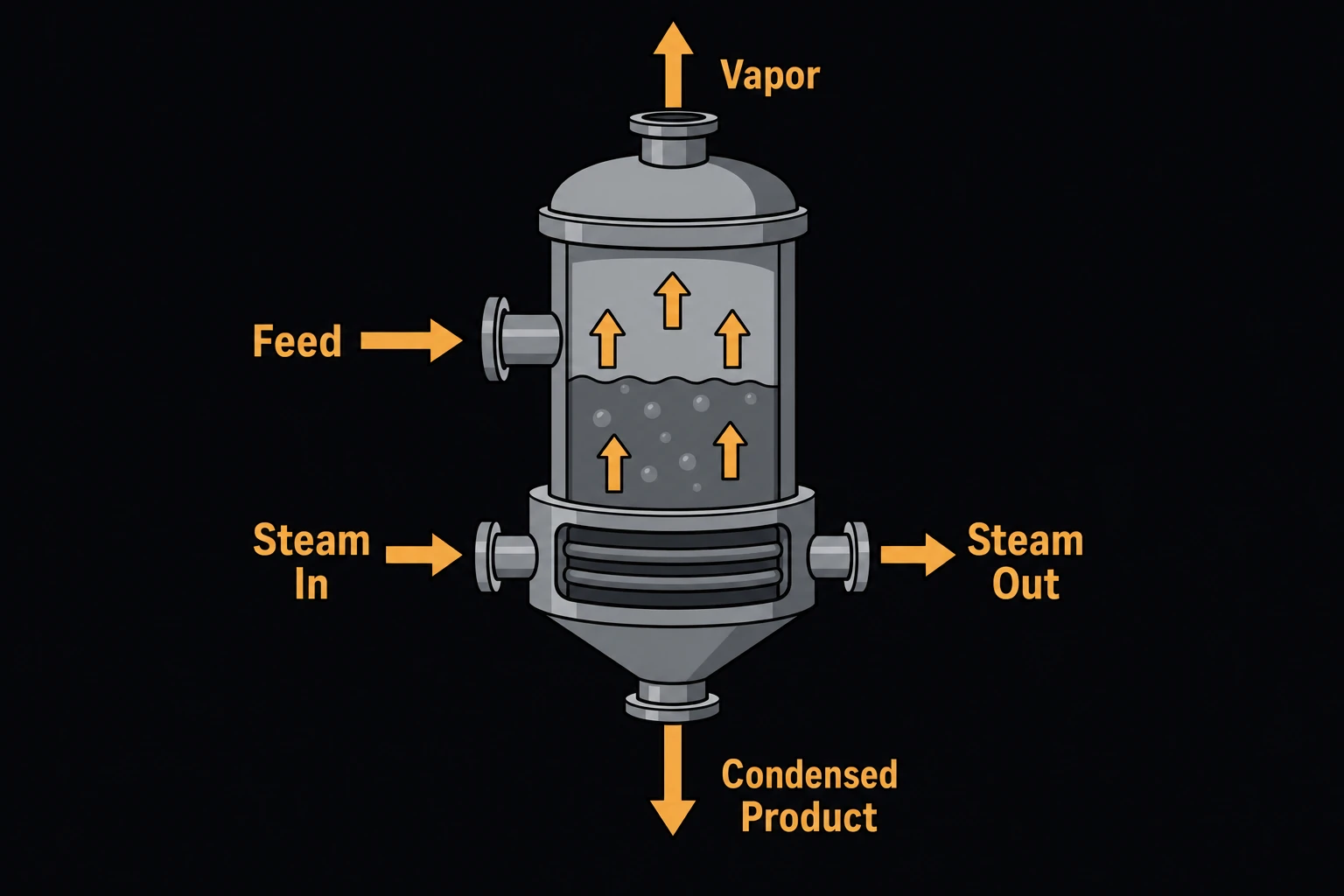
Single-Effect Evaporator
Works out the mass and energy balance of a single-effect evaporator that concentrates a solution with condensing steam. It gives the product and vapor rates, the steam demand, the steam economy and the heat duty. Process and food engineers use it to size the steam supply for juice, milk, sugar and caustic concentrators.
Equations
L = F·xF / xL V = F − L
S·λS = V·λV + F·cpF·(T − TF)
Economy = V/S Q = S·λS
The first line is the solids balance [1], [2]. F is the feed rate, L the concentrated product (thick liquor) and V the water evaporated, all in kg/h. xF and xL are the mass fractions of solids in the feed and the product. The second line is the energy balance. S is the steam demand in kg/h, and λS is the latent heat given up by the condensing steam. λV is the latent heat of the vapor boiled off at the boiling temperature T. cpF is the feed specific heat and TF the feed temperature. Q is the heat duty in kJ/h.
Inputs
- Either latent heat can be typed in or read from the IAPWS-IF97 steam tables [3]. For the steam, give its pressure, gauge or absolute. For the vapor, the page uses water at T.
- T is the temperature of the boiling liquor. It is set by the vacuum in the vapor space, plus any boiling-point rise of the solution.
Limits and common mistakes
- The balance ignores heat of dilution and heat losses. For strong caustic or sugar solutions, use an enthalpy chart instead [1].
- Choosing water vapor at T ignores boiling-point rise. A 50 % caustic solution can boil 30 °C or more above water at the same pressure, so enter the real liquor temperature.
- The steam must condense hotter than the liquor boils, or no heat flows.
- A feed hotter than T flashes on entry and lowers the steam demand.
Worked example
A tomato plant concentrates 5,000 kg/h of juice from 8 % to 30 % solids. The juice enters at 25 °C and boils at 60 °C under vacuum. The heating steam is at 2 bar gauge. How much steam is needed?
- Enter Feed Rate 5000 kg/h, Feed Solids Mass Fraction 0.08 and Product Solids Mass Fraction 0.3.
- Enter Feed Temperature 25 °C, Evaporator Boiling Temperature 60 °C and Feed Specific Heat 3.9 kJ/(kg·K).
- Choose Heating Steam Latent Heat Saturated steam at a pressure, then Heating Steam Pressure 2 bar and Steam Pressure Is Gauge.
- Choose Vapour Latent Heat Water vapour at the boiling temperature T, and press Solve. The Solution shows:
Steam saturation temperature: 133.676 °C
Latent heat of steam λS used: 2,162.99 kJ/kg
Latent heat of vapour λV used: 2,357.69 kJ/kg
Product (thick liquor) rate L: 1,333.33 kg/h
Vapour rate V: 3,666.67 kg/h
Sensible heat to raise feed to T: 682,500 kJ/h
Steam demand S: 4,312.25 kg/h
Steam economy V/S: 0.850291
Evaporator heat duty: 9,327,370 kJ/h
Check by hand: L = 5000 × 0.08/0.3 = 1,333 kg/h and V = 3,667 kg/h. The sensible heat is 5000 × 3.9 × 35 = 682,500 kJ/h. Then S = (3,667 × 2,357.7 + 682,500)/2,163.0 = 4,312 kg/h. The duty is 9.33 GJ/h, or 2.59 MW.