Factor of Safety
Compares the stress a part works at with the strength of its material, and gives the factor of safety and the margin of safety. Pick a material to fill in its minimum specified yield or tensile strength, or type your own strength. Designers use it to judge whether a part is strong enough once the working stress is known.
Equations
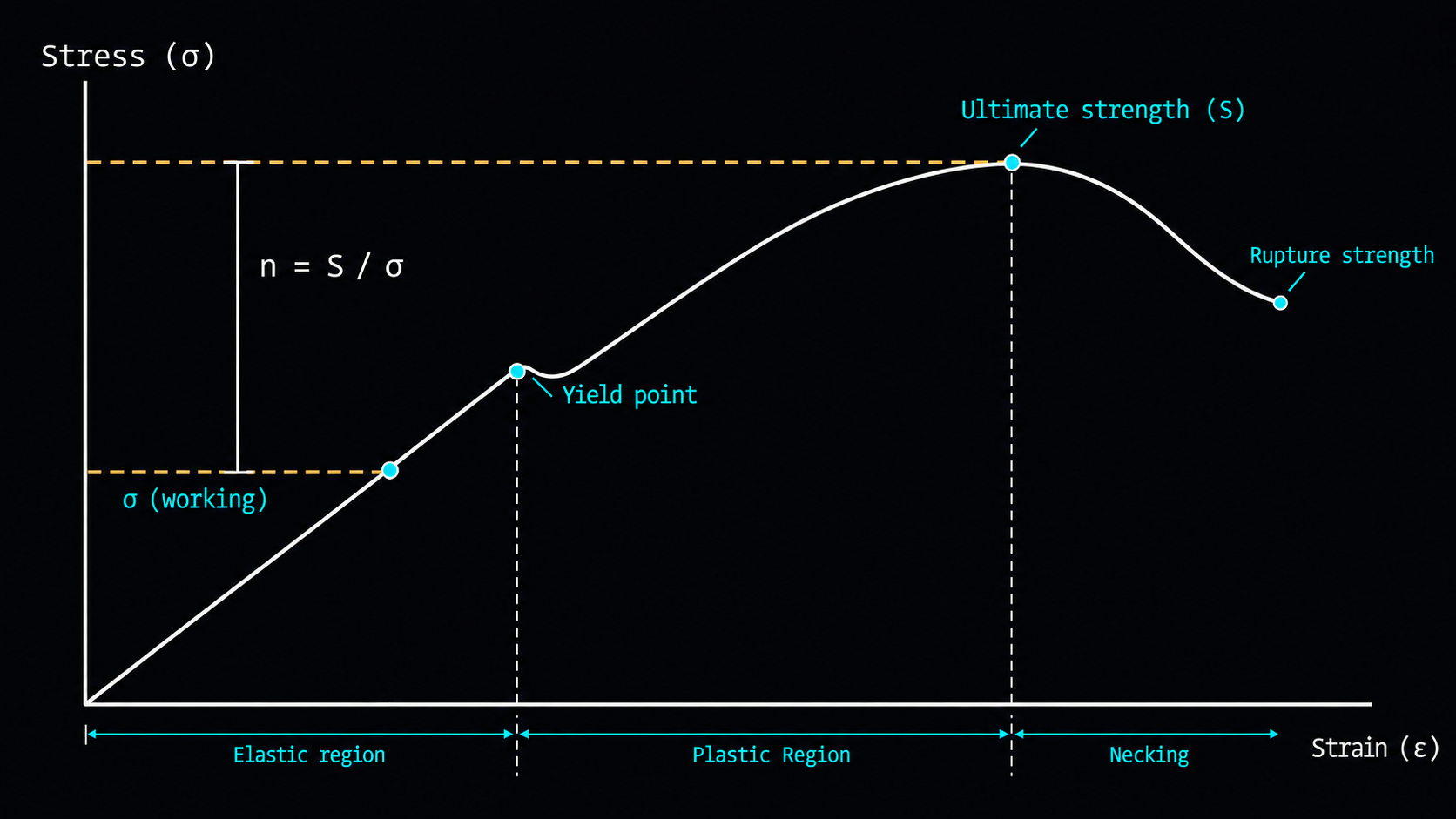
n = S/σ MS = n − 1
S is the failure strength of the material and σ the working stress in the part, both in the same units. n is the factor of safety: how many times the working stress the material can take. MS is the margin of safety: the strength left over, as a fraction of the working stress. A margin of 0.5 means the part could take 50 % more stress.
For a ductile metal, failure is the onset of yielding, so S is the yield strength Sy. For a brittle material such as gray cast iron, which has no yield point, S is the tensile strength Su. The strengths come from ASTM specifications [2] and Shigley’s table of hot-rolled and cold-drawn steels [1]. They are minimums, not typical values.
A factor of safety below 1 shows in red with “Predicted to Fail”. A margin of 0.25 or less shows in yellow, and a negative margin in red.
Limits and common mistakes
- σ must be the peak stress at the critical point. Use the combined (von Mises) stress when there is more than one stress at that point, and include stress concentration for brittle parts.
- This is a static check. A part under repeated load fails by fatigue at stresses well below Sy, so it needs a fatigue analysis.
- The tables give properties at room temperature. Strength falls at high temperature.
- Some codes and industries define the margin of safety with the factor already applied, as S/(nreq·σ) − 1. This page uses n − 1.
- The factor of safety needed depends on the load, material and code. The page doesn’t judge whether n is high enough.
Worked example
A cold-drawn AISI 1018 steel lever arm has a peak bending stress of 135 MPa under its working load. How much safety against yielding does it have?
- Choose Material (minimum specified strengths) AISI 1018, cold-drawn.
- Choose Failure Strength Basis Yield strength Sy.
- Enter Working Stress (σ) 135 MPa and press Solve. The Solution shows:
Yield strength Sy (minimum): 370 MPa
Factor of Safety (n): 2.74074
Margin of Safety: 1.74074
Check by hand. 370 / 135 = 2.74, so the arm could take about 2.7 times its working stress before it yields. The margin, 2.74 − 1 = 1.74, says it could take 174 % more.