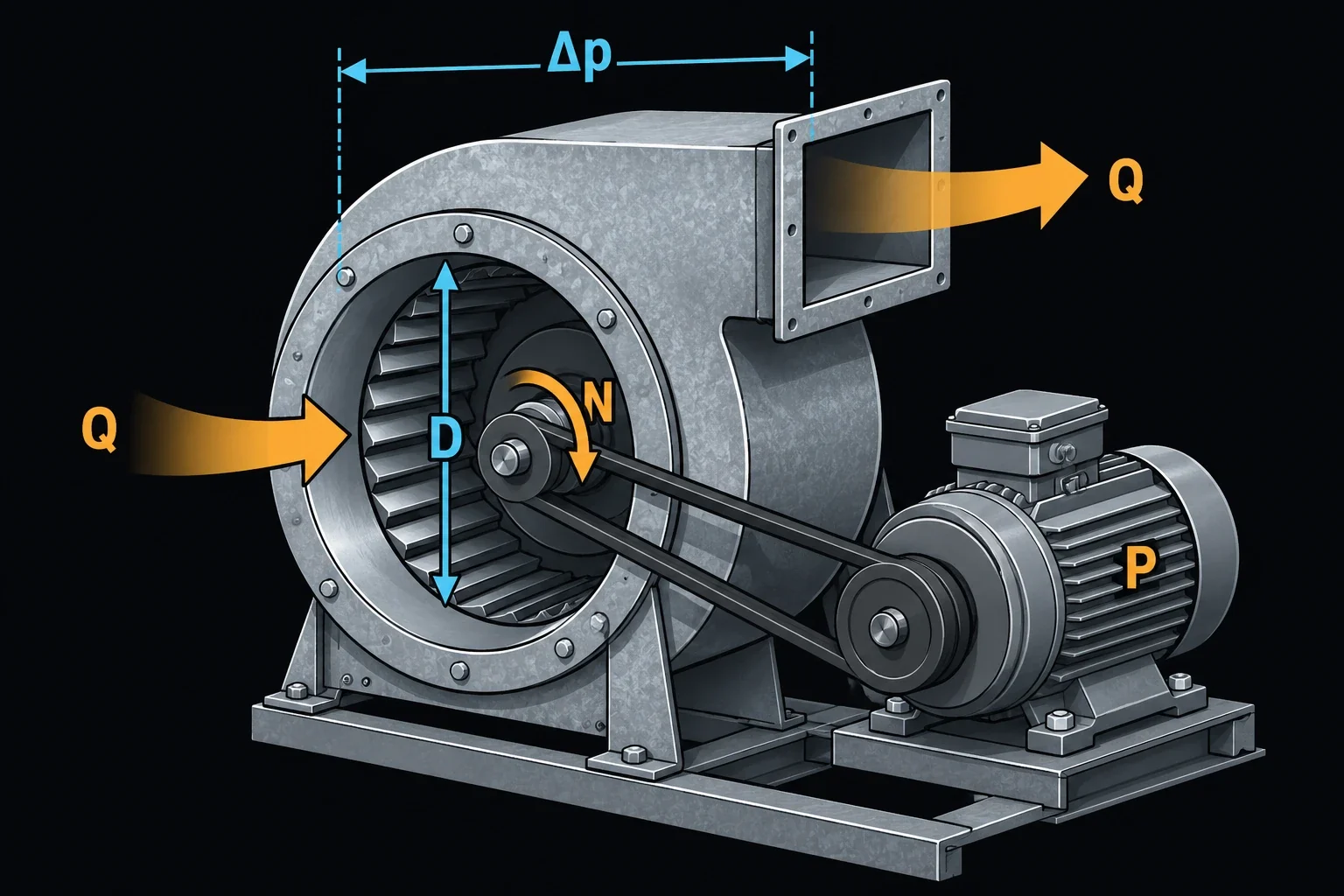
Fan Power & Affinity Laws
Finds the power a fan needs at its duty point, then uses the fan laws to predict its airflow, pressure and power at a new speed, wheel size or air density. HVAC designers and test-and-balance technicians use it to pick a motor, to set a variable-speed drive or to rerate a fan for a new sheave or a high site.
Equations
Pair = Q·Δp P = Pair/ηfan Pmotor = P/ηmotor
Q is the airflow, Δp the fan pressure and Pair the power given to the air. P is the fan shaft power (brake horsepower), ηfan the fan efficiency, and ηmotor the combined efficiency of the motor and drive [1]. Use total pressure with total efficiency, or static pressure with static efficiency, as the fan’s rating gives them; never mix the two.
For a geometrically similar fan at the same point of rating, the fan laws [1], [2] give
Q2/Q1 = (N2/N1)·(D2/D1)3
Δp2/Δp1 = (ρ2/ρ1)·(N2/N1)2·(D2/D1)2
P2/P1 = (ρ2/ρ1)·(N2/N1)3·(D2/D1)5
N is the speed, D the wheel diameter and ρ the air density; subscript 1 is the known point and 2 the new one. Leave D and ρ equal to apply a speed change alone. The efficiency is taken as unchanged, so the new motor power uses the same ηmotor.
Limits and common mistakes
- The fan laws move the fan along a system curve on which pressure rises with the square of the flow. If the system changes (a damper closes, a filter loads), the operating point moves along the fan curve instead, and the laws don’t apply.
- Static pressure control on a variable-air-volume system holds a minimum pressure, so slowing the fan saves less power than the cube law suggests.
- Speeding a fan up raises its power with the cube of speed. Check the motor and the fan’s maximum safe speed first.
- The motor input is not the motor nameplate size. Choose the next standard motor above the shaft power, with some margin.
Worked example
An air handler moves 8,000 CFM at 2.5 in. w.g. total pressure, running at 1,100 rpm with a total efficiency of 70 %. A drive will slow it to 950 rpm. What airflow, pressure and power result?
- Enter Airflow 8000 CFM and Fan Pressure 2.5 in. w.g.
- Enter Fan Efficiency 70 and Motor and Drive Efficiency 90.
- Enter Original Speed 1100 rpm and New Speed 950 rpm. Leave both wheel diameters at 24 in and both densities at 0.075 lb/ft³.
- Press Solve. The Solution shows:
Fan Shaft Power (P1 = Pair/ηfan): 3.35877 kW
New Airflow (Q2 = Q1·(N2/N1)·(D2/D1)³): 6,909.09 CFM
New Fan Pressure (Δp2 ∝ ρN²D²): 1.86467 in. w.g.
New Shaft Power (P2 ∝ ρN³D⁵): 2.16358 kW
Fan brake horsepower (BHP): 4.50418 hp
New brake horsepower: 2.90141 hp
Check with the US formula BHP = CFM × in. w.g./(6356 × η): 8,000 × 2.5/(6356 × 0.70) = 4.50 hp. (The constant 6356 assumes slightly lighter water in the gauge, so it reads 0.2 % low.) The speed ratio is 0.8636, and 0.8636³ = 0.644, so the power falls by about a third for a 14 % cut in airflow.