Isothermal Flash Drum (Rachford–Rice)
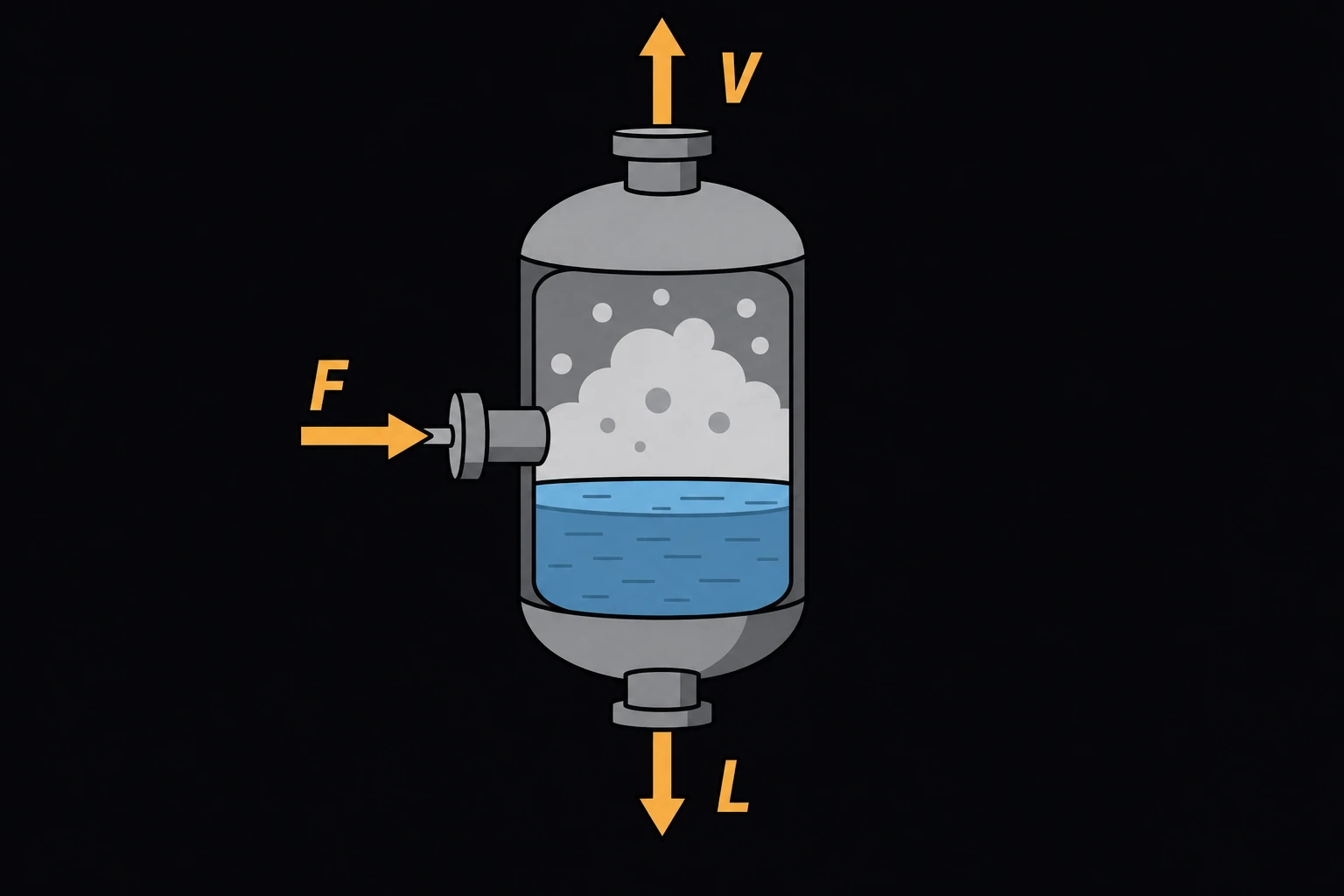
Splits a two-component feed into vapor and liquid at a fixed temperature and pressure. From the feed composition and the two K-values, it finds the fraction of the feed that vaporizes and the composition of each phase. Process engineers use it to size the split in a flash drum, a partial condenser or a separator, and as a check on simulator results.
Equations
Σ zi·(Ki − 1) / (1 + ψ·(Ki − 1)) = 0
xi = zi / (1 + ψ·(Ki − 1)) yi = Ki·xi
The first line is the Rachford–Rice equation [1], [2]. ψ = V/F is the molar vapor fraction: the moles of vapor leaving per mole of feed. zi is the feed mole fraction of component i, xi its mole fraction in the liquid and yi in the vapor. Ki = yi/xi is its equilibrium ratio at the drum’s temperature and pressure. For two components the equation is linear in ψ, so the page solves it exactly:
ψ = −(z1·a + z2·b) / (a·b), a = K1 − 1, b = K2 − 1
When ψ comes out at or below 0, the feed is at or below its bubble point and stays liquid. At or above 1 it is at or above its dew point and is all vapor. The page reports these cases instead of compositions.
Inputs
- K-values depend on temperature and pressure, and in real mixtures on composition too. For an ideal mixture, Ki = Pisat/P from Raoult’s law. Otherwise take them from a correlation, a chart or a simulator.
- One K must be above 1 and the other below 1. Otherwise there is no two-phase split.
Limits and common mistakes
- Mole fractions and molar flows only. Convert mass flows and mass fractions first.
- The page assumes the K-values you enter hold at the drum’s conditions. It doesn’t find the temperature of an adiabatic flash, which needs an energy balance.
- Only two components. A multicomponent feed needs the full sum solved by iteration.
Worked example
A feed of 30 mol% benzene in toluene enters a drum held at 100 °C and 101.325 kPa. At 100 °C the vapor pressures are 180.4 and 74.23 kPa, so Raoult’s law gives K = 1.78 for benzene and 0.733 for toluene. How much of the feed flashes, and what are the two products?
- Enter Feed Mole Fraction — Light Component 0.3.
- Enter K-value — Light Component 1.78 and K-value — Heavy Component 0.733, and press Solve. The Solution shows:
Vapour fraction V/F: 0.22616
Liquid fraction L/F: 0.77384
Liquid composition x1 (light): 0.255014
Vapour composition y1 (light): 0.453926
Liquid composition x2 (heavy): 0.744986
Vapour composition y2 (heavy): 0.546074
Check the benzene balance: 0.77384 × 0.255014 + 0.22616 × 0.453926 = 0.1973 + 0.1027 = 0.3000, the feed. Also y1/x1 = 0.453926/0.255014 = 1.78 = K1.