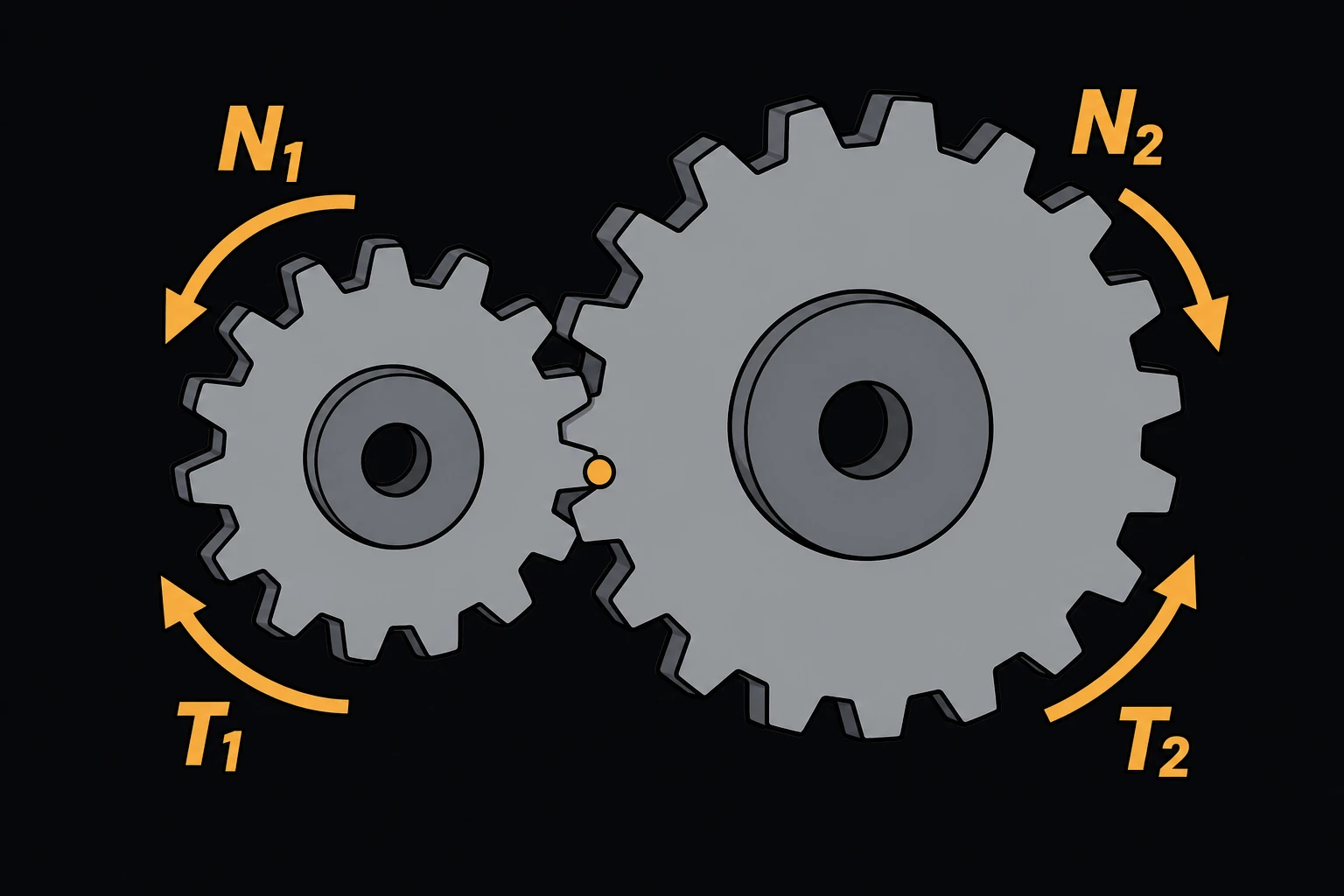
Gear Train Speed & Torque
Finds the output speed and torque of a gear train, such as a gearbox or a speed reducer, from its input speed, input torque and overall ratio. Losses come from an overall efficiency you type, or from the gear type and number of meshes. Designers use it to check that a motor and reducer give the speed and torque a machine needs.
Equations
N2 = N1/i T2 = T1·i·η η = ηmeshn
N1 and T1 are the input speed and torque, and N2 and T2 the output speed and torque. i = N1/N2 is the overall gear ratio, the product of the ratios of all the stages [1]. A ratio above 1 reduces the speed and multiplies the torque; a ratio below 1 does the opposite. η is the overall mechanical efficiency. When you pick a gear type, the page uses the lower end of the per-mesh efficiency range published for it [2], ηmesh = 0.98, raised to the power n, the number of meshes.
Losses reduce the torque but not the speed, since the teeth cannot slip. The output power is η times the input power.
Limits and common mistakes
- Count every tooth contact as a mesh, idler gears included. An idler changes the direction of rotation but not the ratio, and it still costs a mesh’s loss.
- The gear-type efficiencies apply to spur, helical, internal and bevel gears only. Worm gears lose far more and vary with the ratio and the lead angle; enter their efficiency from the maker’s data using the Custom basis.
- Bearing and seal losses are not included in the mesh efficiency. Add them through a lower custom efficiency if they matter.
- Check the output torque against the gearbox’s rated torque, not just the motor’s rating times the ratio.
Worked example
A motor delivering 20 N·m at 1,750 rpm drives a two-stage helical reducer with an overall ratio of 12.5. Find the speed and torque at the output shaft.
- Enter Input Speed (N1) 1750 rpm and Input Torque (T1) 20 N·m.
- Enter Overall Gear Ratio (N1/N2) 12.5.
- Choose Efficiency Basis Parallel-axis gears — spur, helical, internal (98.0–99.5 % per mesh).
- Enter Number of Gear Meshes 2 and press Solve. The Solution shows:
Output Speed (N2): 140 rpm
Output Torque (T2): 240.1 N·m
Overall Efficiency (η = 0.98^2): 0.9604
Check by power. The input is 20 N·m × (2π × 1,750/60) rad/s = 3,665 W. The output is 240.1 × (2π × 140/60) = 3,520 W, which is 96.04 % of the input, as it should be.