Generator Sizing
Finds the smallest continuous and surge (starting) ratings a generator needs to carry a set of loads. Enter the total running watts of everything it will power, the running and starting watts of the largest motor, and a safety margin. Homeowners, contractors and facility staff use it to pick a portable or standby generator before comparing models.
Equations
Pcont = Prun·(1 + m/100)
Psurge = [Prun + (Pstart − Pmotor)]·(1 + m/100)
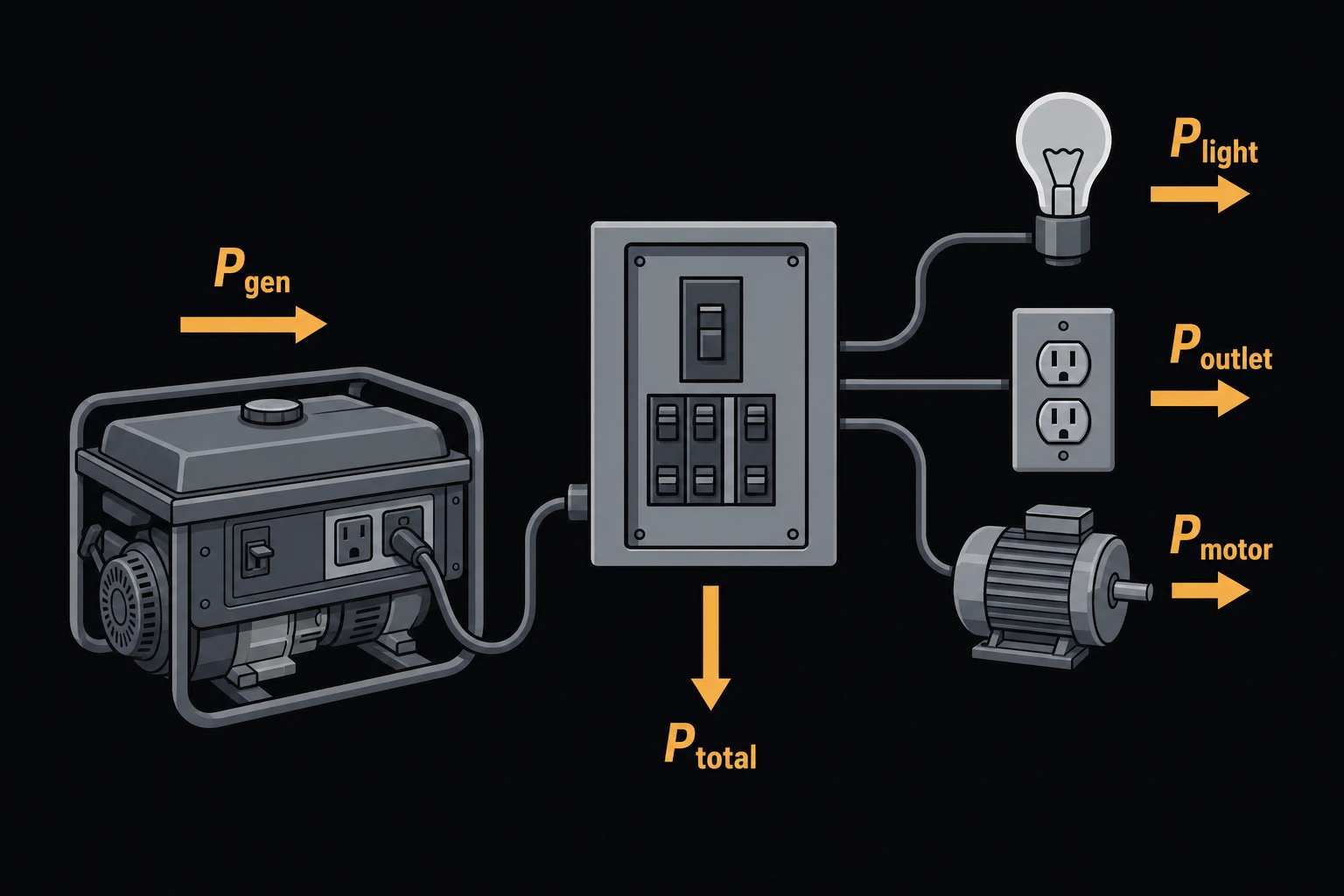
Prun is the total running load, with every load that may be on at once added up. Pmotor is the running power of the largest motor, which is already part of Prun. Pstart is that motor’s starting surge, the brief demand while it comes up to speed. m is the safety margin in percent. Pcont is the rating the generator must hold indefinitely. Psurge is the peak it must supply for a few seconds while the largest motor starts with everything else already running [1].
Only the largest motor’s surge is counted, because the worst normal case is the biggest motor starting last. A motor draws several times its running power while it starts, so this one load usually sets the generator size [1].
Limits and common mistakes
- Enter the largest motor’s running watts in the total as well. The page adds only the surge above its running power.
- Starting watts are often two to three times the running watts, and more for a compressor that starts against pressure. Use the nameplate or the maker’s figure when you have it.
- The inputs are real power in watts. A generator rated in kVA delivers kVA × power factor in watts, often 0.8.
- If two large motors can start together, add both surges by hand. The page assumes one starts at a time.
- Altitude and heat lower a generator’s output. Check the maker’s derating.
Worked example
A house needs a backup generator for a well pump, a refrigerator, the furnace blower and some lights and electronics. They add up to 4200 W running. The well pump is the largest motor: 1000 W running and 2100 W starting.
- Enter Total running load (all loads) 4200 W.
- Enter Largest motor’s running watts (included above) 1000 W and Largest motor’s starting surge watts 2100 W.
- Enter Safety margin (%) 10 and press Solve. The Solution shows:
Minimum continuous rating: 4,620 W
Minimum surge rating: 5,830 W
Check: 4200 × 1.1 = 4620 W. Starting the pump adds 2100 − 1000 = 1100 W, so the peak is 5300 W, and 5830 W with the margin. A generator rated about 5000 W running and 6000 W starting covers both.