Heat Sink Sizing
Gives a first size for a heat sink from the power a part dissipates and the temperature rise it can take. It finds either the thermal resistance the sink must have, to compare against a catalog, or the surface area that convection needs to carry the heat away. Electronics and power-supply designers use it to pick a sink for a regulator, transistor, rectifier or LED.
Equations
Rθ = ΔT / q
A = q / (h·ΔT)
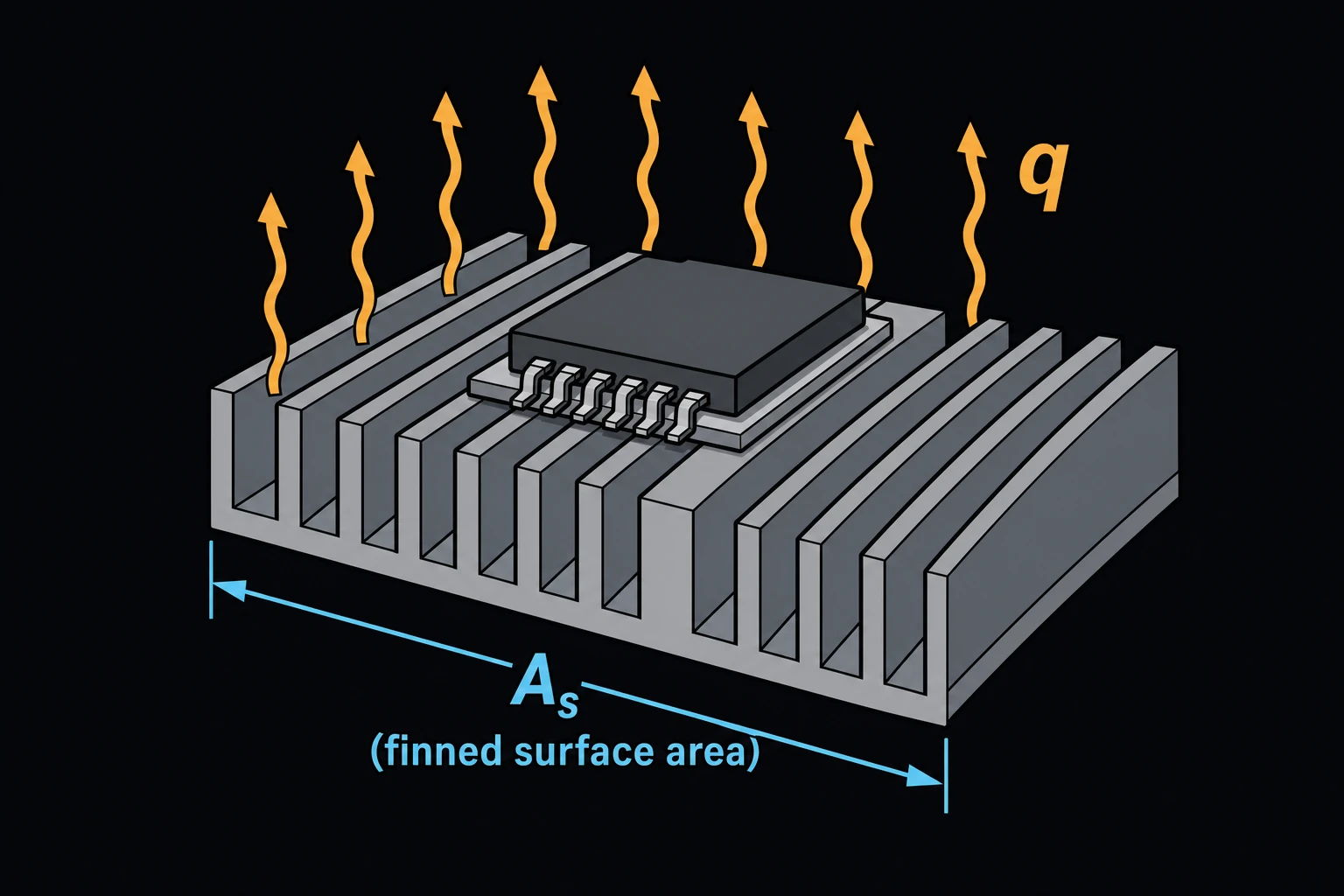
q is the power dissipated, in watts, and ΔT the allowable temperature rise. Rθ is the thermal resistance, in °C/W: the temperature rise per watt of heat flow [1]. A sink with a lower Rθ than the one required will do. A is the convective surface area, counting every fin face, and h the convection coefficient [1]. Pick a Cooling type to fill in the midpoint of its typical range of h [2].
Use the right temperature rise
The heat passes through a chain of resistances: junction to case (RθJC, from the part’s datasheet), case to sink (RθCS, the thermal pad or grease) and sink to air. They add like resistors in series. To size the sink alone, subtract the drop across the first two from the total budget:
ΔT = (TJ,max − TA) − q·(RθJC + RθCS)
TJ,max is the highest junction temperature you allow and TA the hottest air around the sink, inside the enclosure, not in the room.
Limits and common mistakes
- The area assumes the whole surface is at the base temperature. Real fins run cooler toward their tips, so a real sink needs more area than this. Treat the result as a lower bound.
- The ranges of h are wide [2]. Free convection in air runs from 2 to 25 W/(m²·K), and the midpoint, 13.5, is optimistic for a small sink in still air.
- Catalog Rθ values are for a stated airflow and orientation. A sink rated in moving air does worse in still air.
Worked example
A linear regulator dissipates 12 W. Its junction must stay below 125 °C in a cabinet that reaches 50 °C. The datasheet gives RθJC = 1.5 °C/W, and the thermal pad adds 0.5 °C/W. The sink’s budget is 75 − 12 × 2 = 51 °C.
- Choose Solve For Required Thermal Resistance.
- Enter Power Dissipated 12 W and Allowable Temperature Rise 51 °C, and press Solve. The Solution shows: Required Thermal Resistance (Rθ): 4.25 °C/W
- For the surface needed in still air, choose Solve For Required Convective Area and Cooling Free convection, gases (h = 13.5). Press Solve. The Solution shows: Required Convective Area (A): 0.0174292 m²
Check: the whole path may have 75/12 = 6.25 °C/W, and the part and pad use 2, leaving 4.25 °C/W for the sink. The area is about 174 cm². Allowing for cooler fin tips, look for a catalog sink rated 4 °C/W or better in natural convection.