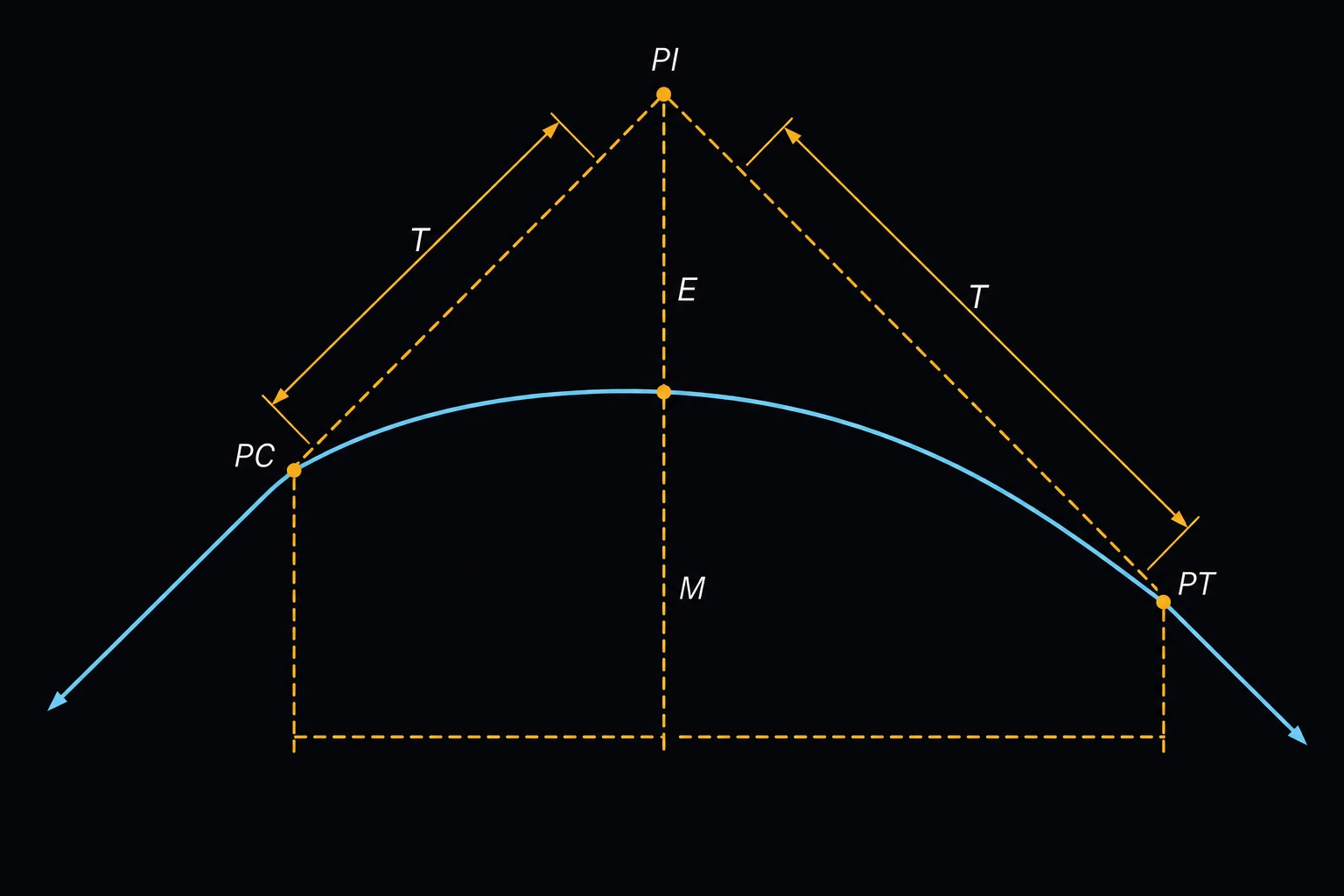
Horizontal Curve Geometry
Gives the layout dimensions of a simple circular curve joining two straight tangents of a road, railroad or pipeline alignment. Enter the radius or the degree of curve and the deflection angle between the tangents. The page gives the tangent distance, curve length, long chord, middle ordinate and external distance. Highway designers and surveyors use these to set out the curve and to place the PC (point of curvature) and PT (point of tangency) along the line.
Equations
T = R·tan(Δ/2)
L = R·Δ
LC = 2R·sin(Δ/2)
M = R·(1 − cos(Δ/2))
E = R·(1/cos(Δ/2) − 1)
Da = 5729.578 / Rft
R is the radius and Δ the deflection angle, the change in direction between the two tangents, which equals the central angle of the arc (in radians in L = R·Δ) [1][2]. T is the distance from the PI (point of intersection of the tangents) back to the PC and on to the PT. L is the length along the arc, LC the straight chord from PC to PT, M the offset from the middle of the chord to the middle of the arc, and E the distance from the PI to the middle of the arc. Da is the degree of curve, arc definition: the central angle that a 100 ft arc subtends, used on US highways [2]. Rft is the radius in feet; the page converts it to meters.
Limits and common mistakes
- The page covers a simple circular curve only. Spiral transitions and compound or reverse curves need their own geometry.
- Railroads often use the chord definition of degree of curve (100 ft chord), which gives a slightly different radius. Enter the radius directly in that case.
- Δ is the deflection between the tangents, not the angle at the PI between them. They add to 180°.
- Stations follow the arc: PT station = PC station + L, not PI station + T.
- M is what limits sight distance past an obstruction on the inside of the curve; E is how far the arc pulls away from the PI.
Worked example
A county road alignment turns 36° at a PI. The design calls for a 4° curve (arc definition). The survey crew needs the tangent distance to set the PC and PT, and the curve length to station them.
- Choose Curve Defined By Degree of curve (arc definition, Da).
- Enter Degree of Curve (Da, degrees per 100 ft arc) 4 and Deflection Angle (Δ, degrees) 36, and press Solve. The Solution shows:
Radius R: 436.594 m
Degree of curve (arc def.): 4 deg
Tangent distance T: 141.858 m
Curve length L: 274.32 m
Long chord LC: 269.83 m
Middle ordinate M: 21.3684 m
External distance E: 22.4681 m
Check by hand. A 4° curve turns 4° every 100 ft of arc, so 36° takes 900 ft = 274.32 m of arc. Its radius is 5729.58/4 = 1,432.39 ft = 436.59 m, and T = 436.59 × tan 18° = 436.59 × 0.3249 = 141.86 m. As a cross-check, M = E·cos(Δ/2) = 22.468 × 0.9511 = 21.368 m.