HVAC Sensible, Latent & Total Heat
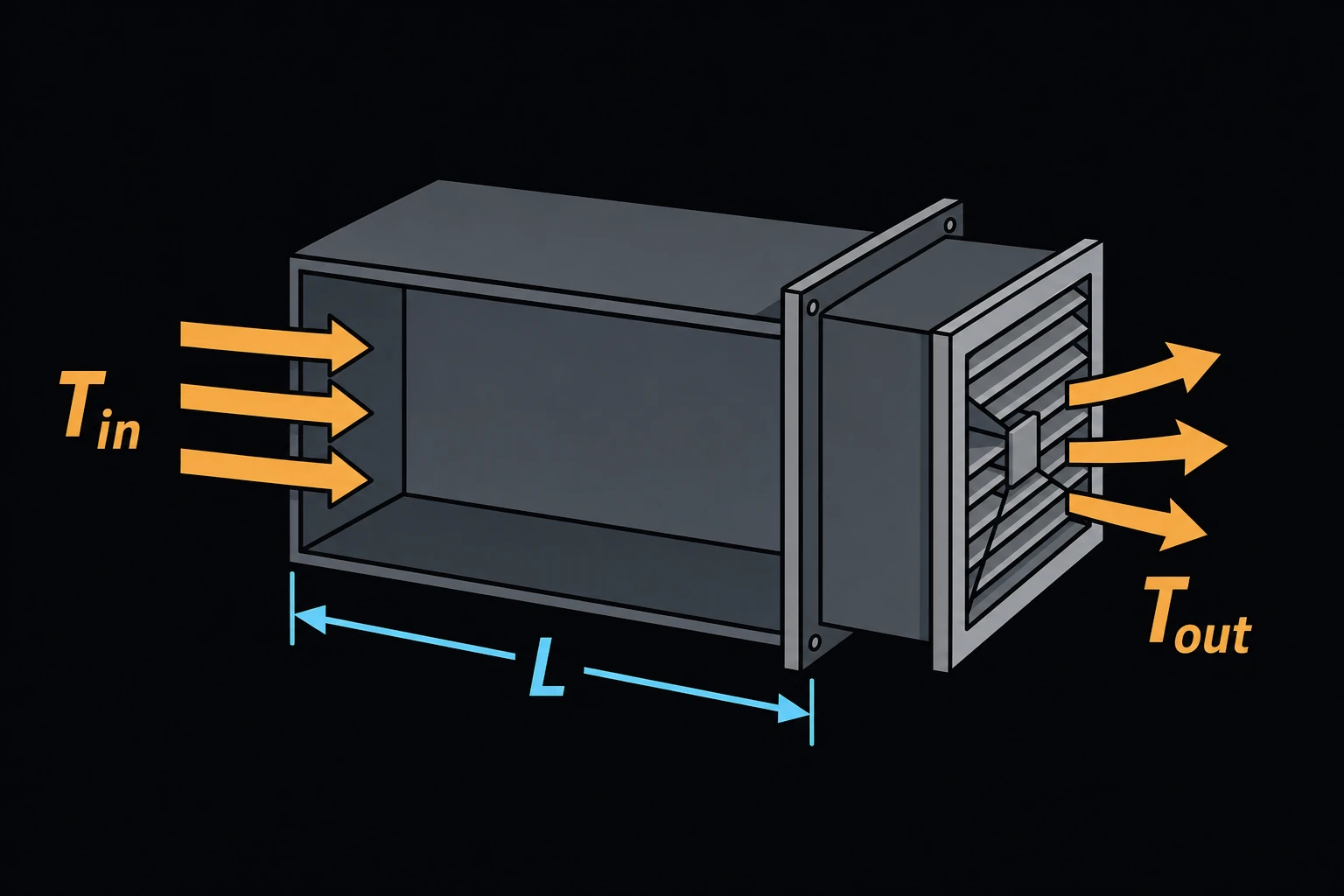
Finds the heat an airflow gains or loses as it passes through a coil, a heater or a room. Sensible heat changes the air’s temperature, latent heat its moisture content, and total heat its enthalpy [1]. HVAC designers use it to size coils and check equipment capacity.
Equations
qs = ρ·Q·cp·ΔT
qL = ρ·Q·hfg·(W1 − W2)
qt = ρ·Q·(h1 − h2)
Q is the volumetric airflow and ρ the air density, so ρ·Q is the mass flow of air. cp is the specific heat of the air and ΔT its temperature change. W1 and W2 are the entering and leaving humidity ratios, the mass of water vapor per mass of dry air. hfg is the latent heat of water vapor, 2501 kJ/kg by default [1]. h1 and h2 are the entering and leaving enthalpies. The Sensible + latent mode adds qs and qL to give qt, and the sensible heat ratio SHR = qs/qt, which a cooling coil must match.
Pick an Air preset to fill in ρ and cp. The dry-air presets are at 20 °C and the standard-atmosphere pressure for the site elevation [1]; the hot-air presets come from [3]. Higher sites have thinner air, so the same airflow carries less heat.
Limits and common mistakes
- Use the density of the air where Q is measured. Supply air at 13 °C is denser than return air at 24 °C.
- With latent heat, every change is entering minus leaving, so a positive result is heat removed, as in cooling. A negative latent load means the air gained moisture.
- Enter humidity ratios and enthalpies read from a psychrometric chart, not relative humidity.
- The SHR is defined only when both loads are removed from the air.
Worked example
A cooling coil at a sea-level site handles 2000 CFM. Air enters at 26.7 °C with W = 11.1 g/kg and leaves at 13.9 °C with W = 9.3 g/kg. What load must the coil carry?
- Choose Heat to Calculate Sensible + latent — total and sensible heat ratio, and enter Airflow Rate 2000 CFM.
- Choose Air Dry air, 20°C, sea level. The density fills in as 1.204 kg/m³ and cp as 1006 J/(kg·K).
- Enter Temperature Drop 12.8 °C, Entering Humidity Ratio 11.1 g/kg and Leaving Humidity Ratio 9.3 g/kg. Keep hfg at 2501 kJ/kg and press Solve. The Solution shows, among other rows:
Sensible Heat Load (qs): 14.6338 kW
Latent Heat Load (qL): 5.11607 kW
Total Heat Load (qt): 19.7499 kW
Sensible Heat Ratio (SHR = qs/qt): 0.740957
Total heat (tons): 5.61579 ton
Check with the US rules of thumb: qs = 1.08 × CFM × ΔT(°F) = 1.08 × 2000 × 23.04 = 49,800 BTU/hr, against the page’s 49,932.7. qL = 4840 × CFM × ΔW = 4840 × 2000 × 0.0018 = 17,400 BTU/hr, against 17,456.7.