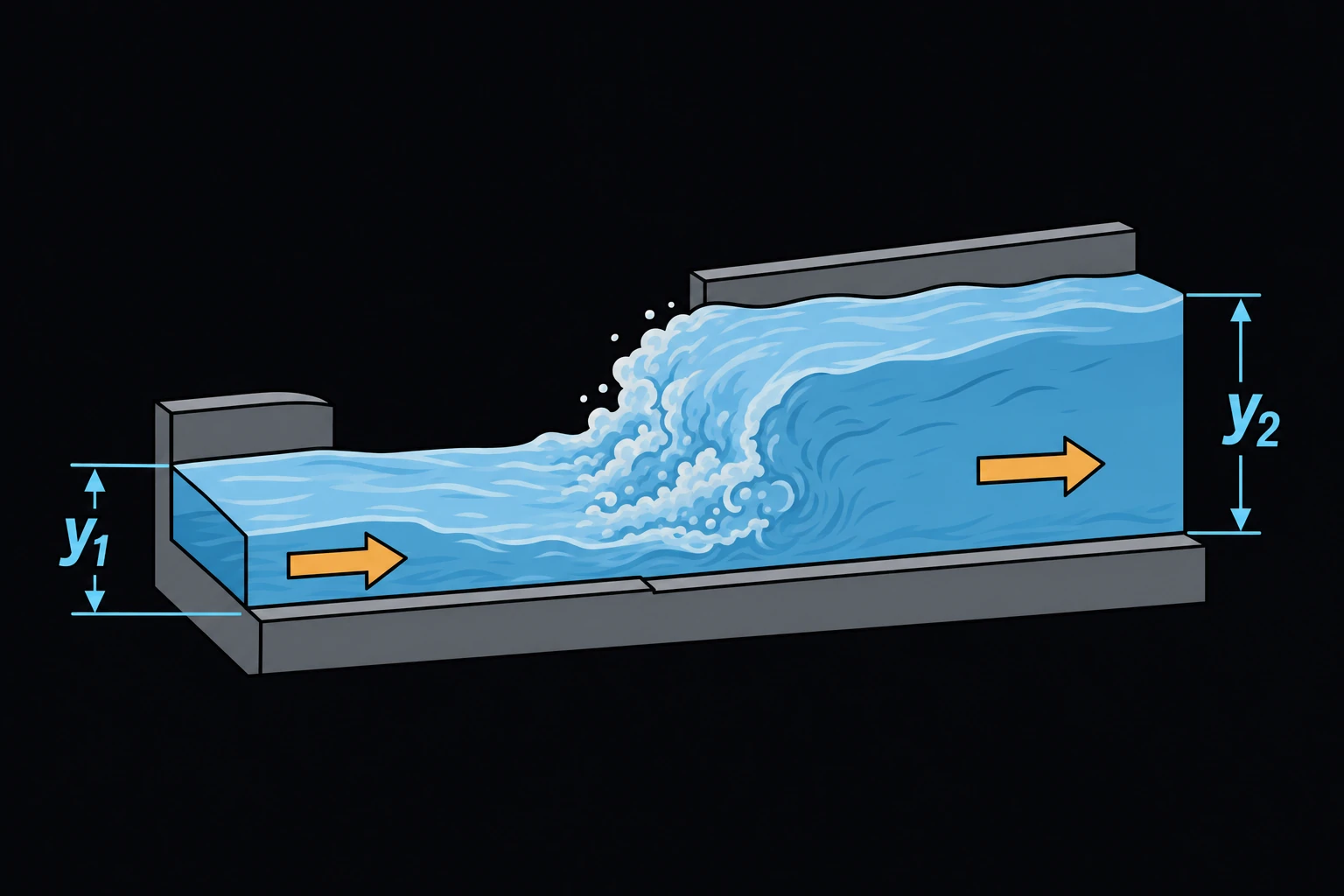
Hydraulic Jump (Rectangular Channel)
A hydraulic jump forms where fast, shallow (supercritical) flow suddenly turns into slow, deep (subcritical) flow, in a turbulent roller that burns off energy. This page takes the depth and velocity entering the jump in a rectangular channel and gives the depth after it, the energy lost, the jump type and its rough length. Engineers use it to design stilling basins below spillways, gates and steep chutes.
Equations
Fr1 = V1 / √(g·y1)
y2 = (y1/2)·(√(1 + 8·Fr1²) − 1)
ΔE = (y2 − y1)³ / (4·y1·y2)
y1 and V1 are the depth and mean velocity entering the jump, y2 the sequent (conjugate) depth after it, and g = 9.80665 m/s². Fr1 is the upstream Froude number. The sequent-depth equation comes from momentum balance across the jump on a flat, frictionless bed [1][2]. The flow per unit width is the same on both sides, so V2 = V1·y1/y2. ΔE is the specific energy lost in the jump, and the efficiency is E2/E1, with E = y + V²/2g. The length is taken as about 6y2 [3]. The jump type follows Fr1 [1]: undular below 1.7, weak to 2.5, oscillating to 4.5, steady to 9 and strong above.
Limits and common mistakes
- The channel must be rectangular, with a level or nearly level bed. Sloping beds, trapezoidal sections and basins with chute blocks or baffles change the result.
- y1 must be the depth right where the jump starts, usually the lowest depth at the toe of the spillway or under the gate. Friction along a long apron makes the flow deeper and slower before it jumps.
- A jump forms only if the tailwater depth matches y2. With less tailwater the jump moves downstream, off the apron; with more it drowns.
- Oscillating jumps (Fr1 2.5 to 4.5) send waves downstream and are hard to contain. Designers try to avoid that range [3].
- The length is approximate. Use the USBR basin curves for a final design [3].
Worked example
Water leaves the toe of a small dam spillway 0.25 m deep at 12 m/s, onto a flat rectangular apron. How deep must the tailwater be to hold a jump on the apron, and how long should the stilling basin be?
- Enter Upstream (supercritical) Depth (y1) 0.25 m.
- Enter Upstream Velocity (V1, m/s) 12 and press Solve. The Solution shows:
Upstream Froude number Fr1: 7.66392
Sequent depth y2: 2.58749 m
Downstream velocity V2: 1.15943 m/s
Downstream Froude number Fr2: 0.230167
Specific energy loss ΔE: 4.93593 m
Jump efficiency E2/E1: 0.349847
Approx. jump length (≈6·y2): 15.5249 m
Jump classification: Steady jump
Check by momentum. Per meter of width, q = 0.25 × 12 = 3 m²/s, and a jump must satisfy q²/g = y1·y2·(y1 + y2)/2. The left side is 9/9.807 = 0.9177; the right is 0.25 × 2.587 × 2.837 / 2 = 0.9177. In energy terms, E1 = 0.25 + 144/19.61 = 7.59 m and E2 = 2.587 + 0.069 = 2.66 m, so the jump removes 4.94 m, about two thirds of the energy. The tailwater needs to be about 2.6 m deep, and the basin about 15.5 m long.