Hydronic Heat Transfer
Relates the heat a hydronic (water) loop carries to its flow rate and its supply–return temperature difference. Give any two and it finds the third, in BTU/hr, kW and tons. HVAC designers use it to set the flow through a coil, boiler, chiller or heat exchanger, and technicians use it to check a coil’s load from a measured flow and temperatures.
Equation
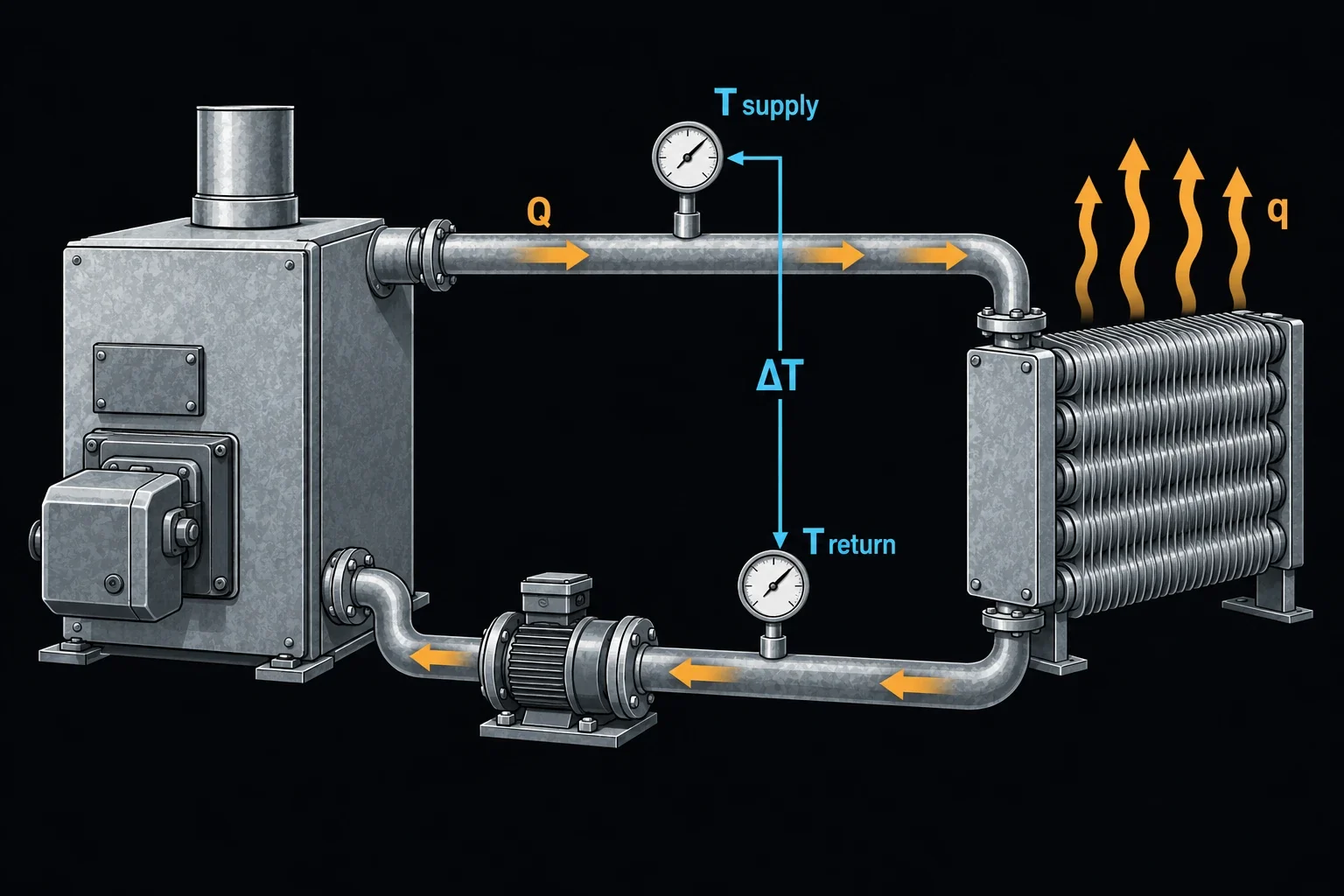
q = ρ·Q·cp·ΔT
q is the heat transfer rate, Q the volume flow rate and ΔT the difference between the supply and return temperatures. ρ is the fluid density and cp its specific heat, so ρ·Q is the mass flow rate ṁ [1]. For water near 60 °F this is the familiar rule
q [BTU/hr] = 500 × GPM × ΔT [°F]
where 500 = 8.33 lb/gal × 60 min/hr × 1 BTU/(lb·°F). The page uses ρ and cp instead of the constant 500, so it stays right for hot water and for other fluids.
Picking a water temperature under Fluid fills in ρ and cp from the IAPWS properties of water [2]. Pick the loop’s mean temperature. For a glycol mixture, choose Custom and enter the density and specific heat from the glycol maker’s data. One ton of refrigeration is 12,000 BTU/hr.
Limits and common mistakes
- ΔT is a difference: 10 °C is 18 °F, not 50 °F.
- A glycol mixture carries less heat per gallon than water, so it needs more flow for the same load. Don’t use the water presets for it.
- The equation gives sensible heat in the liquid only. It says nothing about whether the coil or heat exchanger can actually transfer that heat at those temperatures.
- A loop that runs at a lower ΔT than its design value (the “low ΔT syndrome” of chilled-water plants) needs more flow and pump power for the same load.
Worked example
A chilled-water coil must remove 30 tons, with water supplied at 44 °F and returned at 56 °F. What flow does the coil need?
- Choose Solve For Flow rate (Q).
- Choose Fluid Water, 10°C (50°F), the loop’s mean temperature. The density and specific heat fill in as 999.7 kg/m³ and 4196 J/(kg·K).
- Enter Supply–Return Temperature Difference 12 °F and Heat Transfer Rate 360000 BTU/hr.
- Press Solve. The Solution shows:
Heat Transfer Rate (q, SI): 105.506 kW
Heat Transfer Rate (tons): 30 ton
Flow Rate (Q): 59.7998 GPM
Flow Rate (Q, SI): 3.77278 L/s
Mass Flow Rate (ṁ, US): 29,934.2 lb/hr
Check with the rule of 500: 360,000 / (500 × 12) = 60 GPM, or 2 GPM per ton at a 12 °F rise. The page’s value is 0.3 % lower because water at 50 °F is a little denser, and holds a little more heat per pound, than the 8.33 lb/gal and 1 BTU/(lb·°F) behind the 500.