Pipe Sizing & Pressure Drop (Hydronic)
Sizes the piping of a hot- or chilled-water system. It checks every standard size of Schedule 40 steel pipe [2] or Type L or M copper tube [3] at your flow, recommends the smallest one inside ASHRAE’s usual limits [1], and gives the head loss and pressure drop of the run. HVAC designers use it to lay out mains and branches and to find the head a pump must supply.
Equations
hf = f·(L/D)·V²/(2g) 1/√f = −2·log10(ε/(3.7D) + 2.51/(Re·√f))
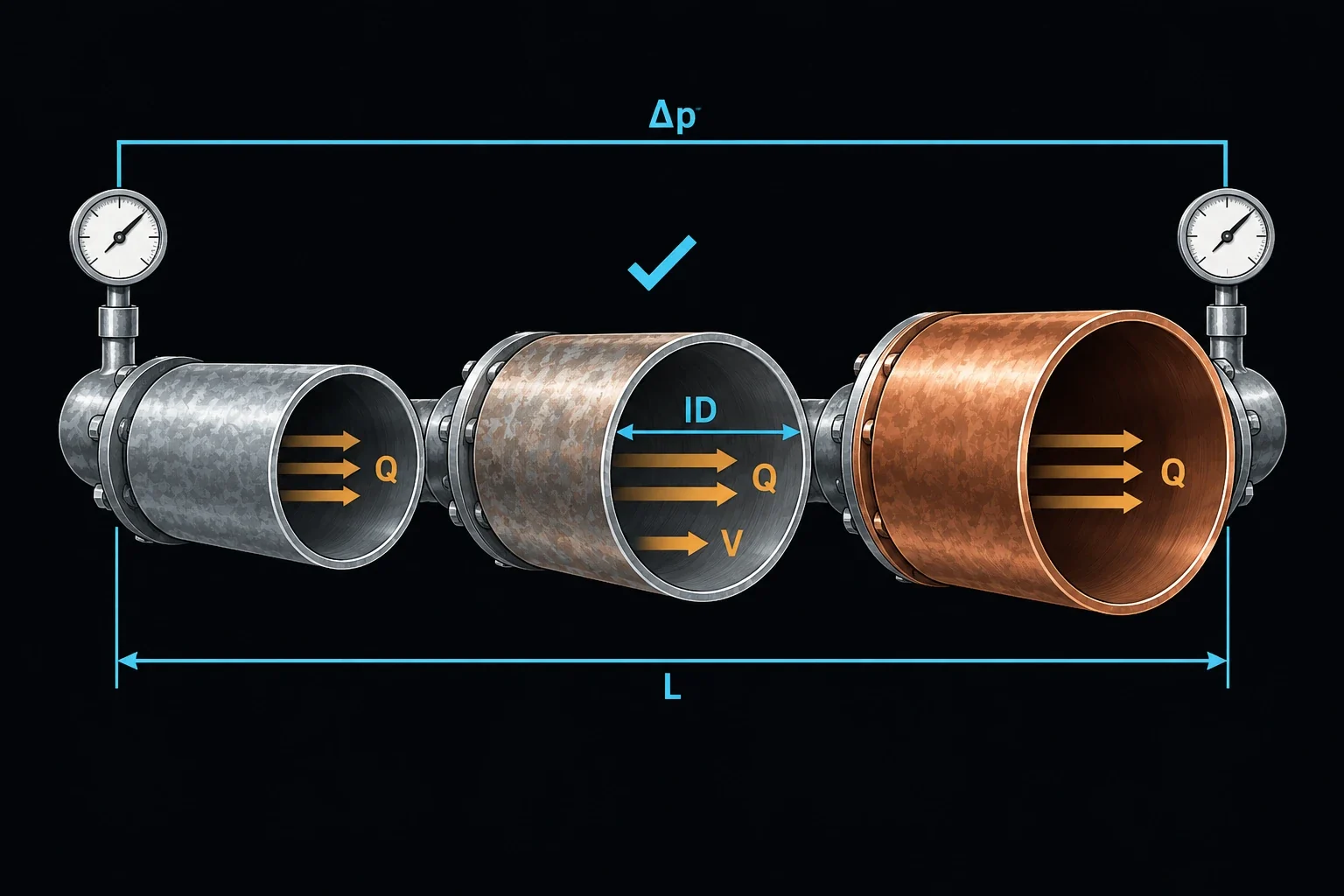
hf is the friction head loss over a length L of pipe with inside diameter D, V = 4Q/(πD²) the mean velocity for a flow Q, and g the acceleration of gravity. f is the Darcy friction factor from the Colebrook equation [5], with ε the pipe roughness (0.045 mm for steel, 0.0015 mm for drawn copper [4]) and Re = ρVD/μ the Reynolds number. ρ and μ are the fluid’s density and viscosity; picking a water temperature fills them in [6], [7]. The pressure drop is Δp = ρ·g·hf.
A size passes if it meets the limit for its size range [1]: a velocity of at most 4 ft/s for 2 in. and smaller, where noise and erosion govern, and a friction loss of at most 4 ft of head per 100 ft for larger pipe, where pumping cost governs. Both limits can be changed. A friction loss in head per 100 of length is the same in feet per 100 ft and meters per 100 m.
The friction limit is a head loss per 100 ft of pipe. Because it is a ratio of lengths, it is the same number in meters per 100 m.
Limits and common mistakes
- L is the equivalent length: the straight pipe plus the equivalent length of each elbow, tee and valve. A run with many fittings can easily be 1.5 times its measured length.
- Take the fluid at the loop’s mean temperature. Cold water is more viscous, so it loses more head than hot water at the same flow.
- For glycol, choose Custom and enter the mixture’s density and viscosity. Glycol is much more viscous than water.
- The head loss is for clean new pipe. Old steel pipe is rougher, so allow a margin.
Worked example
A chilled-water main carries 120 GPM at about 50 °F in Schedule 40 steel. Its run is 250 ft long, fittings included. Pick the pipe size and find the head the pump must overcome in this run.
- Enter Flow Rate 120 GPM and choose Fluid Water, 10°C (50°F).
- Choose Pipe Material Steel pipe, Schedule 40, and leave both limits at 4.
- Enter Equivalent Length of the Run 250 ft and press Solve. The Solution shows:
Recommended Size: 3 in. Schedule 40
Inside Diameter: 3.06772 in
Velocity (V): 5.20883 ft/s
Friction Loss (per 100 ft): 3.42728 ft/100 ft
Head Loss over the Run: 8.5682 ft
Pressure Drop over the Run: 3.71344 psi
Sized By: friction loss (larger than 2 in.)
The list of nearby sizes shows why: 2-1/2 in. would lose 10.17 ft per 100 ft, over the limit. Check the velocity with the rule V [ft/s] = 0.408 × GPM/d², with d in inches: 0.408 × 120/3.068² = 5.20 ft/s. And 3.43 ft per 100 ft over 250 ft is 8.57 ft of head.