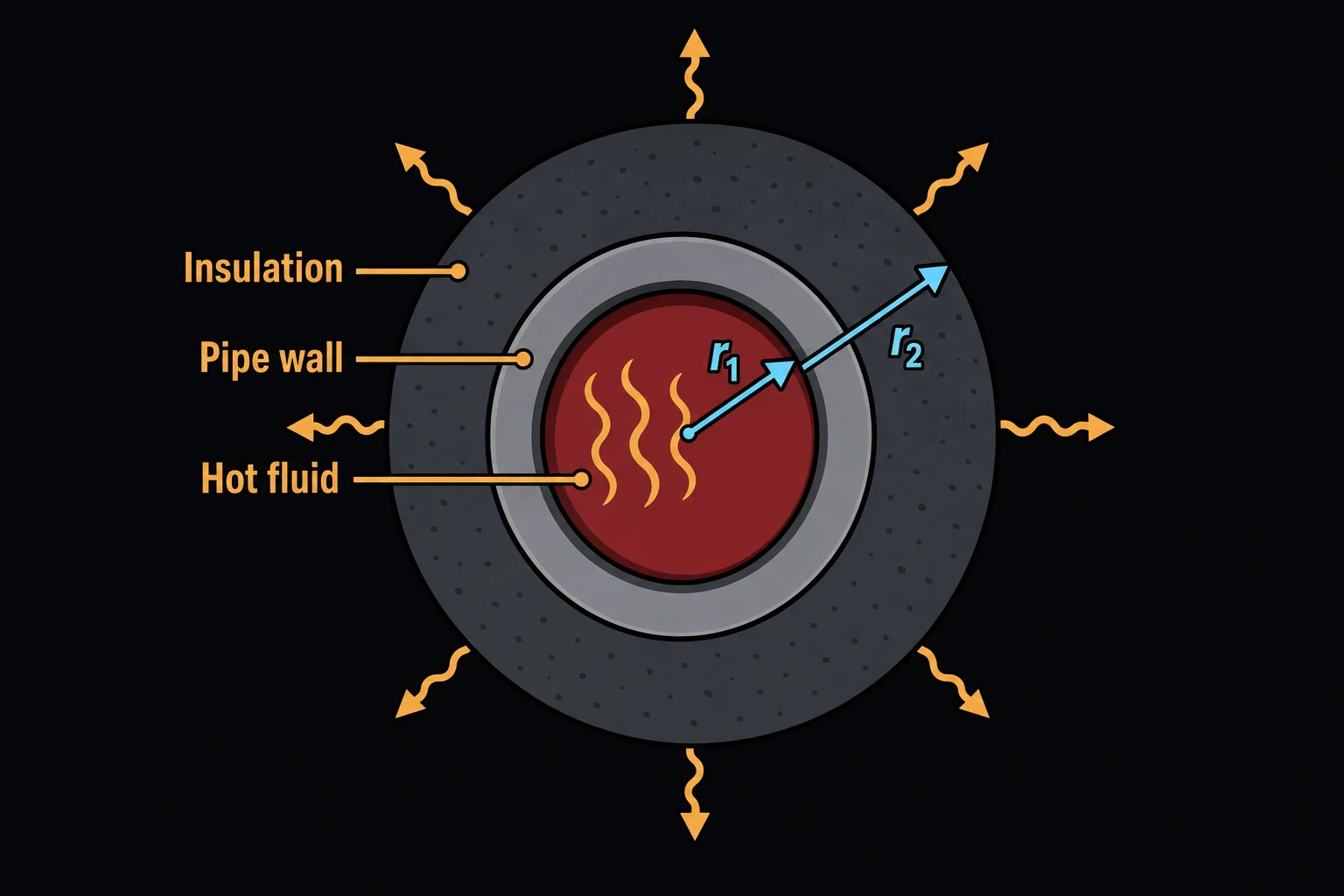
Insulated Pipe Heat Loss
Finds the steady heat loss from an insulated pipe, per meter and over a run, and the temperature of the insulation’s outer surface. Piping, process and HVAC engineers use it to choose an insulation thickness, to estimate the heat a line loses, and to check that the surface is safe to touch.
Equations
q′ = 2π·(Tpipe − Tamb) / R′
R′ = ln(r2/r1)/k + 1/(r2·h)
Ts = Tamb + q′/(2π·r2·h)
The insulation and the outside air film are two resistances in series [1], [3]. q′ is the heat loss in W per meter of pipe. r1 is the bare pipe’s outside radius and r2 = r1 + insulation thickness. k is the insulation’s thermal conductivity in W/(m·K), and h the outer surface coefficient in W/(m²·K), which lumps convection and radiation. Ts is the surface temperature. The pipe wall and the inside film are neglected, so Tpipe is the wall temperature, which is close to the fluid temperature for most liquids and steam.
Inputs
- Choosing a Pipe Size fills the outside diameter from ASME B36.10M [6].
- Choosing an Insulation fills k with the ASTM specification’s maximum conductivity at a 38 °C mean temperature [4], [5]. Conductivity rises with temperature, so for a hot pipe use the manufacturer’s value at the insulation’s actual mean temperature.
- h is about 5–10 W/(m²·K) in still indoor air and higher outdoors in wind. A shiny jacket radiates less than a dull one, which lowers h.
Limits and common mistakes
- Enter the bare pipe diameter, not the insulated one. The page adds the thickness itself.
- Below the critical radius k/h, thin insulation adds more outer surface than resistance and increases the loss [1]. With common insulation and h, k/h is only a few mm, so this rarely matters for pipe.
- The result covers straight pipe. Valves, flanges and supports lose much more per meter unless they are insulated too.
- Wet or crushed insulation conducts far more heat than the dry value.
Worked example
A 60 m run of 4 in heating-water pipe at 80 °C passes through a 15 °C plant room. It has 40 mm of mineral fiber insulation. How much heat does the run lose?
- Choose Pipe Size NPS 4 (114.3 mm OD).
- Enter Insulation Thickness 40 mm.
- Choose Insulation Mineral fiber pipe insulation, ASTM C547. k fills in as 0.0361 W/(m·K).
- Leave Outer Surface Coefficient at 10 W/(m²·K).
- Enter Pipe Wall / Fluid Temperature 80 °C, Ambient Temperature 15 °C and Pipe Length 60 m, and press Solve. The Solution shows:
Insulation outer radius r2: 97.15 mm
Heat loss per unit length q′: 25.94 W/m
Total heat loss over L: 1,556.4 W
Insulation surface temperature: 19.2496 °C
Check by hand: ln(97.15/57.15)/0.0361 = 14.71 and 1/(0.09715 × 10) = 1.03, so q′ = 2π × 65/15.74 = 25.9 W/m. The bare pipe would lose about π × 0.1143 × 10 × 65 = 233 W/m, so the insulation saves about 89 %.