Inverter Sizing
Finds the smallest continuous and surge power ratings an inverter needs to run a set of AC loads from a battery or solar system. Use it when choosing an inverter for an off-grid cabin, RV, boat, work truck or backup power system.
Equations
Pcont = Prun·(1 + m/100) Psurge = max(Pstart, Pcont)
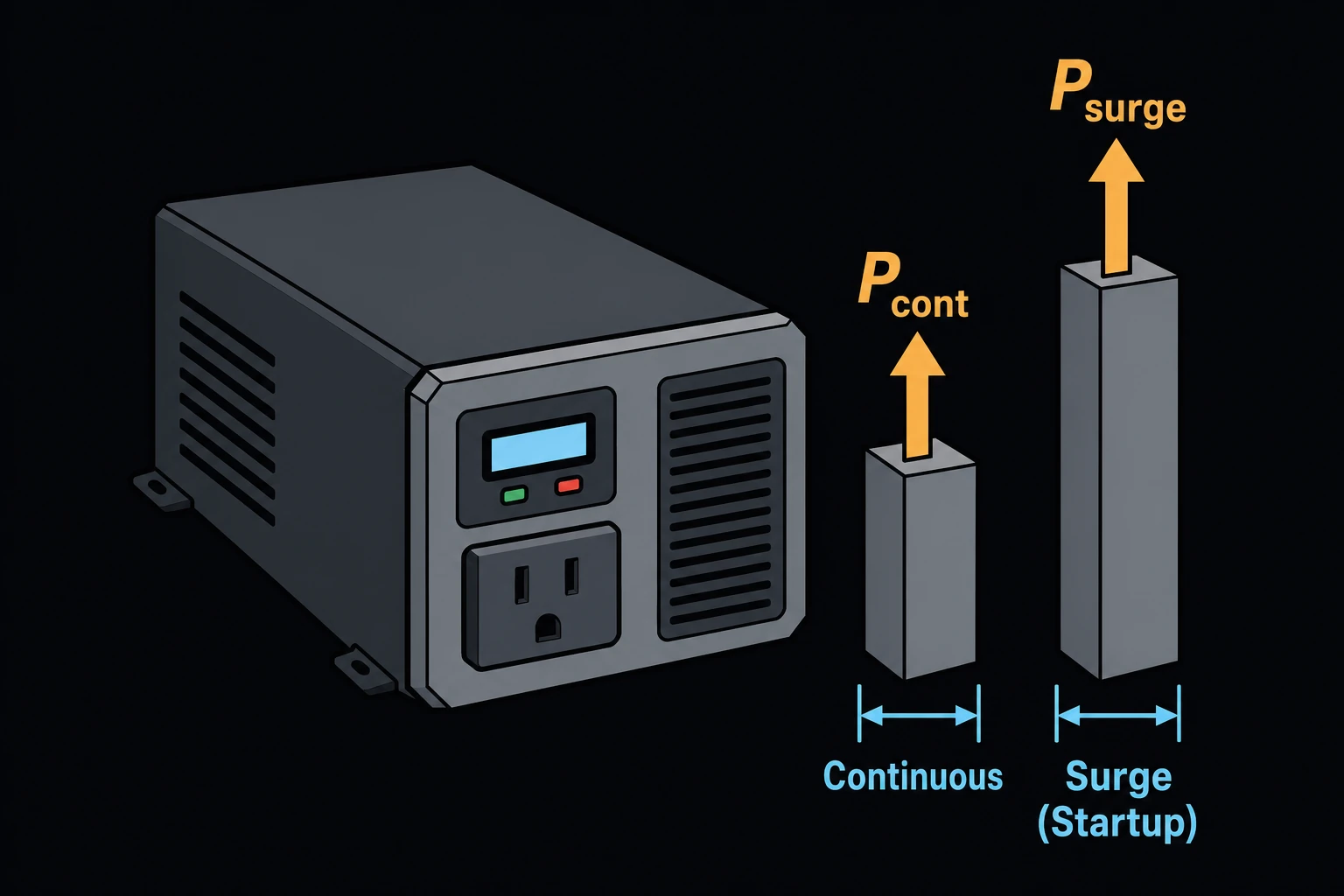
Prun is the continuous (running) load: the total power, in watts, of every load that can run at the same time. m is the safety margin in percent. It keeps the inverter below its full rating for long periods, where it runs hot and less efficiently, and leaves room for added loads [1]. Pcont is the minimum continuous rating to buy.
Pstart is the surge (startup) load: the highest total power drawn for a moment, while a motor or compressor starts and the other loads keep running. Motors in fridges, pumps, air compressors and power tools can draw three to seven times their running power for a fraction of a second. The inverter’s surge rating must cover that peak. Psurge is the larger of Pstart and Pcont, because a surge rating is never below the continuous one. The page does not add the margin to the surge load, so build any surge margin into Pstart.
Limits and common mistakes
- Add the starting surge of only the largest motor to the running total, unless several motors can start at once.
- Use the real power in watts. For loads listed in volt-amperes, or motors with a low power factor, check that the inverter’s VA rating also covers them.
- Surge ratings differ between makers: some hold for milliseconds, others for several seconds. Compare the duration with how long the motor takes to start.
- The inverter rating does not size the battery or cables. The DC current is roughly the AC power divided by the battery voltage and the inverter efficiency, and it is large at 12 V.
Worked example
A cabin runs a fridge, lights, a laptop and a 750 W well pump. With everything on, the running load is 1,250 W. The pump starts at about three times its running power, so the peak while it starts is 1,250 − 750 + 2,250 = 2,750 W. A 25 % margin is wanted.
- Enter Continuous (running) load 1250 W.
- Enter Surge (startup) load 2750 W.
- Enter Safety margin (%) 25 and press Solve. The Solution shows:
Minimum continuous rating: 1,562.5 W
Minimum surge rating: 2,750 W
Check by hand: 1,250 × 1.25 = 1,562.5 W, and the surge load of 2,750 W is larger than that, so it sets the surge rating. A standard 2,000 W inverter with a 4,000 W surge rating covers both. On a 12 V battery at 90 % efficiency, the 1,250 W running load draws about 1,250 / (12 × 0.9) = 116 A.