Number of Kanban Cards
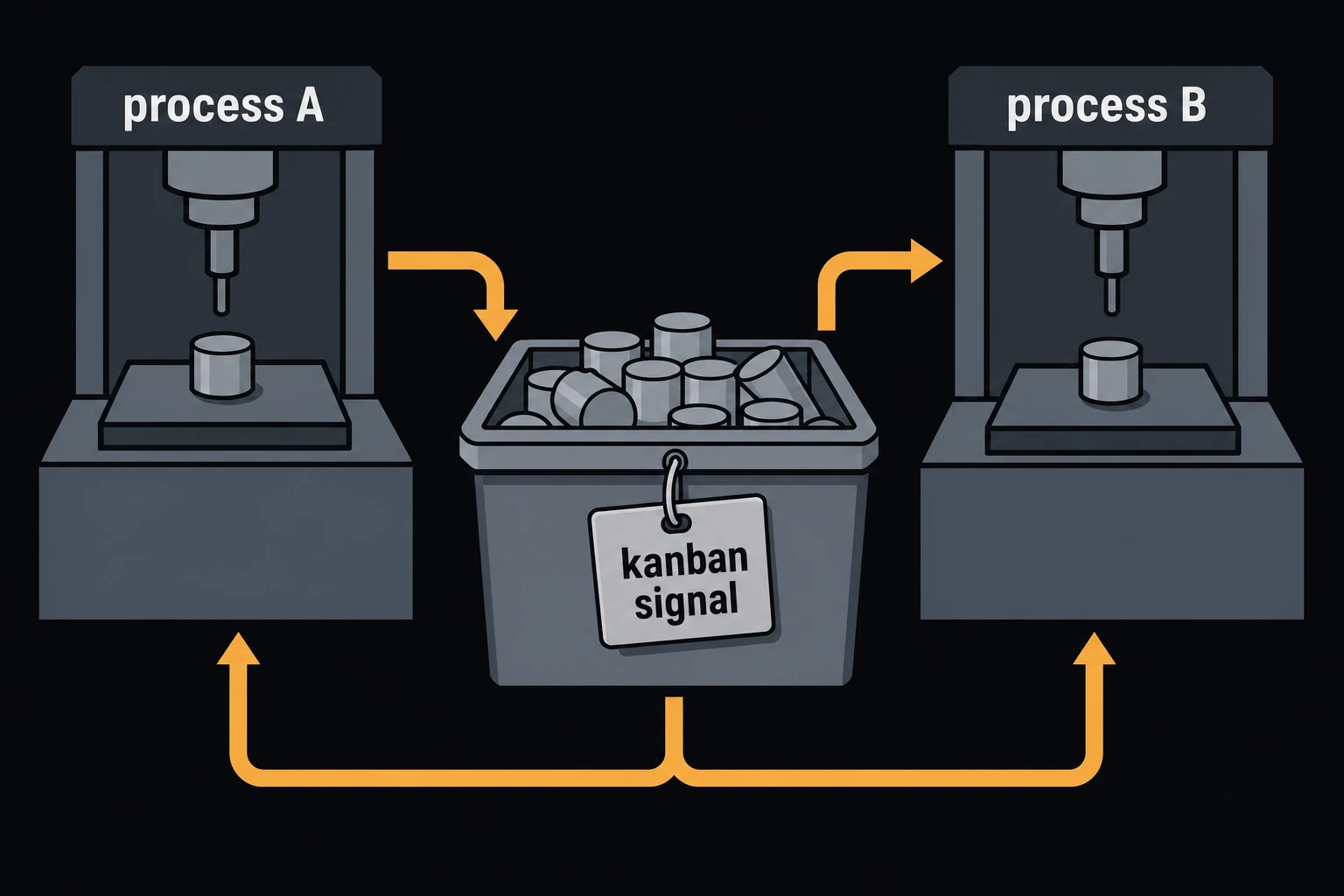
Finds how many kanban cards to put in a loop between a supplying process and the process it feeds. Each card authorizes one container of parts, so the card count caps the inventory in the loop. Lean and production engineers use it to set up a pull system and to resize it when demand or lead time changes [1].
The kanban equation
N = D·L·(1 + α) / C
N is the number of cards, D the average demand rate of the using process and L the replenishment lead time: the time from a card being released to its full container coming back. That covers the wait, the setup and the run at the supplier, and the move. C is the number of parts one container holds, and α is a safety factor that covers swings in demand and lead time (0.10 means 10 % extra) [1], [2]. The page rounds N up to whole cards, since a part card cannot circulate. The authorized work in process is the whole cards times C [3].
D·L, the demand during the lead time, is the stock the loop must hold just to keep up. The safety factor and the rounding add the rest.
Inputs, limits and common mistakes
- Use one time unit for both demand and lead time: parts per hour with hours, or parts per day with days. The page does not convert them.
- The lead time is the whole loop, not only the run time at the supplier. Leaving out the queue and the move is the usual reason a new loop runs short.
- α is a fraction, not a percentage. Toyota practice keeps it small, often 10 % or less, and lowers it as the process steadies [1].
- The equation assumes steady demand. For a part with lumpy or seasonal demand, size the loop for the peak period or use reorder-point stock instead.
- Fewer, larger containers mean fewer cards but more stock. Check the authorized work in process, not just the card count.
Worked example
A weld cell uses 60 brackets an hour from a press. A card takes 2.5 hours to go round the loop, and the brackets travel in totes of 24. The team wants a 15 % margin.
- Enter Average Demand Rate (units per time unit) 60 and Replenishment Lead Time (same time unit) 2.5.
- Enter Safety Factor (α, e.g. 0.20 = +20%) 0.15 and Container / Lot Capacity (units per card) 24.
- Press Solve. The Solution shows:
Kanban cards (exact): 7.1875
Kanban cards required: 8
Authorized WIP between the processes: 192 units
Demand during lead time: 150 units
Check: 60 × 2.5 = 150 brackets during the lead time, × 1.15 = 172.5, and 172.5 / 24 = 7.19 totes, so 8 cards. Eight totes hold 192 brackets, a little over three hours of the cell’s use.