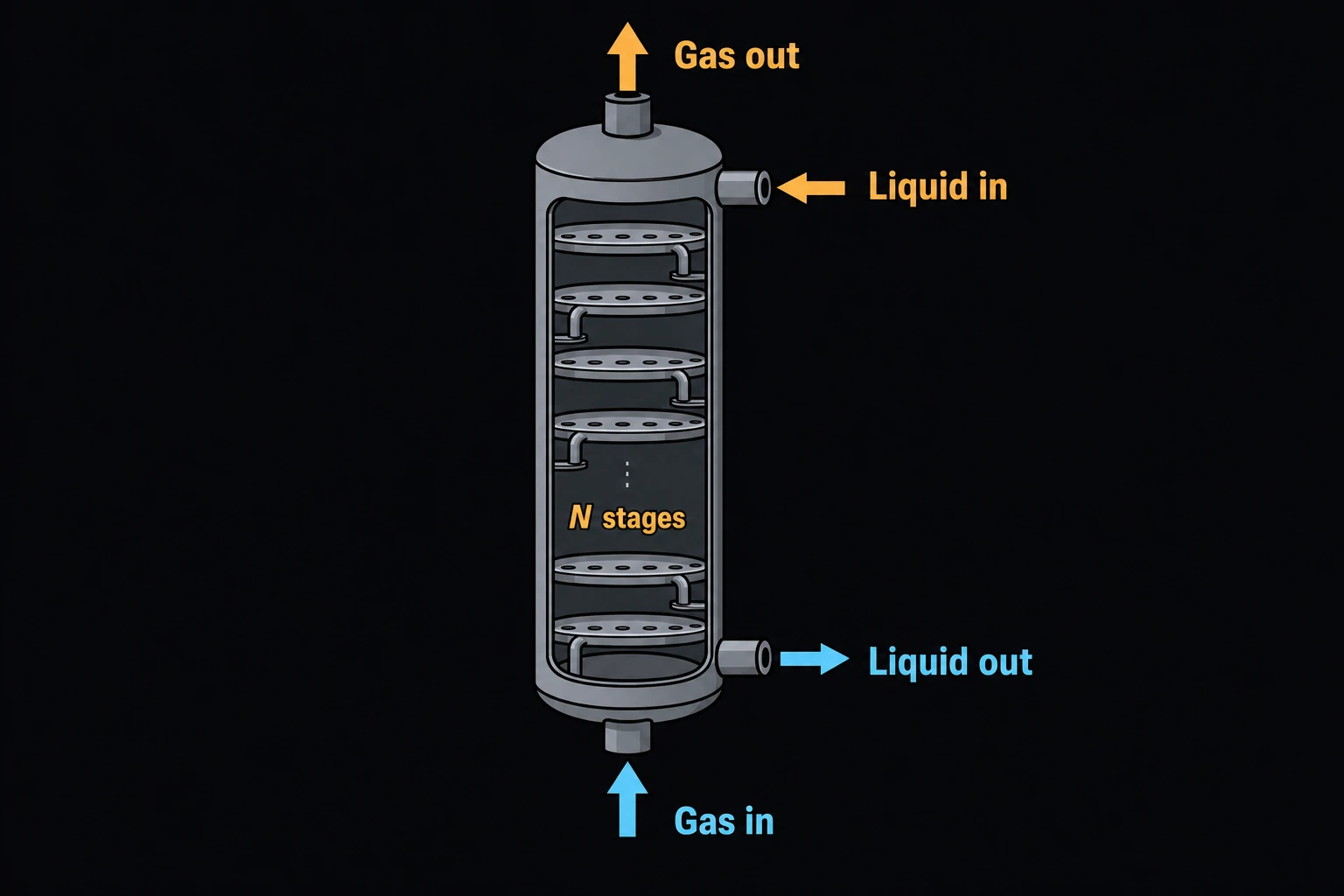
Absorber / Stripper Stages (Kremser)
Sizes a countercurrent gas absorber with the Kremser equation. It finds either the number of equilibrium stages needed to absorb a target fraction of a solute, or the fraction absorbed by a set number of stages. Process engineers use it to screen solvent rates and column heights for scrubbers and absorbers.
Equations
A = L / (m·G)
f = (AN+1 − A) / (AN+1 − 1)
N = ln[(1 − 1/A)/(1 − f) + 1/A] / ln A
A is the absorption factor. L is the solvent molar flow and G the gas molar flow, both in kmol/h (only their ratio matters). m is the slope of the equilibrium line y = m·x, with y and x the solute mole fractions in the gas and the liquid. f is the fraction of the entering solute that the solvent absorbs, and N is the number of equilibrium (theoretical) stages [1], [2]. When A = 1 the equations become f = N/(N + 1) and N = f/(1 − f) [3].
When it applies
- The solvent enters free of solute, and L, G and m stay roughly constant through the column. That holds for dilute gases (a few percent solute) and nearly isothermal operation [3], [4].
- A must exceed 1 to absorb almost all of the solute. With A < 1 the recovery can never exceed A however many stages you add, and the page says so. A of 1.25 to 2 is the usual economic range.
- For a stripper, the same equations hold with the stripping factor S = m·G/L in place of A. Enter the stripping gas flow as L, the liquid flow as G and 1/m as m; f is then the fraction stripped.
Common mistakes
- Using a Henry’s constant in pressure units as m. Divide it by the total pressure to get the mole-fraction slope.
- Reading N as real trays. Divide by a tray efficiency, or multiply by the height of a theoretical stage (HETP) for packing.
- Using the inlet gas flow when the solute is a large fraction of it. The method then needs solute-free flows or a stage-by-stage calculation.
Worked example
A scrubber must remove 98 % of a solvent vapor from 100 kmol/h of air, using 180 kmol/h of water. The equilibrium slope is m = 1.2. How many stages are needed, and what will a whole number of stages give?
- Leave Solve For on Number of stages (given target recovery).
- Enter Liquid (solvent) Molar Flow 180 kmol/h, Gas Molar Flow 100 kmol/h and Equilibrium Slope 1.2.
- Enter Target Fractional Recovery of Solute 0.98 and press Solve. The Solution shows:
Absorption factor A = L/(m·G): 1.5
Required equilibrium stages N: 7.03545
Minimum solvent check (A > 1?): Yes — absorption feasible - Round up to 8 stages. Choose Solve For Fractional recovery (given number of stages), enter Number of Equilibrium Stages 8 and press Solve:
Fractional recovery of solute: 0.986646
Fractional recovery: 98.6646 %
Check by hand: A = 180/(1.2 × 100) = 1.5. N = ln(50 × 0.3333 + 0.6667)/ln 1.5 = ln 17.33/0.4055 = 7.04. With 8 stages, 1.59 = 38.44, so f = (38.44 − 1.5)/(38.44 − 1) = 0.9866.