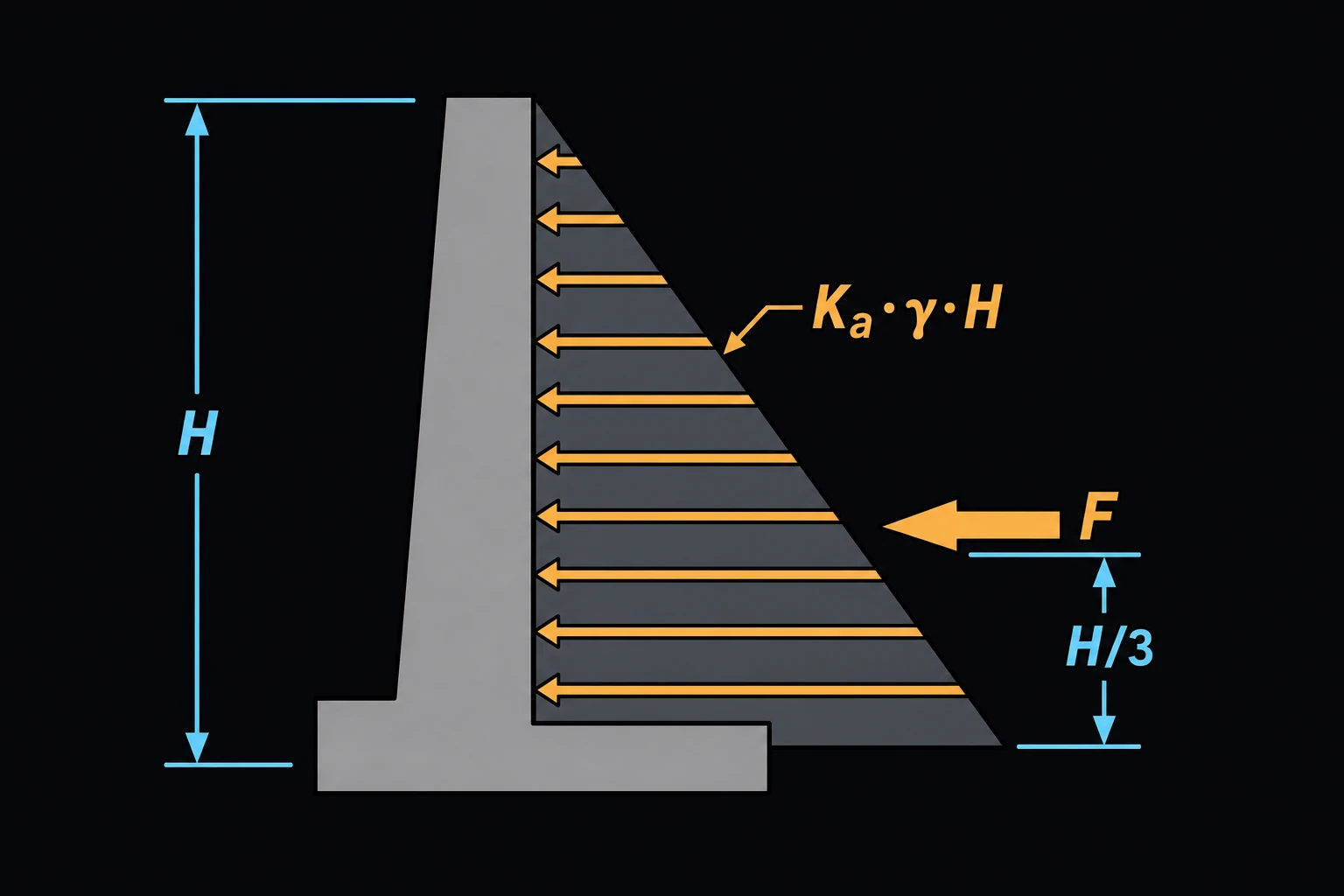
Lateral Earth Pressure (Rankine)
Finds the sideways push of soil on a retaining wall, basement wall or abutment by Rankine’s theory [1], [2]. It gives the earth-pressure coefficient, the pressure at the base, the thrust per meter of wall and the height where that thrust acts. Use it for a first check of a wall against sliding and overturning.
Equations
Ka = tan²(45° − φ/2)
K0 = 1 − sin φ
Kp = tan²(45° + φ/2)
Psoil = ½·K·γ·H² Pq = K·q·H
φ is the drained friction angle of the backfill, γ its unit weight, H the wall height and q a uniform load on the ground surface. K is the coefficient for the chosen condition. Active (Ka) applies when the wall can lean away from the soil a little, as a cantilever wall does. At-rest (K0, Jaky’s formula [2]) applies to a wall that can’t move, such as a braced basement wall. Passive (Kp) is the resistance of soil pushed by the wall. The soil pressure grows linearly from zero at the top to K·γ·H at the base, so Psoil acts at H/3. The surcharge adds a uniform K·q, so Pq acts at H/2. With a backfill slope β the active coefficient becomes Ka = cos β·(cos β − √(cos²β − cos²φ)) / (cos β + √(cos²β − cos²φ)), and β must be less than φ.
Picking a soil group fills in typical values of γ [4] and φ [3] for compacted fill. They are for preliminary design; use test results when you have them. Fine-grained soils (silt and clay) make poor backfill, and the page warns when you pick one.
Limits and common mistakes
- The soil is dry or drained and cohesionless (c′ = 0). Water behind the wall adds its own pressure, which is not included. Provide drainage or add it separately.
- With a sloped backfill, Rankine’s thrust acts parallel to the slope, at β to the horizontal. Only its horizontal part, P·cos β, pushes the wall over.
- Full passive pressure needs a large movement, often several percent of the height. Designs usually divide Kp by a safety factor or ignore the top layer of soil.
Worked example
A 3 m cantilever retaining wall holds back well-graded sand fill with a level surface. A 12 kPa surcharge allows for light traffic behind it. What thrust must the wall resist?
- Choose Condition Active (Rankine).
- Choose Soil SW. The unit weight fills in as 18.85 kN/m³ and the friction angle as 38°.
- Enter Wall Height 3 m, Surface Surcharge 12 and Backfill Slope Angle 0, and press Solve. The Solution shows:
Active coefficient Ka: 0.237883
Pressure at base (soil): 13.4526 kPa
Total thrust per metre of wall: 28.7428 kN/m
Height of resultant above base: 1.14897 m
Check by hand. Ka = tan²(26°) = 0.4877² = 0.2379. The soil gives 0.5 × 0.2379 × 18.85 × 3² = 20.18 kN/m at 1 m, and the surcharge 0.2379 × 12 × 3 = 8.56 kN/m at 1.5 m. The total is 28.74 kN/m, acting at (20.18 × 1 + 8.56 × 1.5) / 28.74 = 1.149 m above the base.