Liquid–Liquid Extraction Stages (Dilute, Immiscible)
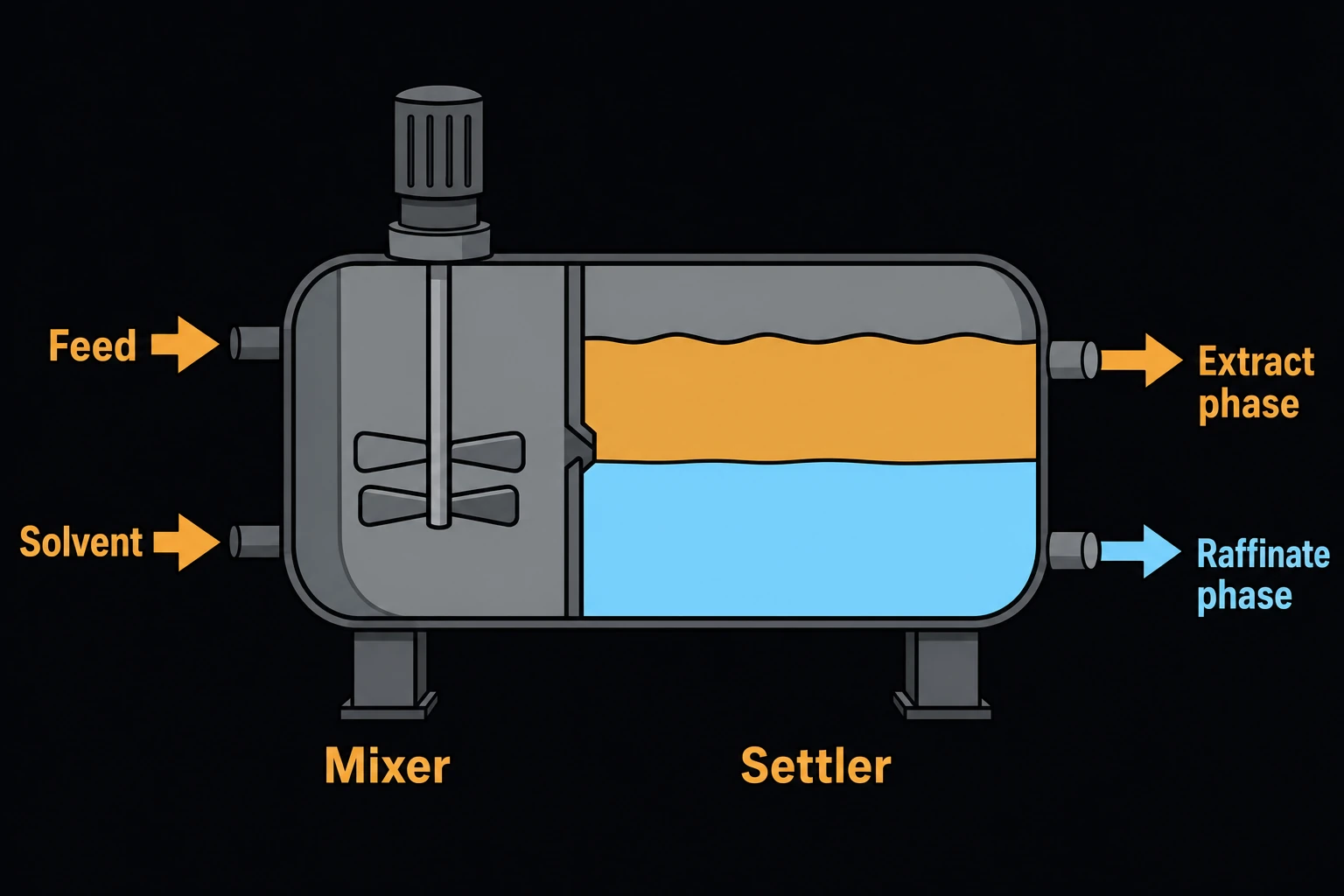
Finds the number of equilibrium stages a liquid–liquid extraction needs to recover a target fraction of a solute, or the recovery that a set number of stages gives. It covers countercurrent cascades (columns, mixer-settler trains) and cross-current cascades, where fresh solvent goes to every stage. Process engineers use it to screen solvent rates and stage counts.
Equations
E = m·S/F
Countercurrent: xr = (E − 1)/(EN+1 − 1)
Cross-current: xr = 1/(1 + E/N)N
F is the flow of the feed carrier (the raffinate phase) and S the flow of solvent (the extract phase), in kg/h. m is the distribution coefficient y = m·x, where y and x are the solute concentrations in the extract and raffinate phases, on the same basis as F and S (kg of solute per kg of solvent and per kg of carrier). E is the extraction factor, N the number of equilibrium stages, and xr the fraction of the solute left in the raffinate. The recovery is 1 − xr.
The countercurrent form is the Kremser equation [1], [2]; at E = 1 it becomes xr = 1/(N + 1). The cross-current form splits the solvent equally among the N stages [3]. For a target recovery, the page solves either equation for N, which comes out as a fraction; round it up.
Limits and common mistakes
- The method assumes a dilute solute, immiscible solvent and carrier, and constant m. For partly miscible systems, use a triangular diagram.
- The solvent is assumed to enter free of solute. Recycled solvent with some solute left in it lowers the recovery.
- With E < 1, countercurrent recovery can never exceed E. Cross-current recovery can never exceed 1 − e−E, however many stages are used. The page says so when a target is out of reach.
- A coefficient in mol/L, or one defined the other way round (raffinate over extract), gives a wrong E.
- N counts ideal stages. Allow for stage efficiency.
Worked example
A solute must be extracted from 1,000 kg/h of an aqueous stream with 1,500 kg/h of solvent, recovering 99 % of it. Lab tests give m = 1.6. How many countercurrent stages are needed, and what would a cross-current train with the same solvent give?
- Leave Configuration on Countercurrent and Solve For on Stages (given recovery).
- Enter Feed (raffinate-phase) Flow 1000 kg/h, Solvent (extract-phase) Flow 1500 kg/h and Distribution Coefficient 1.6.
- Enter Target Solute Recovery 0.99 and press Solve:
Extraction factor E = m·S/F: 2.4
Fraction of solute left in raffinate: 0.01
Required stages N: 4.6527 - Round up to 5 stages. Choose Solve For Recovery (given stages), enter Number of Stages 5 and press Solve:
Fraction left in raffinate: 0.00736443
Solute recovery into extract: 99.2636 % - Choose Configuration Cross-current (equal solvent per stage) and press Solve again:
Fraction left in raffinate: 0.140829
Solute recovery into extract: 85.9171 %
Check by hand: E = 1.6 × 1500/1000 = 2.4. For five countercurrent stages, 2.46 = 191.1, so xr = 1.4/190.1 = 0.00736. For cross-current, each stage gets E/5 = 0.48, so xr = 1/1.485 = 0.1408. Countercurrent flow makes far better use of the same solvent.