Electromagnetic Force (Lorentz)
Finds the magnetic force on a moving electric charge, or on a straight length of wire carrying current, in a uniform magnetic field. Enter the flux density and the angle between the motion (or current) and the field. Students use it for physics and electromagnetics problems, and engineers use it to estimate the force on conductors in motors, loudspeakers, busbars and particle beams.
Equations
Point charge: F = q·v·B·sinθ
Conductor: F = B·I·L·sinθ
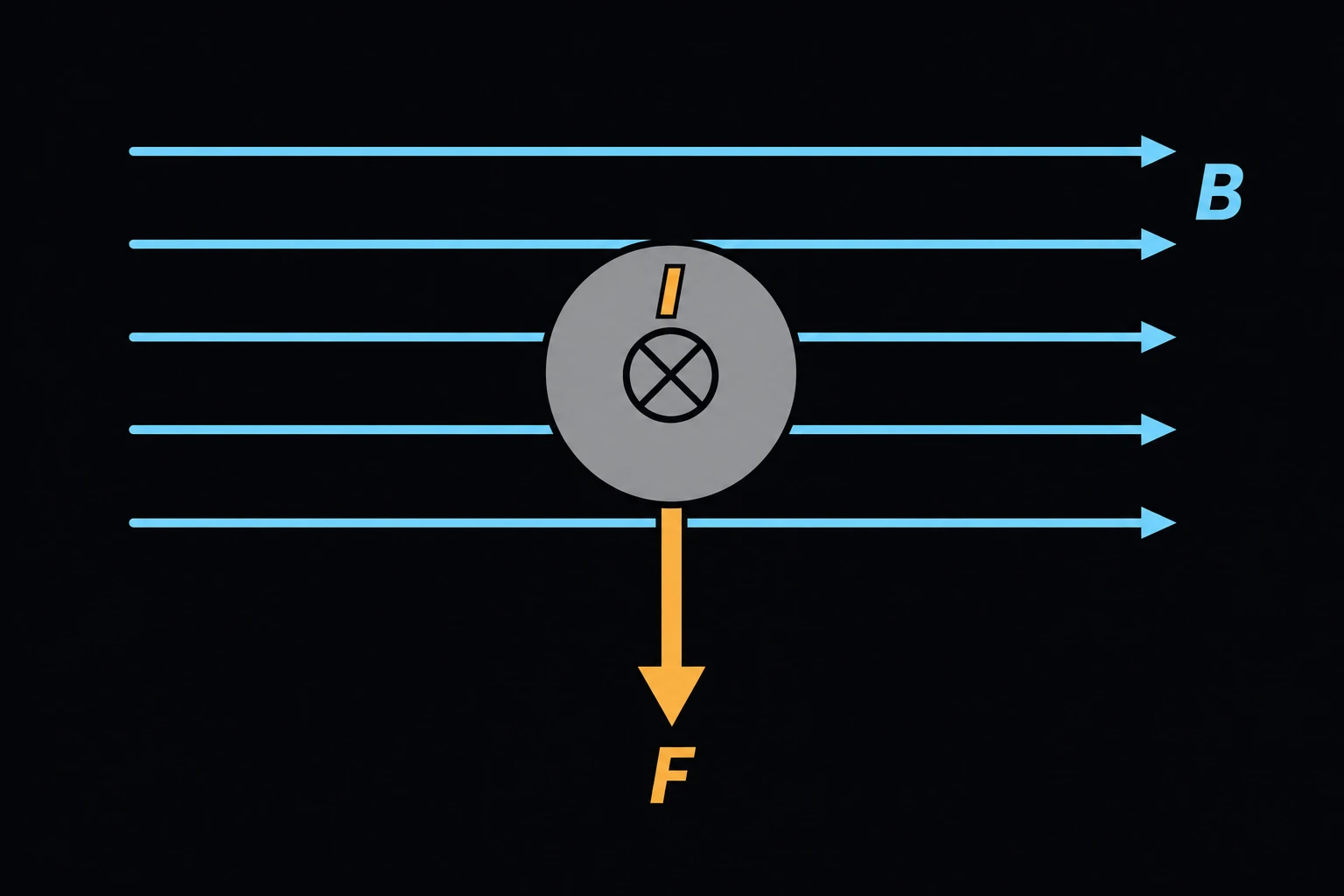
F is the force in newtons and B the magnetic flux density in tesla. q is the charge in coulombs and v its speed. I is the current in the conductor and L the length of conductor inside the field. θ is the angle between the direction of motion (or of the current) and the field [1]. The force is greatest at 90° and zero when the charge moves, or the current flows, along the field.
Both come from the Lorentz force law, F = q(v × B), with the electric field left out [1]. The force acts at right angles to both the motion and the field; find its direction with the right-hand rule. A negative charge, such as an electron, or a reversed current gives a negative result: the force points the opposite way.
Limits and common mistakes
- The field is taken as uniform along the whole length L. In a real magnet gap, use only the length inside the gap and the average B there.
- B is in tesla. 1 T is 10,000 gauss, so a 5000 G magnet is 0.5 T.
- θ is measured from the field, not from the pole face. A wire lying across a gap whose field runs straight from pole to pole is at 90°.
- For a coil, multiply by the number of turns in the field: each turn adds its own B·I·L.
Worked example
One conductor of a permanent-magnet motor lies in an air gap where B is 0.8 T. It carries 12 A, and 6 cm of it lies in the gap, at right angles to the field. Find the force on it.
- Choose Case Current-carrying conductor.
- Enter Current (I) 12 A and Conductor length (L) 6 cm.
- Enter Magnetic flux density (B, Tesla) 0.8 and Angle between v (or I) and B (θ, degrees) 90, and press Solve. The Solution shows: Force (F): 0.576 N
Check: 0.8 T × 12 A × 0.06 m = 0.576 N, and T·A·m is N. A rotor with 40 such conductors at a 25 mm radius would then give about 40 × 0.576 × 0.025 = 0.58 N·m of torque.