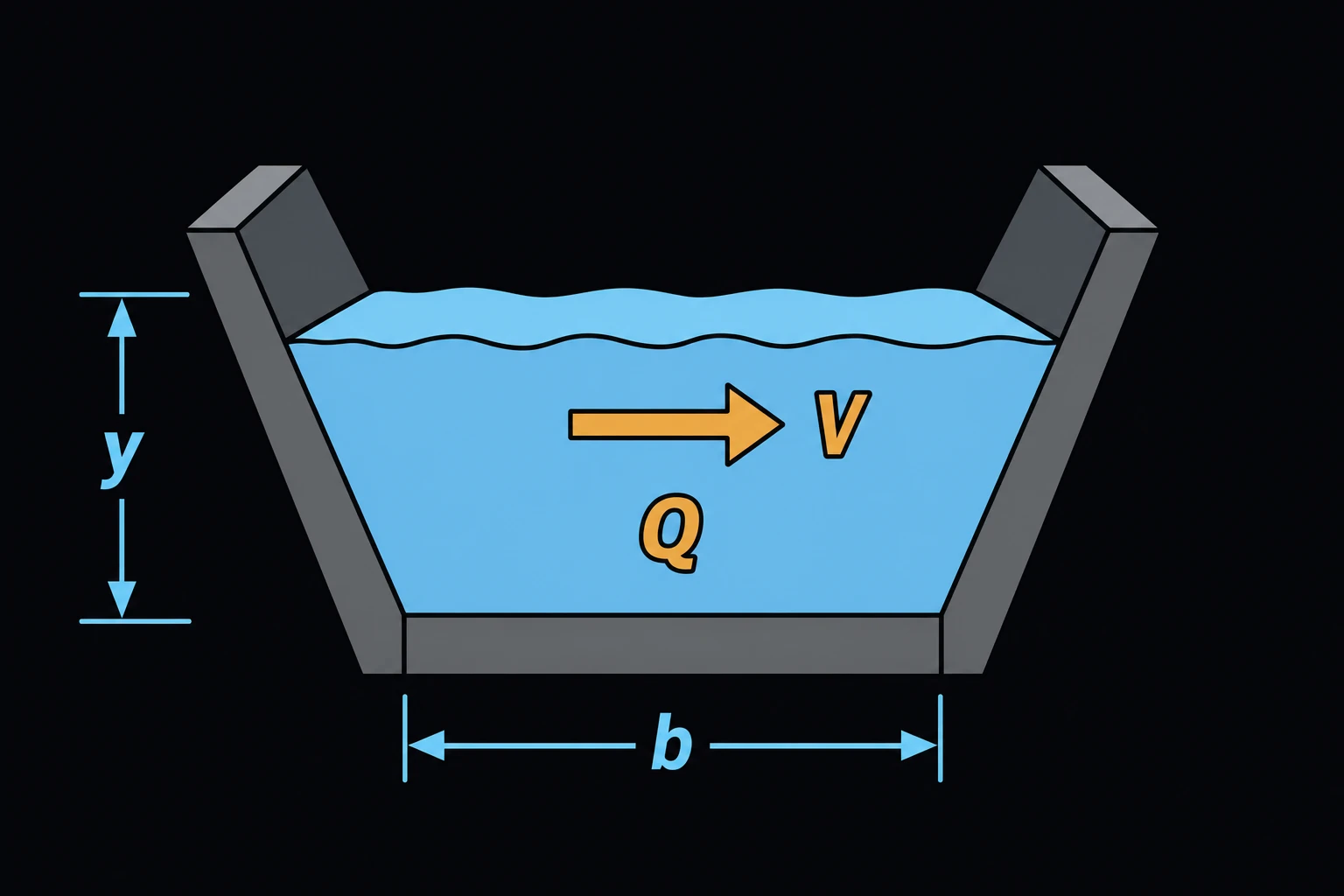
Open Channel Flow (Manning's Equation)
Finds the velocity and flow rate of steady, uniform flow in a rectangular open channel from its bottom width, flow depth, lining roughness and slope. Civil and drainage engineers use it to size ditches, flumes and lined channels, and to check how much a channel carries at a given depth.
Equations
V = (1/n)·R2/3·S1/2 Q = V·A
A = b·y P = b + 2y R = A/P
This is Manning’s equation in SI units [1], [2]. V is the mean velocity in m/s and Q the flow rate in m³/s. n is Manning’s roughness coefficient. S is the slope of the channel bed, as a ratio (m of fall per m of length). b is the bottom width and y the flow depth. A is the flow area, P the wetted perimeter (the bed and both walls, but not the water surface) and R the hydraulic radius.
Inputs
- Choosing a Channel Lining fills in Chow’s normal value of n for it [1]. The menu also shows the range of n for each lining. Use the high end for a channel that will be poorly maintained or grow weeds.
- Enter the slope as a ratio: a fall of 2 m per km is 0.002, not 0.2.
Limits and common mistakes
- The section is a rectangle: vertical walls and a flat bed. For a trapezoid, circle or natural section, work out A and P for that shape.
- Manning’s equation assumes uniform flow, so the depth is the normal depth. Near a culvert, a drop or a change of slope, the depth differs, and a backwater calculation is needed.
- The page solves for Q from a depth. To find the depth for a known flow, adjust the depth until Q matches.
- The 1/n form is SI. In US units the equation needs the factor 1.49, so don’t mix it with SI values of n and R.
Worked example
A float-finished concrete drainage flume is 1.5 m wide and laid at a slope of 0.2 %. How much does it carry when it runs 0.6 m deep?
- Enter Channel Bottom Width 1.5 m and Flow Depth 0.6 m.
- Choose Channel Lining Concrete, float finish. The roughness fills in as n = 0.015.
- Enter Channel Slope 0.002 and press Solve. The Solution shows:
Flow Area (A): 0.9 m²
Wetted Perimeter (P): 2.7 m
Hydraulic Radius (R): 0.333333 m
Flow Velocity (V): 1.43332 m/s
Flow Rate (Q): 1.28999 m³/s
Check by hand: R = 0.9/2.7 = 1/3 m, R2/3 = 0.4807 and √0.002 = 0.04472, so V = 0.4807 × 0.04472/0.015 = 1.433 m/s and Q = 1.433 × 0.9 = 1.29 m³/s. The Froude number is 1.433/√(9.81 × 0.6) = 0.59, so the flow is subcritical, as expected on a mild slope.