Material Removal Rate
Finds the material removal rate (MRR) of a turning cut: the volume of metal the tool takes off per minute. Machinists, process planners and estimators use it to compare cutting conditions, estimate roughing time and check that a cut stays within the lathe’s power. Multiply the rate by the material’s specific cutting energy to get the cutting power.
Equation
MRR = v·f·d
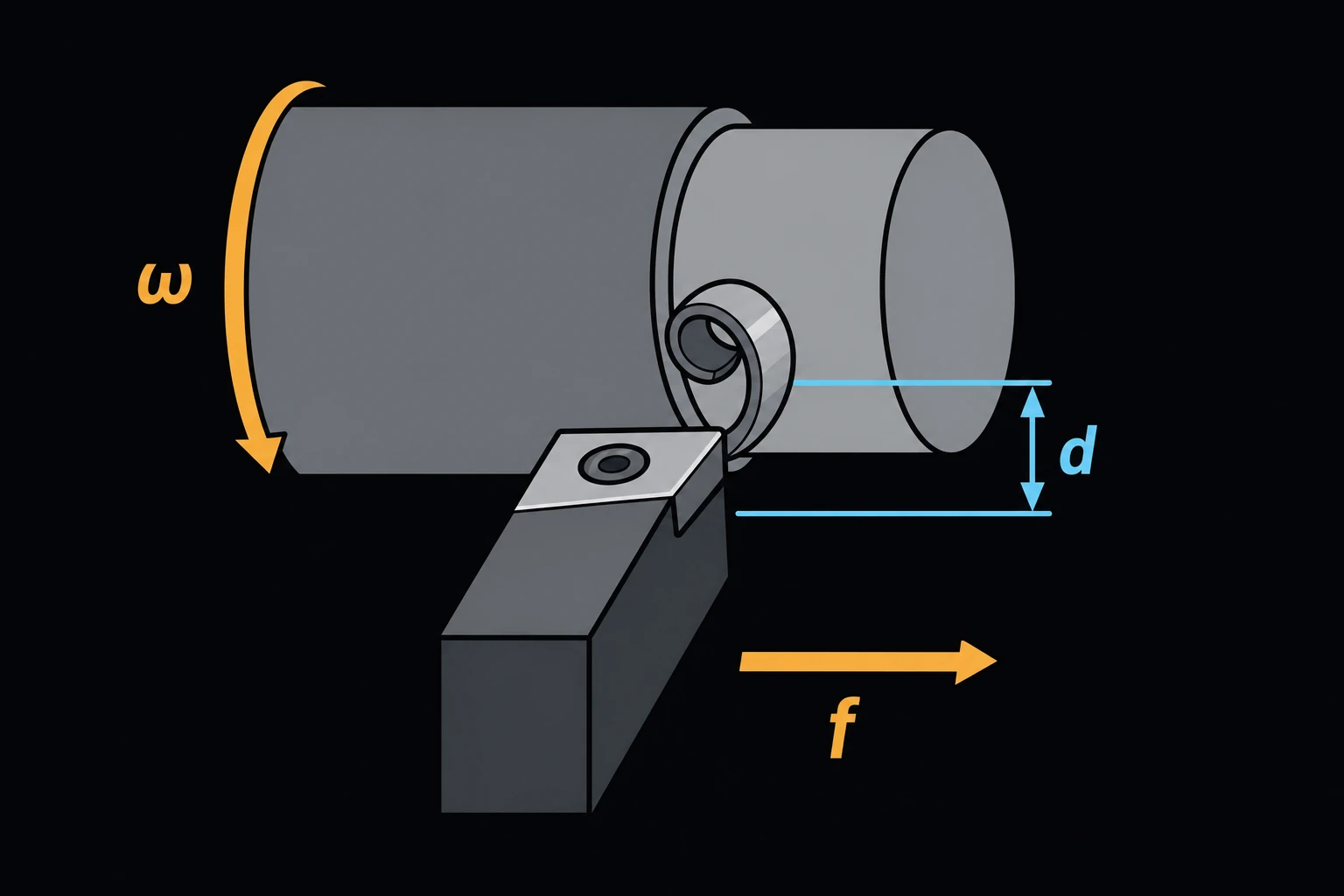
v is the cutting speed, the surface speed of the work past the tool; f the feed, how far the tool advances along the part each revolution; and d the depth of cut, measured radially from the uncut surface [1]. The result is in cm³/min. With v in m/min and f and d in mm, the product is already in cm³/min, because 1 m·mm² is 1,000 mm³, which is 1 cm³. The equation treats the chip as a strip of width d and thickness f moving at speed v [1].
Limits and common mistakes
- Cutting speed is a surface speed, not the spindle speed. Convert with v = π·D·N, where D is the work diameter and N the speed in rev/min.
- Depth of cut is per side. A cut 3 mm deep makes the diameter 6 mm smaller.
- Feed is per revolution. Divide a feed rate in mm/min by the spindle speed first.
- The equation is for turning, boring and facing on a lathe. Milling and drilling remove material differently, so don’t use it for them.
- v·f·d is the textbook approximation. On a small diameter with a deep cut, the true volume is a little lower, because the surface speed falls toward the bottom of the cut.
Worked example
A steel shaft is rough turned with a carbide insert at 200 m/min, a feed of 0.25 mm/rev and a 3 mm depth of cut. How fast is metal coming off?
- Enter Cutting Speed 200 m/min.
- Enter Feed per Revolution 0.25 mm and Depth of Cut 3 mm.
- Press Solve. The Solution shows: Material Removal Rate (MRR): 150 cm³/min
Check: 200 × 0.25 × 3 = 150, and the units work out to cm³/min as shown above. That is 150 / 16.387 = 9.15 in³/min. On an 80 mm bar the spindle turns at 200,000 / (π × 80) = 796 rev/min.