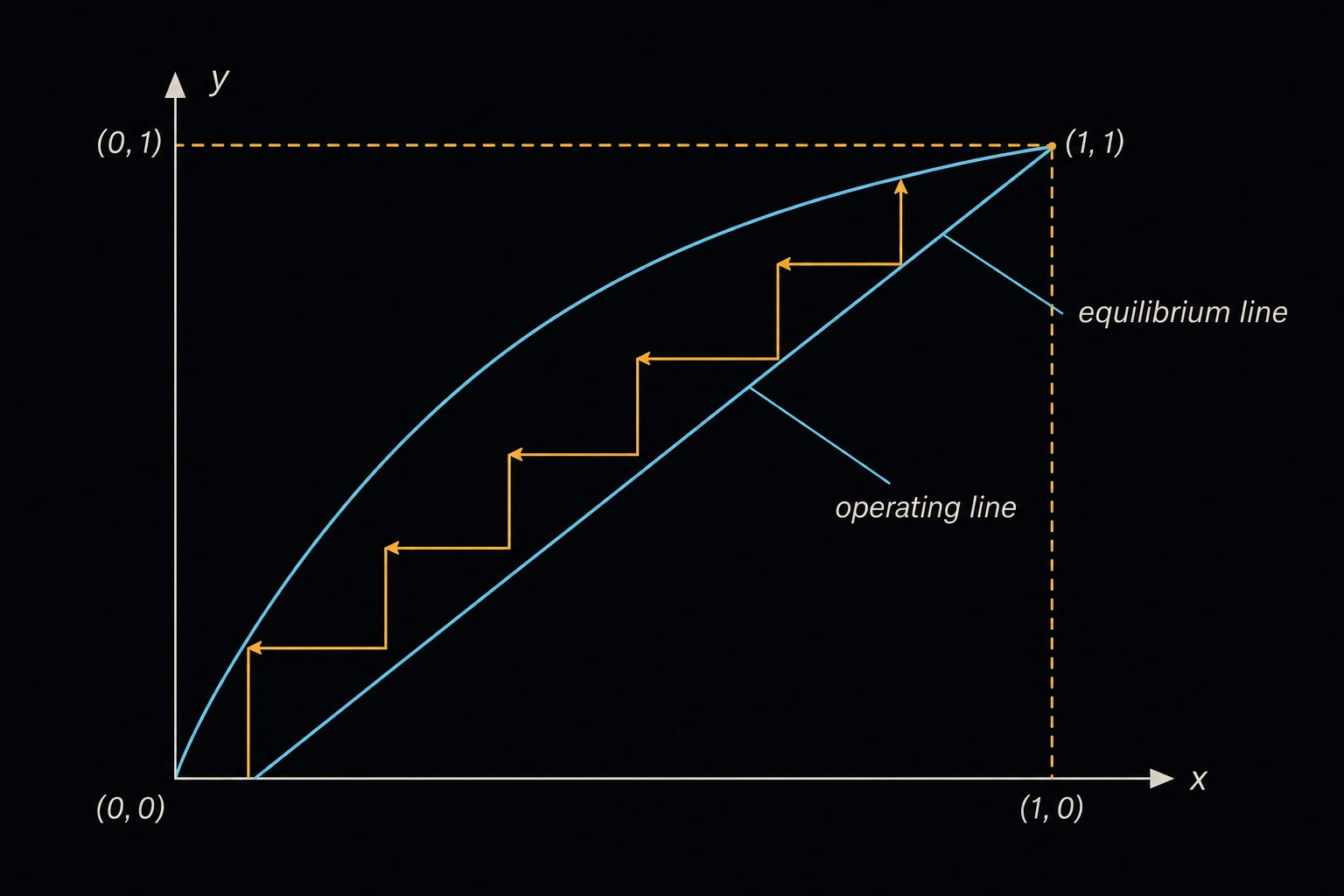
Distillation Column — Minimum & Actual Stages
Gives a first estimate of a binary distillation column: the minimum stages at total reflux, the minimum reflux ratio, and the theoretical stages at your operating reflux. Process engineers use it for screening before a rigorous simulation.
Equations
Nmin = ln[(xD/(1 − xD))·((1 − xB)/xB)] / ln α
y* = αx / (1 + (α − 1)x)
Rmin = (xD − y′) / (y′ − x′)
X = (R − Rmin)/(R + 1)
Y = 1 − exp[((1 + 54.4X)/(11 + 117.2X))·((X − 1)/√X)]
N = (Y + Nmin)/(1 − Y)
The first line is the Fenske equation [1]. xD, zF and xB are the mole fractions of the light component in the distillate, feed and bottoms. α is the relative volatility, taken as constant. y* is the vapor in equilibrium with liquid x. The pinch (x′, y′) is where the q-line crosses the equilibrium curve; for q = 1 it is at x′ = zF. Rmin is the reflux whose operating line just touches the pinch [2], [4]. Y is the Gilliland correlation in Molokanov’s equation form [3]. Nmin and N both count the reboiler as a stage.
Inputs
- All compositions are mole fractions of the more volatile (light) component, not mass fractions.
- q is the heat needed to vaporize one mole of feed divided by its molar latent heat. It is 1 for a saturated liquid, 0 for a saturated vapor, above 1 when subcooled, and the liquid fraction when partly vaporized.
Limits and common mistakes
- Constant α and constant molar overflow are assumed. Azeotropes or a strongly varying α (such as ethanol–water) need a stage-by-stage construction or a simulator.
- The results are theoretical (equilibrium) stages. Divide by a tray efficiency, often 0.5 to 0.8, to get real trays.
- A partial condenser is also an equilibrium stage. If the column has one, subtract it as well as the reboiler.
- Gilliland is a fit to many columns. Expect about ±10 % on N, more when R is close to Rmin.
Worked example
A benzene–toluene splitter takes a 40 mol% benzene feed at its bubble point. It must make 95 % benzene overhead and leave 5 % benzene in the bottoms, with a reflux ratio of 2. How many theoretical stages does it need?
- Enter Distillate Mole Fraction 0.95, Feed Mole Fraction 0.4 and Bottoms Mole Fraction 0.05.
- Enter Relative Volatility 2.5, a typical average for benzene–toluene.
- Leave Feed Condition on Saturated liquid at its bubble point (q = 1).
- Enter Operating Reflux Ratio 2 and press Solve. The Solution shows:
Minimum stages Nmin (Fenske, incl. reboiler): 6.42687
Pinch liquid composition x': 0.4
Minimum reflux ratio Rmin: 1.44444
R / Rmin: 1.38462
Gilliland ordinate Y: 0.473319
Theoretical stages N (incl. reboiler): 13.1013
So the column needs about 12.1 theoretical stages plus the reboiler. Check by hand: y′ = 2.5 × 0.4/(1 + 1.5 × 0.4) = 0.625, so Rmin = (0.95 − 0.625)/(0.625 − 0.4) = 1.444. Nmin = ln(19 × 19)/ln 2.5 = 5.889/0.9163 = 6.43. The rule of thumb N ≈ 2Nmin at R of 1.2 to 1.5 times Rmin gives about 12.9, close to 13.1.