Motor Efficiency
Finds how efficient an electric motor is and how much power it turns into heat. Enter the electrical power going in and the shaft power coming out, as measured on a test stand or read from a power meter and a load. Or enter the shaft output and an efficiency to find the input power the motor draws. For the second case, a list of NEMA Premium motors fills in the rated output and nominal full-load efficiency for you. Plant engineers use it to size supplies, estimate energy costs and work out how much heat a motor puts into a room.
Equations
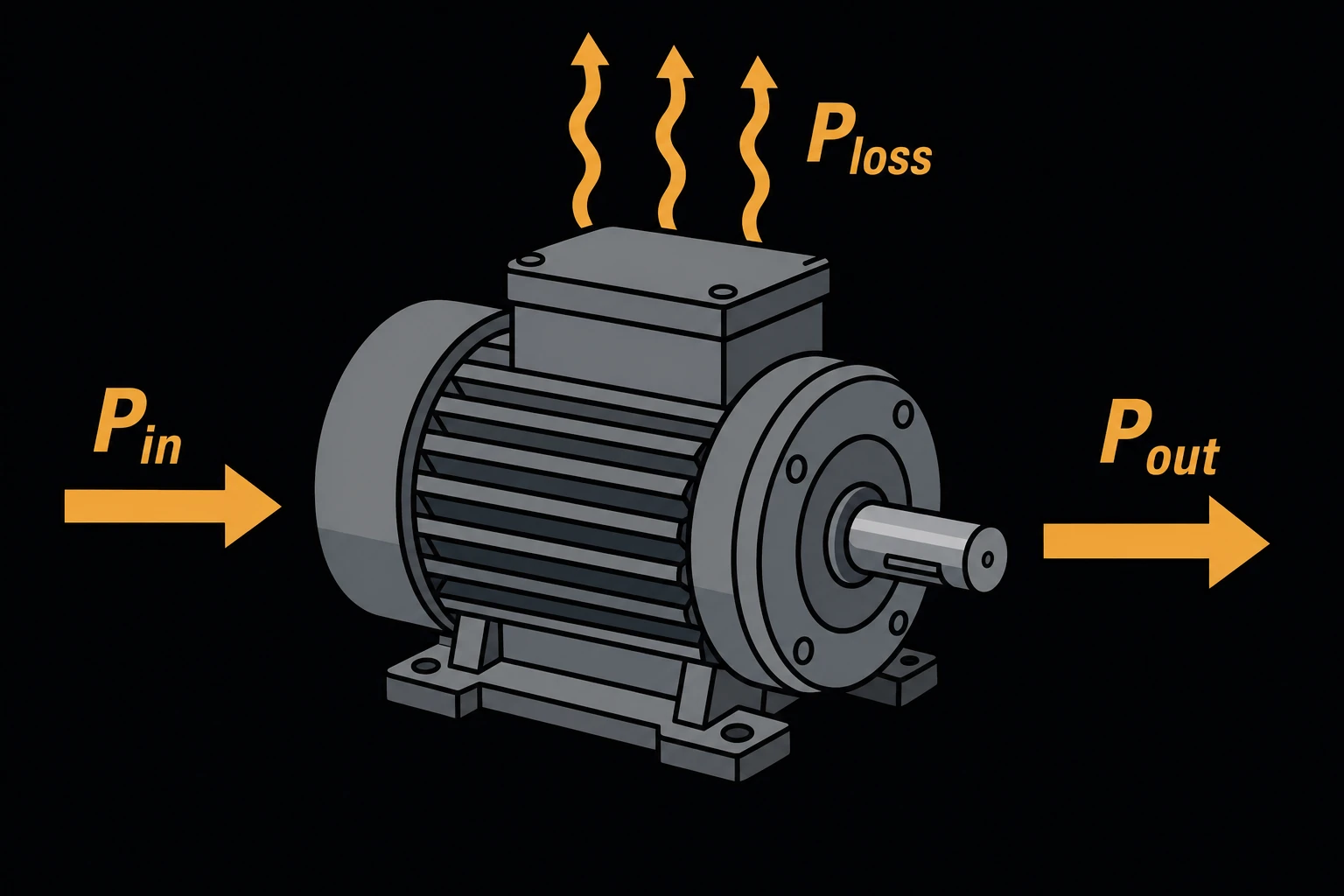
η = Pout / Pin × 100 % Ploss = Pin − Pout
Pin is the electrical power the motor takes from the supply, Pout the mechanical power delivered at the shaft, and η the efficiency [1]. The difference, Ploss, is the copper loss in the windings, the iron loss in the core, friction and windage, and stray load loss. All of it ends up as heat. Given the output and the efficiency, the page turns the first equation around: Pin = Pout / (η/100).
The motor list holds the NEMA Premium nominal full-load efficiencies for 4-pole, enclosed, 60 Hz motors from 1 to 200 hp [2]. The rated output fills in as the nameplate horsepower at 745.7 W per hp.
Limits and common mistakes
- Pin must be real electrical power in kW, not volt-amperes. Volts times amps leaves out the power factor and makes the motor look less efficient than it is.
- The nameplate rating is the output, not the input. A 20 hp motor draws more than 20 hp from the line.
- The listed efficiencies hold at full load. Efficiency falls off below about half load, so a lightly loaded motor wastes a larger share of its input.
- NEMA nominal efficiency is the average of a batch. A single motor may test somewhat lower and still meet the standard [2].
Worked example
A 20 hp NEMA Premium fan motor runs at full load. Find the power it takes from the supply and the heat it gives off into the fan room.
- Choose Given Output power and efficiency (find the input).
- Choose Motor 20 hp (15 kW) — 93.0 % nominal. The output and efficiency fill in.
- Press Solve. The Solution shows:
Input power (Pin): 16.0366 kW
Power loss: 1.12256 kW
Efficiency (η): 93 %
Check: 20 hp × 745.7 W = 14.914 kW, and 14.914 / 0.93 = 16.037 kW. The loss is the other 7 % of the input: 0.07 × 16.037 = 1.123 kW, about the heat of eleven 100 W heaters.