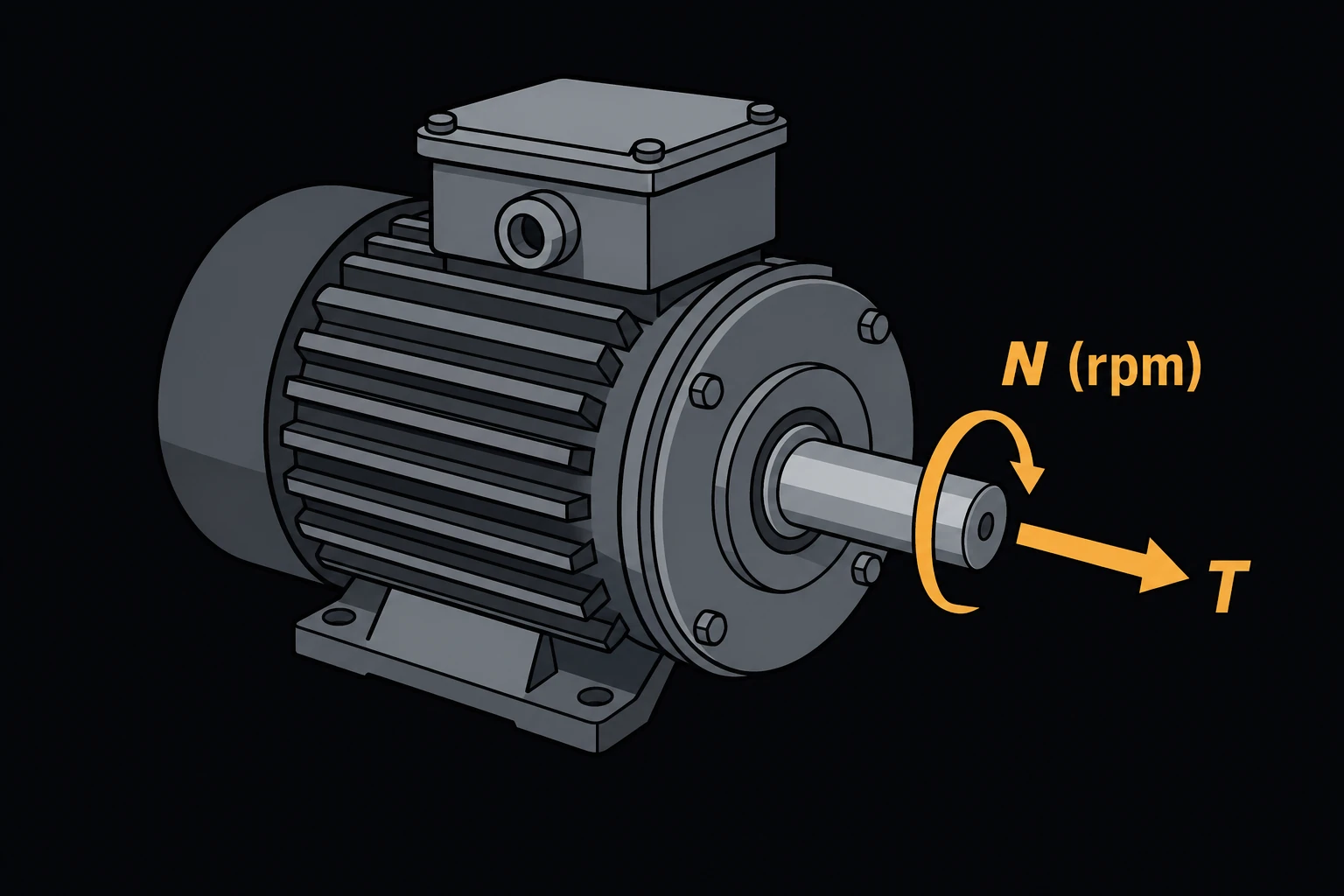
Motor Torque/Speed/Power
Converts between the torque, speed and power of a rotating shaft: give any two and it finds the third. Use it to read a motor nameplate as a torque, to check that a motor can drive a gearbox, pump or conveyor, or to find the power a shaft carries. It works for electric motors, engines, turbines and any other rotating machine, with inputs in SI or US units.
Equations
P = T·ω ω = 2πN/60 Nsync = 120f/p
P is the shaft power in watts, T the torque in newton-meters, and ω the angular speed in radians per second. N is the speed in revolutions per minute (rpm), and the factor 2π/60 converts it to ω [1]. The Given choice picks the two known quantities. The page then rearranges the same equation for the third: T = P/ω or N = 60P/(2πT).
The Speed from motor poles list fills in the synchronous speed of an AC motor. f is the supply frequency in hertz and p the number of poles [1]. A synchronous motor runs at exactly this speed. An induction motor runs a few percent slower, by its slip, so use its nameplate speed when you have it.
Limits and common mistakes
- Use output (shaft) power, not electrical input power. A motor’s nameplate rating is its shaft output. The power drawn from the supply is higher by the losses.
- The result is the torque at one operating point. A motor can briefly produce well above its rated torque when starting or under overload. Check the motor’s torque-speed curve for the starting duty.
- A gearbox multiplies torque by its ratio and divides speed by it. Run the page once on each side, and allow for the gear efficiency.
- In US units the familiar shortcut is T (lbf·ft) = 5252 × hp/rpm. It only holds for those exact units.
Worked example
A 7.5 kW, four-pole, 60 Hz induction motor drives a conveyor. Its nameplate speed is 1760 rpm. What is its full-load torque, to size the coupling?
- Choose Given Power (P) & Speed (N).
- Leave Speed from motor poles (synchronous, 120·f/p) at Custom, since the nameplate speed includes the slip.
- Enter Speed (N) 1760 rpm.
- Enter Power (P) 7.5 kW and press Solve. The Solution shows:
Torque (T): 40.693 N·m
Speed (N): 1,760 rpm
Power (P): 7.5 kW
Check by hand: ω = 2π × 1760/60 = 184.3 rad/s, and 7500 / 184.3 = 40.69 N·m. With the US shortcut, 7.5 kW is 10.06 hp, and 5252 × 10.06/1760 = 30.0 lbf·ft, which is 40.7 N·m. The synchronous speed of this motor is 120 × 60/4 = 1800 rpm, so its slip is 2.2 %.