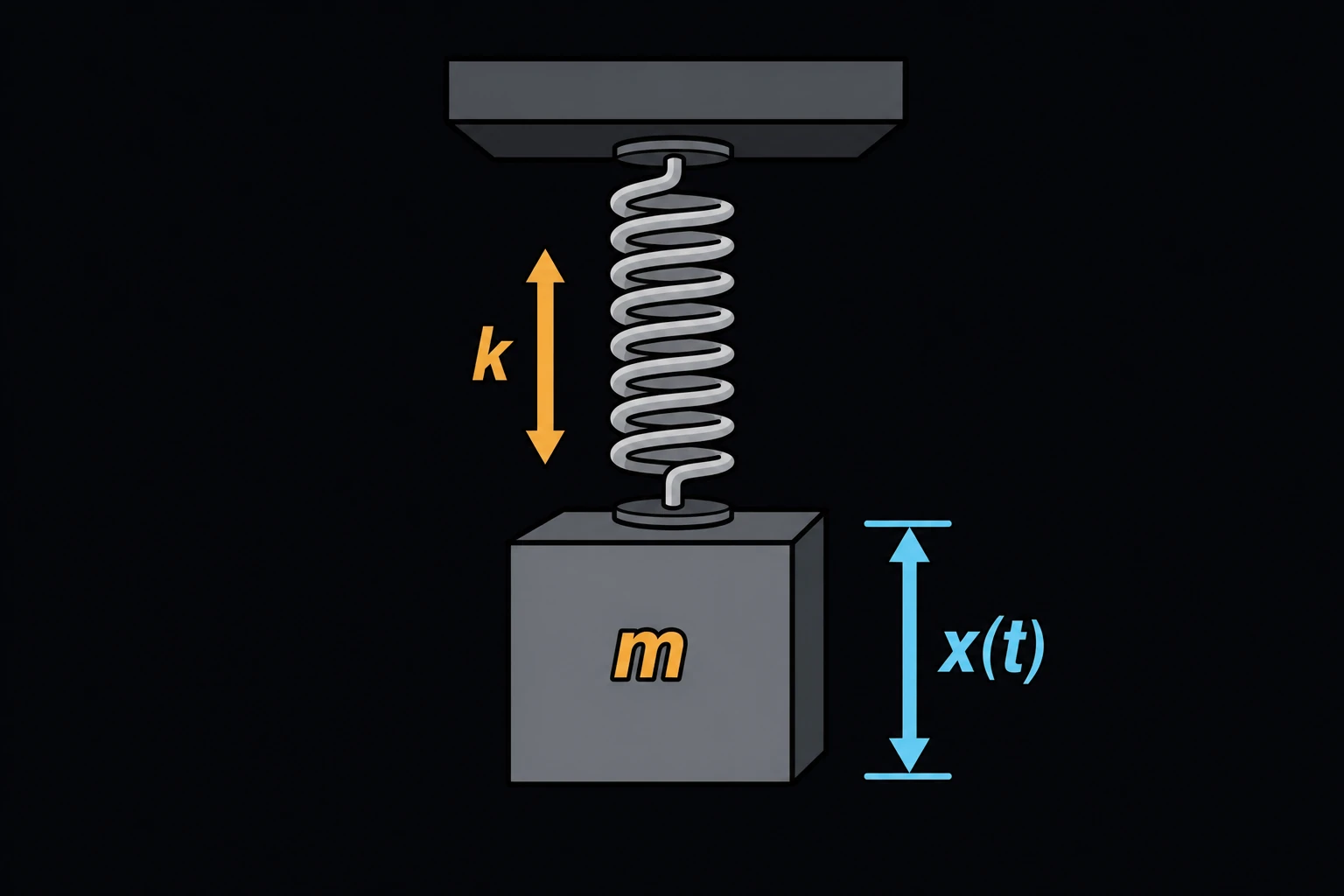
Natural Frequency
Finds the undamped natural frequency of a single mass on a spring, in rad/s and in Hz. Designers use it to choose vibration isolators and machine mounts, and to check that a part’s natural frequency is well away from the speeds and forcing frequencies it will see in service.
Equations
ωn = √(k/m) fn = ωn/(2π)
k is the spring stiffness, the force per unit of deflection, and m is the mass that moves. ωn is the natural frequency in radians per second, and fn the same frequency in cycles per second (Hz) [1]. The page converts k to N/m and m to kg before it takes the root, so any of the offered units can be used.
The frequency rises with stiffness and falls with mass, but only as the square root: doubling the stiffness raises the frequency by 41 %, not 100 %.
Limits and common mistakes
- This is one mass moving in one direction on a massless spring, with no damping. Light damping lowers the frequency only slightly; use the Vibration Damping calculator to see by how much.
- Enter the total stiffness under the mass. Springs side by side (in parallel) add: four mounts of 150 N/mm make 600 N/mm. Springs stacked end to end (in series) combine as 1/k = 1/k1 + 1/k2.
- Enter mass, not weight. A 120 kg machine is 120 kg, not 1,177 N.
- If the spring is heavy compared with the mass, add about one third of the spring’s mass to m.
- An isolator only reduces the force passed to the floor when the forcing frequency is more than √2 times fn [1]. Near fn it makes the vibration worse.
Worked example
A 120 kg pump sits on four rubber mounts, each rated 150 N/mm. Find the natural frequency of the pump on its mounts, to compare with its running speed.
- Enter Spring Stiffness (k) 600 N/mm, the four mounts in parallel.
- Enter Mass (m) 120 kg and press Solve. The Solution shows:
Natural Frequency (ωn): 70.7107 rad/s
Natural Frequency (fn): 11.254 Hz
Check with the static deflection. The pump’s weight, 120 × 9.81 = 1,177 N, compresses the mounts 1,177/600 = 1.96 mm, and fn ≈ 15.76/√(δ in mm) = 15.76/1.40 = 11.25 Hz. A pump running at 1,800 rpm (30 Hz) turns at 2.7 times fn, above √2 times, so the mounts isolate it.