NIOSH Lifting Equation
Applies the revised NIOSH lifting equation to a two-handed manual lift. From the hand positions, the travel, the twist, how often the lift is made, for how long, and how good the grip is, it gives the recommended weight limit (RWL) and the lifting index (LI) for the load you enter. Safety engineers and ergonomists use it to rate a lifting task.
The lifting equation
RWL = LC · HM · VM · DM · AM · FM · CM LI = L / RWL
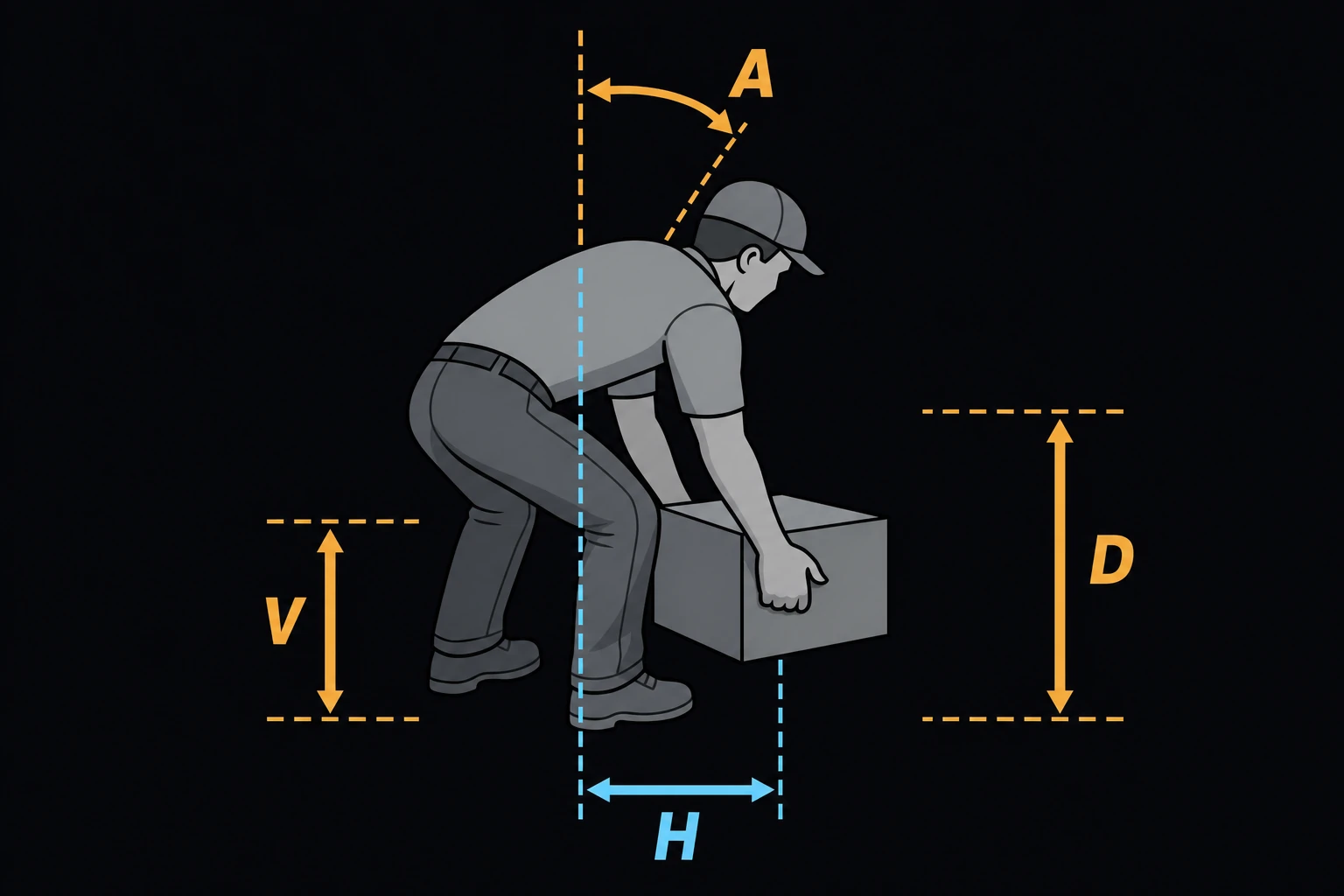
HM = 25/H VM = 1 − 0.003|V − 75| DM = 0.82 + 4.5/D AM = 1 − 0.0032A
LC is the load constant, 23 kg. Each multiplier is 1 under ideal conditions and smaller as they get worse [1]. H is the horizontal distance from the midpoint between the ankles to the hands, in cm (HM = 1 below 25 cm). V is the height of the hands above the floor at the start of the lift. D is the vertical travel (DM = 1 below 25 cm), and A is the twist of the load away from straight ahead, in degrees. FM comes from Table 5 of [1] by lifts per minute, work duration and whether V is below 75 cm. The page uses the next tabulated frequency at or above the one you enter. CM comes from the coupling quality, and L is the weight lifted.
Reading the result and its limits
- LI ≤ 1 is a nominal risk for most healthy workers. Above 1 the risk rises, and above 3 many workers are at high risk [1].
- A multiplier is 0, and the task is outside the equation, when H > 63 cm, V > 175 cm, D > 175 cm, A > 135°, or the frequency is too high for the duration.
- Rate the origin of the lift. If the worker must also control the load at the destination, as in setting it down carefully, rate the destination too and use the worse result.
- The equation does not cover one-handed lifts, lifting while seated or kneeling, pushing or pulling, unstable loads such as liquids, or lifts on slippery floors [1].
Worked example
A packer lifts 15 kg cartons from a conveyor at hand height 70 cm, 45 cm in front of the ankles, and turns 30° to set them on a shelf 40 cm higher. The task runs 4 lifts a minute over an 8-hour shift, and the cartons have no handles.
- Enter Weight Lifted (kg) 15 and Horizontal Distance 45.
- Enter Vertical Height of Hands at Origin 70, Vertical Travel Distance 40 and Asymmetry Angle 30.
- Enter Lifting Frequency (lifts/min) 4 and choose Work Duration > 2 to 8 hours.
- Choose Coupling Quality Fair.
- Press Solve. The Solution shows:
HM · VM · DM: 0.510285
AM · FM · CM: 0.38646
Frequency multiplier FM: 0.45
Recommended Weight Limit (RWL): 4.53571 kg
Lifting Index (LI = weight / RWL): 3.30709
Risk assessment: LI > 3.0 — many workers at high risk; redesign required
Check: 23 × 0.510285 × 0.38646 = 4.536 kg, and 15/4.536 = 3.31. Moving the conveyor so that H = 25 cm raises the RWL to about 8.2 kg (LI 1.8). Also limiting the task to 1 to 2 hours (FM = 0.72) gives about 13.1 kg (LI 1.15), so the task still needs lighter cartons or a lift assist.