Ohm's Law & Power
Finds the voltage, current, resistance and power of a resistive element from any two of voltage, current and resistance. Technicians, hobbyists and designers use it to size a resistor, check what a load draws from a supply, or pick a resistor’s power rating.
Equations
V = I·R P = V·I = I2·R = V2/R
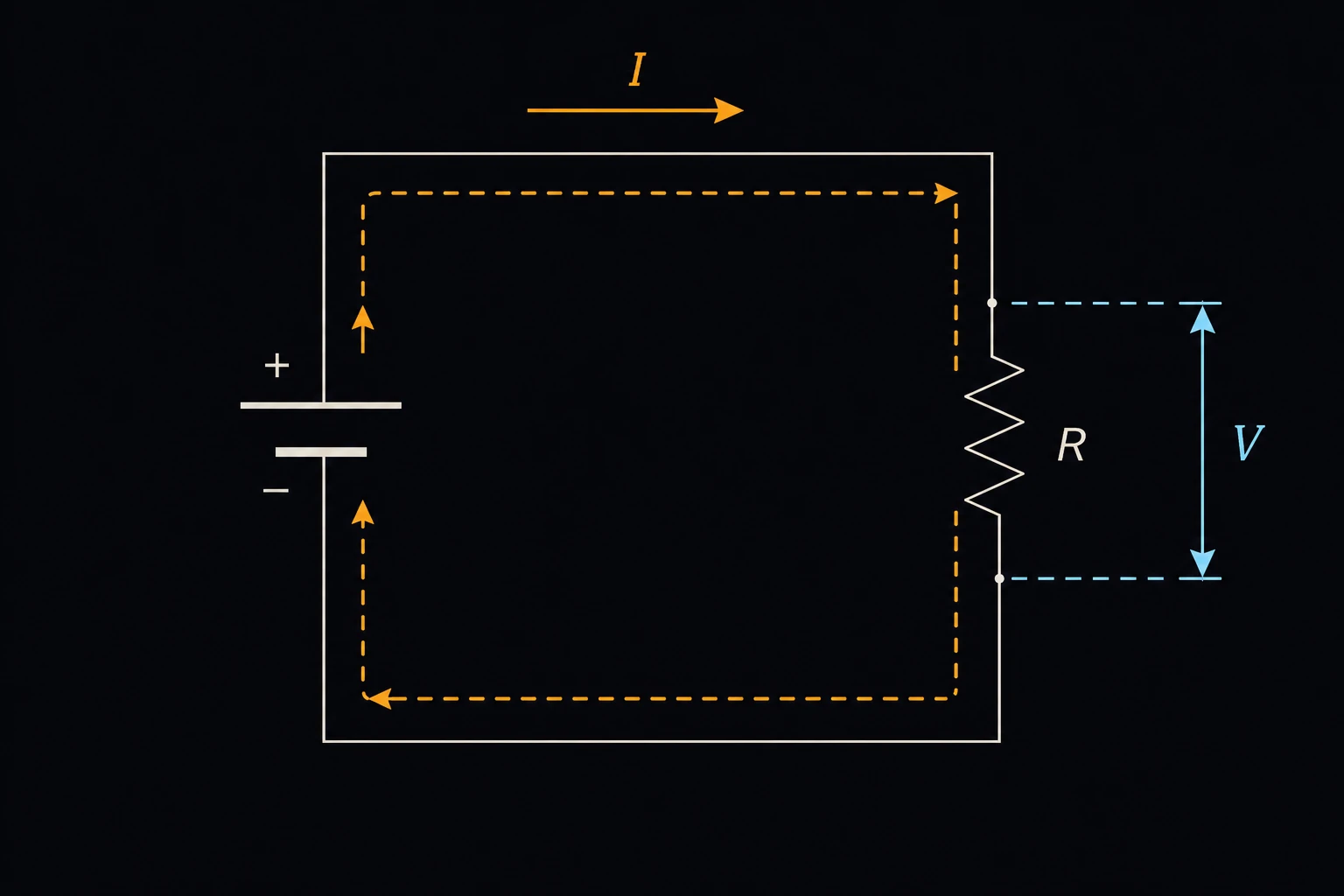
V is the voltage across the element in volts, I the current through it in amperes, R its resistance in ohms and P the power it turns into heat, in watts [1]. Choose Given to say which two values you know. The page solves Ohm’s law for the third and then finds P = V·I. The three forms of the power equation give the same answer, so use whichever pair you measured.
Inputs and limits
- Each field has a unit picker, so you can enter millivolts, milliamps or kilohms directly.
- Resistance must be positive when you give voltage and resistance, and can’t be negative when you give current and resistance. Zero current with a voltage gives no resistance, so the page rejects it.
- Voltage and current may both be negative, to follow a sign convention, but they must share a sign. Opposite signs would mean a negative resistance, which a passive element can’t have.
Common mistakes
- Ohm’s law holds for resistors, heaters and wires. A lamp filament, diode, LED or motor has no fixed resistance, so a cold-ohmmeter reading won’t predict its running current.
- With AC, use RMS voltage and current. The power is then real power only for a purely resistive load; reactive loads need the power factor.
- V is the voltage across the element itself, not the supply voltage when other parts share the circuit.
- A resistor’s rating should sit well above the power it dissipates. Running at the full rating makes it very hot.
Worked example
A 33 Ω load resistor goes across a 12 V bench supply to test the supply under load. What current flows, and what power rating does the resistor need?
- Choose Given Voltage (V) & Resistance (R).
- Enter Voltage (V) 12 V and Resistance (R) 33 Ω.
- Press Solve. The Solution shows:
Current (I): 0.363636 A
Power (P): 4.36364 W
Check by hand: P = V2/R = 144/33 = 4.364 W, and V·I = 12 × 0.3636 gives the same. A common rule is to rate a resistor for at least twice its dissipation, so choose a 10 W part rather than a 5 W one.