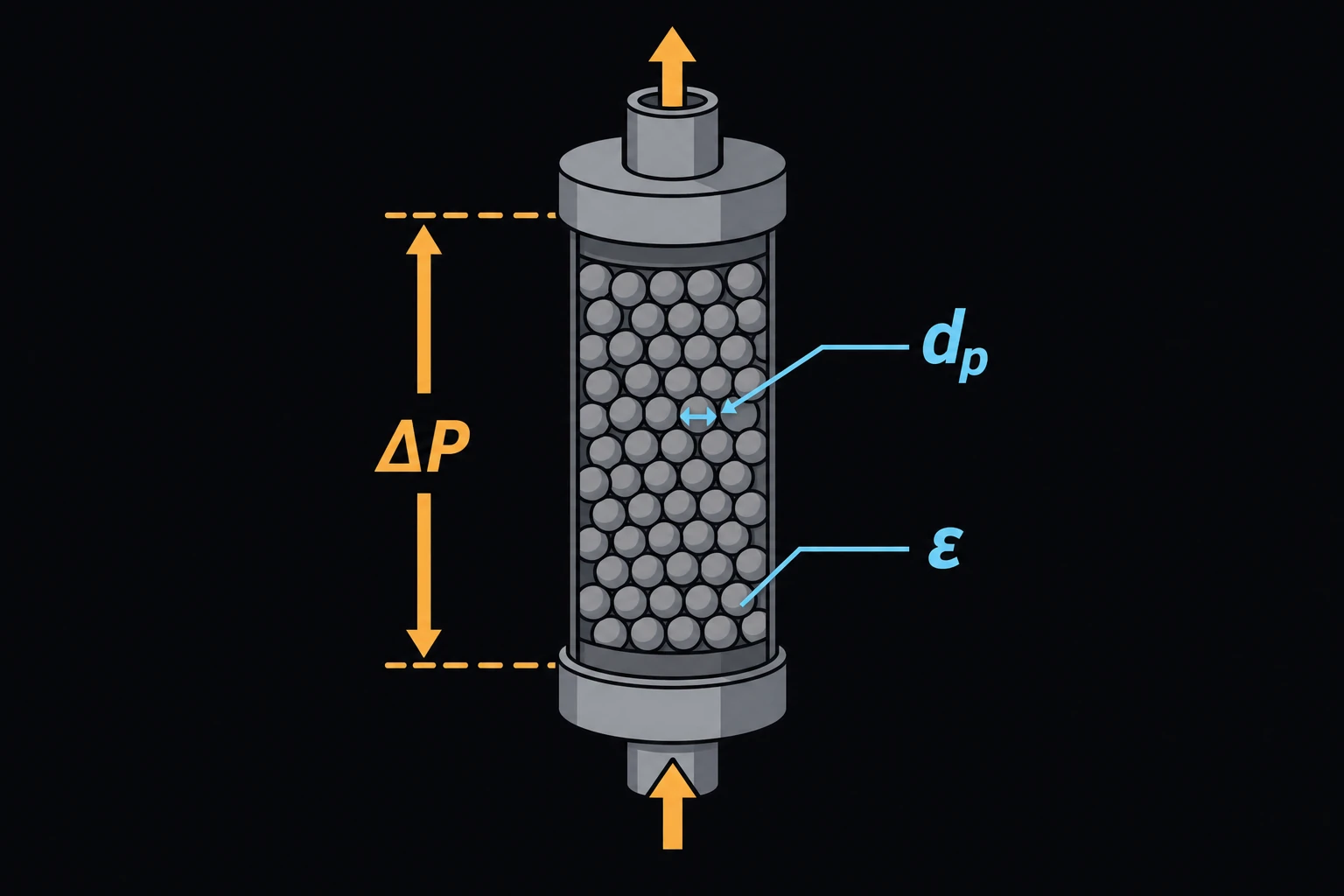
Packed Bed Pressure Drop (Ergun)
Finds the pressure drop of a gas or liquid flowing through a bed of packed particles, using the Ergun equation. It splits the drop into a viscous part and an inertial part, so you can see which one governs. Chemical and process engineers use it for catalyst beds, adsorbers, dryers and filters, to size the blower or pump and to check that a bed won’t lift or crush.
Equations
ΔP/L = 150·μ·(1 − ε)²·U/(ε³·dp²) + 1.75·ρ·(1 − ε)·U²/(ε³·dp)
Rep = ρ·U·dp/(μ·(1 − ε))
ΔP is the pressure drop across a bed of height L [1], [2]. U is the superficial velocity: the volume flow divided by the full cross-section of the empty vessel, not the faster speed in the gaps. ε is the void fraction, the share of the bed volume that is open space. dp is the particle diameter, and ρ and μ are the fluid density and viscosity. The first term is the viscous loss, which grows with U; the second is the inertial loss, which grows with U². Rep is the modified particle Reynolds number. Below about 10 the viscous term dominates; above about 1000 the inertial term does [2].
Inputs
- Choosing a Fluid fills in its density and viscosity [3]–[6].
- Loose random packings of spheres have ε of about 0.36–0.40. The pressure drop is very sensitive to it: a change from 0.40 to 0.36 raises the viscous term by more than half.
Limits and common mistakes
- The constants 150 and 1.75 are for spheres or near-spheres [1]. For other shapes, use the equivalent diameter, the sphericity times the diameter of a sphere of the same volume [2].
- For a gas with a large pressure drop, the density changes along the bed. If ΔP is more than about 10 % of the inlet pressure, use the mean pressure or split the bed into sections.
- A wide size spread or fines fill the gaps and lower ε. Measure it on the real packing if you can.
Worked example
An air purifier column holds a 1.5 m bed of 3 mm alumina beads with a void fraction of 0.38. Air at 20 °C and 1 atm passes through it at a superficial velocity of 0.25 m/s. What pressure must the fan supply across the bed?
- Enter Superficial Velocity 0.25 m/s and Bed Void Fraction 0.38.
- Enter Particle Diameter 3 mm.
- Choose Fluid Air, 20°C, 1 atm. The density fills in as 1.2 kg/m³ and the viscosity as 0.018 cP.
- Enter Bed Height 1.5 m and press Solve. The Solution shows:
Modified particle Reynolds number: 80.6452
Viscous term (ΔP/L): 525.405 Pa/m
Inertial term (ΔP/L): 494.332 Pa/m
Total pressure gradient ΔP/L: 1,019.74 Pa/m
Total pressure drop ΔP: 1.52961 kPa
Check with the friction-factor form of the same equation [2]: fp = 150/Rep + 1.75 = 150/80.65 + 1.75 = 3.61, and ΔP/L = fp·ρ·U²·(1 − ε)/(dp·ε³) = 3.61 × 1.2 × 0.0625 × 0.62/(0.003 × 0.05487) = 1020 Pa/m. At Rep = 81 the two terms are nearly equal, as expected midway between the regimes. The drop is 1.5 % of atmospheric pressure, so a constant density is fine.