PCB Trace Sizing
Finds the width a printed circuit board trace needs to carry a current without heating more than a set amount, using the IPC-2221 design curves. It also gives the trace’s resistance and voltage drop over a length you enter. PCB designers use it to size power, motor and supply traces.
The trace-width equations
I = k·ΔT0.44·A0.725 W = A/t
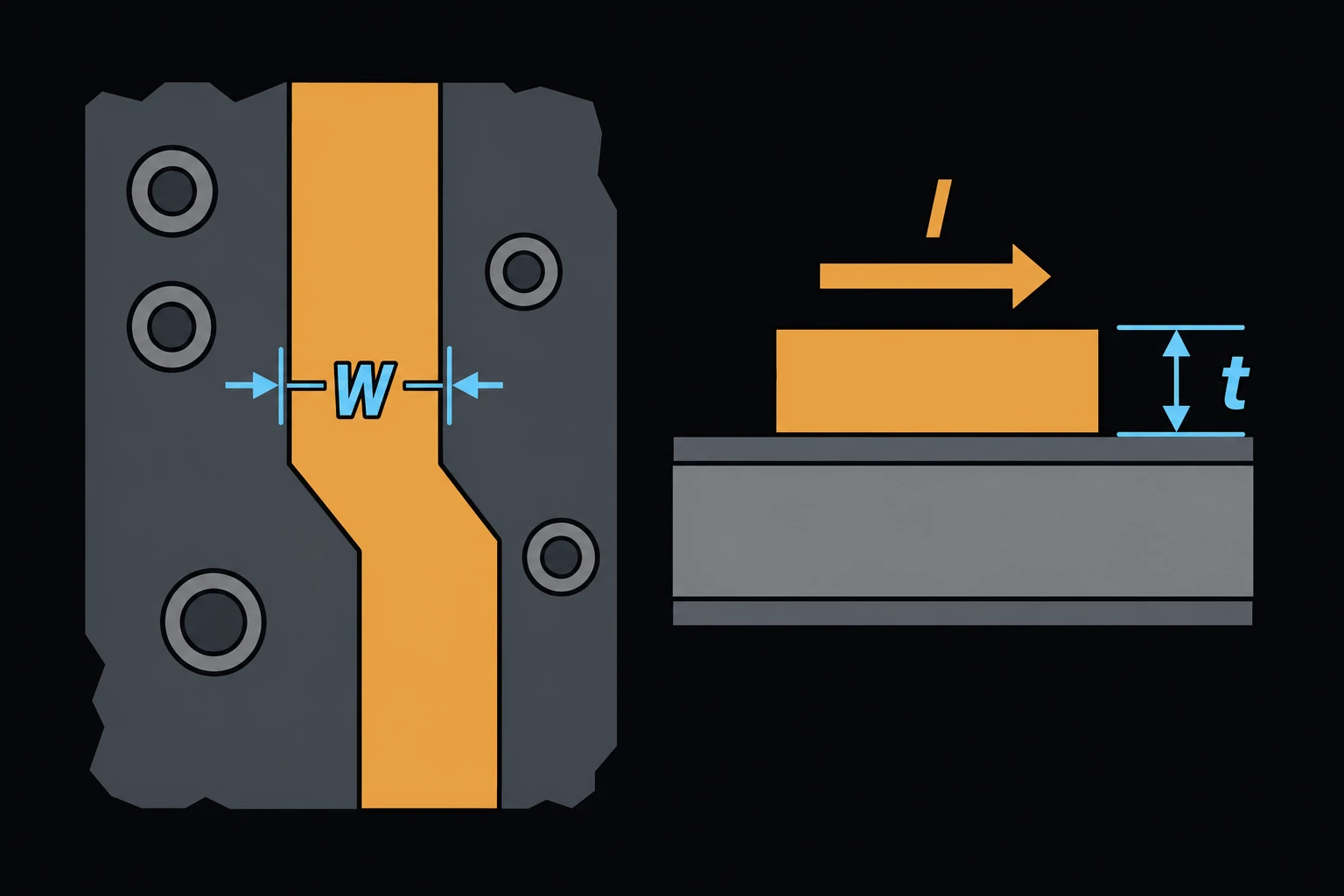
I is the trace current in amperes, ΔT the allowed temperature rise above ambient in °C and A the copper cross-section in square mils. k is 0.048 for an external (surface) trace and 0.024 for an internal (buried) one, which sheds heat less easily [1]. The page solves for A, then divides by the copper thickness t to get the width W. t is 1.378 mil for each oz/ft² of copper weight, so 1 oz copper is about 35 µm thick.
R = ρ·L/A V = I·R
R is the trace resistance, ρ = 1.68×10⁻⁸ Ω·m the resistivity of copper at room temperature, L the trace length and V the voltage drop along it.
Limits and common mistakes
- The IPC-2221 curves were drawn for currents up to 35 A on outer layers, widths up to 400 mil, rises of 10 to 100 °C and 0.5 to 3 oz copper [1]. The page doesn’t stop you going outside them, so treat such results as rough.
- Copper weight is the finished weight. Plating usually adds copper to outer layers, and etching takes some away at the edges.
- The resistance uses the room-temperature resistivity. Copper’s resistance rises about 0.4 % per °C, so a hot trace drops a little more voltage.
- Nearby heat sources, planes and other high-current traces change the real temperature rise. Leave margin on crowded boards.
Worked example
A 3 A motor supply runs 8 cm across the top layer of a board with 1 oz copper. The trace may rise no more than 10 °C. Size it and find its voltage drop.
- Enter Trace current (I) 3 A and Allowable temperature rise (ΔT, °C) 10.
- Choose Trace location External (surface).
- Enter Copper weight (oz/ft²) 1 and Trace length 8 cm.
- Press Solve. The Solution shows:
Required trace width: 1.36699 mm
Required trace width: 53.8183 mil
Trace resistance: 0.02809 Ω
Voltage drop: 0.0842701 V
Draw the trace at least 1.4 mm (55 mil) wide. Check: 3/(0.048 × 100.44) = 22.7, and 22.71/0.725 = 74.2 mil². Dividing by 1.378 mil gives 53.8 mil. The 84 mV drop is under 1 % of a 12 V supply.